
The wellness-and-pilgrimage hotel cluster on the lowest point on Earth — built for Russian and Eastern European inbound that hasn't returned, and the geological retreat that is reshaping the shoreline.
The Dead Sea is the structural laggard of the Israeli hospitality recovery — and the only region where the geological substrate underneath the hotel cluster is physically moving.
Roughly 15 hotels along the Israeli Dead Sea shore. Concentrated in Ein Bokek at the southern end. Roughly 3,500–4,000 hotel rooms. The cluster was built through the 1980s and 1990s on Russian, Eastern European, and German wellness traffic — the segment that came for the mineral water, the mud treatments, the dry desert air, and the medical-tourism positioning. That segment did not return at scale after October 7. It is unclear when, or whether, it will.
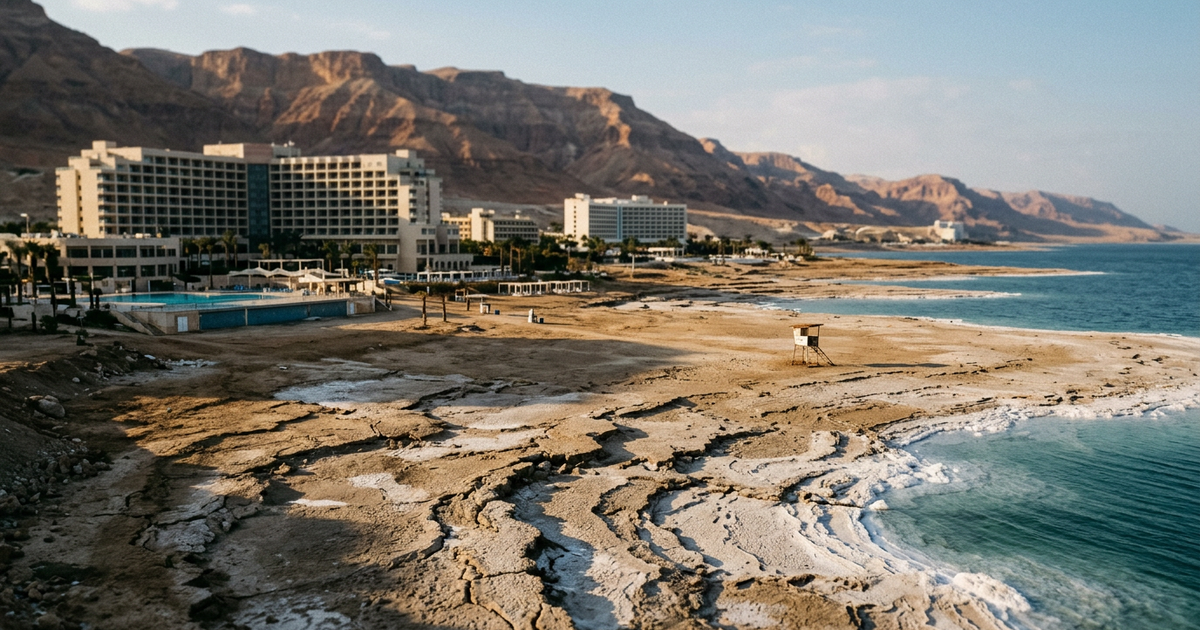
Behind the demand-side question is a geological one. The Dead Sea is shrinking. The water level drops more than a meter a year. Sinkholes have closed roads, beaches, and parts of the original hotel infrastructure. The shoreline is not where it was when the hotels were built.
BY THE NUMBERS
- Dead Sea hotels (Israeli side): ~15
- Hotel rooms: ~3,500–4,000
- Primary concentration: Ein Bokek (southern basin)
- Secondary concentration: Ein Gedi (kibbutz hotel) · the historic northern cluster (largely defunct)
- Major operators: Isrotel · Fattal/Leonardo · Dan · Crowne Plaza (Africa-Israel ownership)
- Pre-war inbound mix: Russia, Eastern Europe, Germany dominant
- Water level drop: roughly 1+ meter per year
- Sinkholes recorded along Dead Sea shore: 6,000+
What Is the Ein Bokek Hotel Cluster?
Ein Bokek is the modern Dead Sea hotel cluster. Located at the southern end of the sea, on the engineered evaporation ponds that Dead Sea Works (and the Jordanian operator on the eastern shore) maintain as part of the potash and mineral extraction industry, Ein Bokek is the one part of the Israeli Dead Sea shoreline where the water level is stable. The northern basin is retreating; the southern engineered basin is not.
The major hotel operators built the Ein Bokek cluster through the 1980s and 1990s. Isrotel, Fattal, Dan, and Crowne Plaza properties anchor the city. Lot Spa, Royal Dead Sea, David Dead Sea, Isrotel Dead Sea, Leonardo Plaza Dead Sea, Leonardo Club Dead Sea, Herods Dead Sea, Crowne Plaza Dead Sea, and the smaller independent operators.
The clientele was structurally specific: European package wellness tourists, primarily Russian, German, Polish, Czech, and Eastern European. The booking patterns ran heavily on charter and group itineraries. Length of stay was longer than typical Israeli inbound (7–14 days versus the 4–7 night Israeli norm). The economics worked at occupancy levels that depended on charter capacity into Ben Gurion and, later, into Ramon Airport.
What Happened to the Northern Dead Sea Shore?
The historic northern Dead Sea hotel cluster — the Mineral Beach area, the old Lido, the Ein Feshkha-adjacent properties — has largely been overtaken by the geological retreat. Sinkholes have made the original hotel sites inaccessible or dangerous. The northern shore tourism economy is now anchored more on day-visitor traffic from Jerusalem than on overnight hotel stays.
Ein Gedi remains the one significant non-Ein Bokek hotel position. The Kibbutz Ein Gedi country lodge operates above the shore in the kibbutz itself, drawing Israeli domestic leisure and the Christian pilgrimage circuit that includes the David Stream, the Ein Gedi reserve, and the Masada-Qumran corridor.
Why Did Demand Collapse at the Dead Sea?
The Dead Sea was the part of Israeli hospitality most exposed to the structural changes in the inbound market over the past five years.
First, the Russian collapse. Russian inbound to Israel was already declining before February 2022. After the Russian invasion of Ukraine and the resulting sanctions and flight restrictions, the Russian inbound to Israel collapsed — and the Dead Sea wellness segment was the disproportionate casualty. Russian tourists were the largest single source-country contribution to Dead Sea hotel occupancy. That demand has not returned and is unlikely to return at scale in the medium term.
Second, the Eastern European decline. Polish, Czech, and Hungarian inbound recovered partly but not fully. The package-tour operators that aggregated Dead Sea wellness itineraries through the 2010s have rebuilt smaller programs through 2025–2026.
Third, the October 7 cycle. The German, French, and broader Western European inbound that had partly offset the Russian decline collapsed in late 2023 and has rebuilt unevenly. The Dead Sea cluster ran at occupancy well below design through 2024.
State displaced-family contracts filled some Dead Sea inventory during the war period. The economics were state rates, not commercial inbound. That contract layer has now largely wound down.
Why Is the Dead Sea Shrinking?
The Dead Sea is shrinking. The mechanism is well understood: the Jordan River, which historically fed the sea, has been substantially diverted by upstream Israeli, Jordanian, and Syrian water consumption since the 1960s. The natural inflow that previously balanced evaporation has been reduced by roughly 90 percent. The sea is retreating at more than a meter a year vertically and proportionally horizontally.
The visible consequences for the hotel cluster are two. First, sinkholes. As the sea recedes, the underlying salt layers dissolve, creating subterranean cavities that collapse into surface sinkholes. More than 6,000 have been recorded along the Dead Sea shore. Major roads have been closed. Beaches have been abandoned. The northern hotel cluster has been hollowed out by the phenomenon.
Second, shoreline access. Hotels built when the shoreline was close are now hundreds of meters from the water. The Ein Bokek cluster is preserved by the southern evaporation ponds, which maintain stable water levels through the potash extraction operation. The northern shore has no such artificial preservation.
The Red Sea–Dead Sea conveyance project, periodically proposed as the engineering solution, has not advanced beyond the bilateral discussion stage. The political, economic, and ecological complications have kept the project on the shelf for two decades. There is no near-term resolution to the geological retreat.
WHY IT MATTERS
- The Dead Sea is the structural laggard of the Israeli hospitality recovery — slowest-recovering region, most exposed to the Russian inbound collapse
- Roughly 15 hotels and 3,500–4,000 rooms anchored on Ein Bokek and a small Ein Gedi position
- The pre-war demand mix (Russian, Eastern European, German wellness tourism) is structurally changed and will not fully recover
- The geological retreat is reshaping the shoreline — Ein Bokek is preserved by engineered ponds; the northern shore is not
- The cluster operates as a specialist regional resort market with limited overlap with the broader Israeli hospitality system
What Holds the Dead Sea Hotel Cluster Up?
Three structural features keep the Ein Bokek cluster operating despite the demand and geological pressures.
One — the medical-tourism positioning. The Dead Sea mineral water and atmospheric composition (high oxygen, low UV) is medically recognized for psoriasis, atopic dermatitis, and certain respiratory conditions. European health insurance systems — particularly German — have historically reimbursed Dead Sea wellness stays for qualifying conditions. That reimbursement infrastructure produced durable repeat-visit demand that survived multiple cycles before October 7. Recovery in this segment is slow but real.
Two — the Israeli domestic market. Dead Sea hotels have been the default Israeli family wellness vacation for two generations. Domestic leisure traffic — Tel Aviv professional families, three-day Sukkot and Passover stays, school holiday weekends — provides a floor under occupancy even when inbound is absent. The VAT on Dead Sea stays is full (unlike Eilat's free trade zone status), but the domestic loyalty is durable.
Three — the operator persistence. Isrotel, Fattal, and Dan have continued to operate their Dead Sea properties through the downturn. None has signaled exit. The properties are integrated into the operators' broader Israeli portfolios and the operating-margin discipline at scale absorbs the regional softness. A standalone Dead Sea hotel operator without a national portfolio would not survive the same conditions.
What's the Outlook for the Dead Sea Hotel Cluster?
Three structural questions matter for the next decade.
One — does the European wellness traffic rebuild? German, Polish, and Czech inbound is the most plausible recovery driver. Russian inbound is not. The rebuild pace through 2026, 2027, and 2028 will determine whether the Dead Sea returns to design occupancy or settles at a structurally lower equilibrium.
Two — does the geological retreat accelerate? The base case is continued retreat at the current pace. The downside case is acceleration if upstream water diversion increases. The upside case is the Red Sea–Dead Sea conveyance project finally advancing. None of the three is likely in the near term.
Three — does the operator structure change? If a major operator decides the Dead Sea cluster does not justify the capital commitment for ongoing upgrades, a property exit could begin a broader rationalization of the cluster. The base case is continued operation. The signal to watch is whether any of the major operators publicly reduces its Dead Sea exposure.
The lowest point on Earth has the highest exposure to two structural shifts the rest of the Israeli hotel sector has not faced: a permanently changed inbound mix and a literally moving shoreline. The cluster has survived both so far. Whether it thrives is the question for the next ten years.
Frequently Asked Questions
Are the Dead Sea hotels sinking or shrinking?
The hotels themselves aren't sinking, but the sea is shrinking around them, retreating more than a meter a year. Ein Bokek, where most hotels sit, is preserved by engineered evaporation ponds that keep the water level stable; the historic northern hotel cluster wasn't so lucky and has been largely hollowed out by sinkholes.
What are the best hotels at the Dead Sea in Israel?
The major operators — Isrotel, Fattal/Leonardo, Dan, and Crowne Plaza (Africa-Israel) — anchor Ein Bokek, the southern hotel cluster, with properties including Lot Spa, Royal Dead Sea, David Dead Sea, Isrotel Dead Sea, Leonardo Plaza Dead Sea, and Herods Dead Sea.
Why do people go to Dead Sea hotels?
Medical and wellness tourism: the mineral water and atmospheric composition are medically recognized for psoriasis, atopic dermatitis, and certain respiratory conditions, historically reimbursed by European health insurers, particularly German. Domestic Israeli leisure travel is the other main demand pillar.
Why has Dead Sea hotel occupancy dropped?
Two structural shifts: the collapse of Russian inbound tourism after 2022, which was the largest single source market for Dead Sea wellness stays, and the broader post-October 7 decline in European inbound. Domestic Israeli demand provides a floor but hasn't fully offset the loss.
↗ Index: this is the Dead Sea regional entry in the Israeli Hotels cluster — the Olam guide to the Israeli hotel sector. Capstone: Who Owns the Israeli Hotel Sector. Companions: Eilat: The Israeli Tourism Fall-Back · The Israeli Pilgrimage Hotel Layer · Isrotel: From Eilat to Beresheet.