
The original Israeli hospitality giant — built on Eilat, listed on the TASE, and now moving up the curve through Exclusive Collection.
Part of: Who Owns the Israeli Hotel Sector
The original Israeli hospitality giant, built on Eilat, listed on the TASE, and now moving up the curve through Exclusive Collection.
Isrotel is the second-largest hotel operator in Israel by room count and the most domestically anchored major Israeli hospitality company.
Founded in 1980. Built on Eilat. Listed on the Tel Aviv Stock Exchange. Roughly 25 properties across Israel today, with the Exclusive Collection sub-brand carrying the move into boutique luxury. The Lubinski family, anchored by founder David Lewis, remains the controlling shareholder, more than four decades into the company’s life.
Where Fattal exports, Isrotel deepens. The strategic logic has been the inverse of Fattal’s for most of the company’s history.
BY THE NUMBERS
Founded: 1980, by David Lewis (Lubinski family)
Listed: Tel Aviv Stock Exchange (ISRO)
Properties: ~25 across Israel
Rooms: ~6,500+
Core regions: Eilat · Tel Aviv · Jerusalem · Dead Sea · Negev · Galilee · Judean Hills
Exclusive Collection (luxury): Beresheet · The Orient Jerusalem · Mizpe Hayamim · Cramim · Carmim
How Did Isrotel Build Eilat?
Eilat is the foundation of the Israeli hotel industry, and Isrotel is the foundation of Eilat.
Through the 1980s and 1990s, Isrotel built or acquired the bulk of the southern resort city’s upscale and mid-market hotel inventory. Royal Beach, King Solomon, Royal Garden, Yam Suf, Sport Hotel, Lagoona, Princess, Riviera, Agamim. The portfolio defines the Eilat skyline.
The economic model was structural: Israeli domestic leisure demand was growing through the 1990s, Eilat was the principal destination, and Isrotel built capacity ahead of the curve. The 1994 Israel–Jordan peace treaty opened the Red Sea corridor and reinforced the Eilat-Aqaba tourism geography. Isrotel rode that wave.
By 2000, Isrotel was the dominant operator in Eilat and one of the two or three largest Israeli hotel operators by any measure.
How Did Isrotel Expand Across Israel?
Through the 2000s and 2010s, Isrotel expanded geographically: Tel Aviv (Royal Beach Tel Aviv, Tower), Jerusalem (The Orient, the historic German Colony property opened in 2017 as part of the trophy cluster), the Dead Sea, Mitzpe Ramon (Beresheet, 2011), the Judean Hills (Cramim), and the Galilee (Mizpe Hayamim, acquired and integrated; Carmim).
The expansion was deliberate and slow. Isrotel built its own properties more often than it acquired existing ones, particularly in the upscale and luxury layers.
What Is Isrotel Exclusive Collection?
Isrotel Exclusive Collection is the most significant strategic move the company has made since the original Eilat build-out.
Launched as a sub-brand in the 2010s, Exclusive Collection grouped Isrotel’s upscale and design-led properties under a coherent luxury banner: Beresheet (the Ramon Crater destination resort), The Orient (Jerusalem), Cramim (wine country), Mizpe Hayamim (Galilee wellness), Carmim. The sub-brand created a distinct positioning layer that allowed Isrotel to compete in the boutique-luxury market alongside Alrov, the Norman, and the international flag properties.
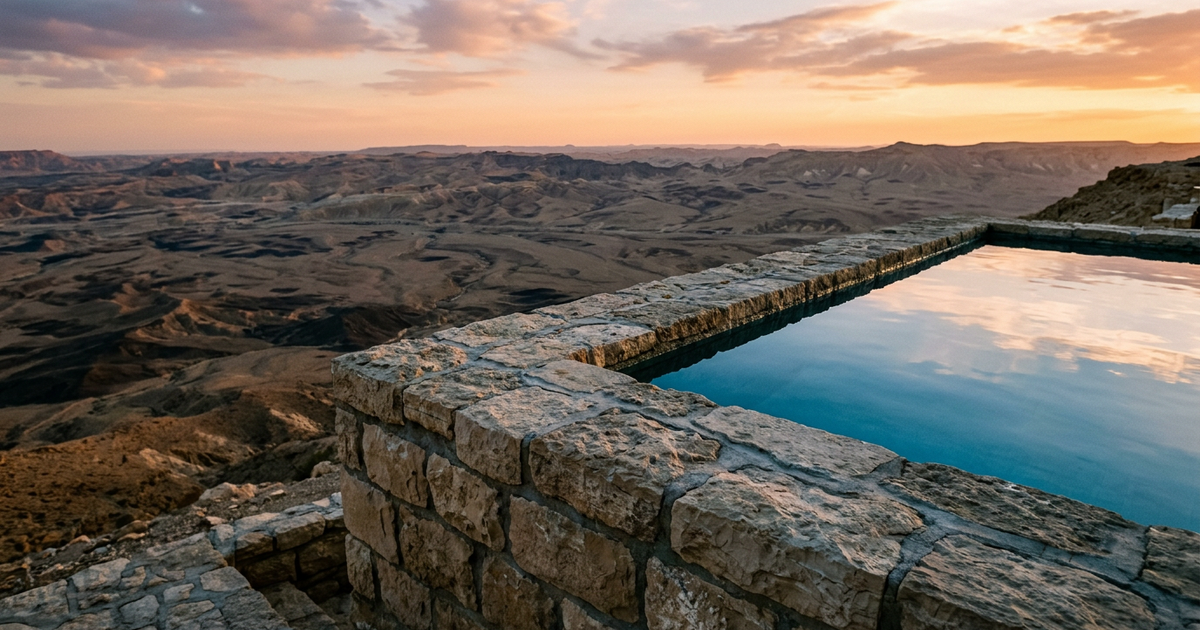
Beresheet is the flagship. Opened in 2011 on the rim of the Ramon Crater, it was the property that proved the Israeli market could support a $700-a-night destination resort. Beresheet directly preceded, and arguably enabled, Six Senses Shaharut, which opened a decade later in the Arava and validated the same thesis at international ultra-luxury scale. Without Beresheet, the Six Senses Israel project does not happen on the timeline it did.
How Does Isrotel Trade on the TASE (ISRO)?
Isrotel is listed on the Tel Aviv Stock Exchange (ISRO). The Lubinski family, through David Lewis and the family’s holding structure, remains the controlling shareholder. Israeli institutional investors hold meaningful minority positions.
The market capitalization sits well below Fattal’s, reflecting the structural difference: Isrotel is a domestic Israeli hotel operator, exposed entirely to the Israeli inbound and domestic tourism cycle, with no European or international hedge.
Through 2024, that exposure produced the worst year in the company’s recent history. Through 2025 and into 2026, the recovery has been strong: Eilat ran near-full on domestic demand throughout, Mizpe Hayamim and Cramim held up on the country-house Israeli market, and Beresheet held its ADR. The Jerusalem and Dead Sea properties were slower to recover.
WHY IT MATTERS
- Second-largest hotel operator in Israel, the most domestically exposed major listed company
- Family-controlled by the Lubinski group for 45 years, with no signal of strategic sale or external capital
- Exclusive Collection moved Isrotel into the boutique-luxury layer of the market that other major operators had ceded
- Beresheet (2011) opened the door to Six Senses Shaharut (2021), and the next decade of international ultra-luxury Israel
- No international hedge, full exposure to Israeli inbound and domestic tourism cycle
How Is Isrotel Different From Fattal Hotels?
Three differences matter.
One: geography. Fattal is global. Isrotel is Israel-only.
Two: segment mix. Fattal is volume-anchored, with Setai TLV as the boutique outlier. Isrotel is more balanced: solid mid-market Eilat resort volume, plus the Exclusive Collection at the top of the curve.
Three: institutional posture. Isrotel feels older, more conservative, more deliberate. Fattal feels acquisitive and aggressive. Both work; they’re different operating cultures.
What Is Isrotel's Outlook?
Isrotel’s next chapter is about the Exclusive Collection. The mid-market Eilat business is mature; the upside is in moving Israeli ADR upward through more luxury supply, and Isrotel is positioned for that. Cramim and Mizpe Hayamim have headroom. The brand could plausibly extend into one or two more properties at the top of the curve over the next five years.
There is no obvious indication that Isrotel will export, the way Fattal and Brown have. The strategic identity is Israeli. The family is Israeli. The portfolio is Israeli. That is unlikely to change.
The original Israeli hotel company. Still building. Still listed. Still in the family.
Isrotel: FAQ
What is Isrotel?
Isrotel is the second-largest hotel operator in Israel by room count and the most domestically anchored major Israeli hospitality company. Founded in 1980, it operates roughly 25 hotels and 6,500+ rooms across Israel, with the Exclusive Collection sub-brand carrying its boutique-luxury portfolio.
Who owns Isrotel?
Isrotel is controlled by the Lubinski family, anchored by founder David Lewis. The family has held control for more than 45 years.
When was Isrotel founded?
Isrotel was founded in 1980 by David Lewis of the Lubinski family.
What is Beresheet?
Beresheet is Isrotel’s flagship luxury property, opened in 2011 on the rim of the Ramon Crater in the Negev desert. It was the resort that proved the Israeli market could support a $700-a-night destination property.
What is Isrotel Exclusive Collection?
Isrotel Exclusive Collection is the company’s boutique-luxury sub-brand, launched in the 2010s. It includes Beresheet, The Orient, Cramim, Mizpe Hayamim, and Carmim.
How many hotels does Isrotel operate?
Isrotel operates approximately 25 hotels and 6,500+ rooms across Israel as of 2026.
Is Isrotel publicly listed?
Yes. Isrotel is listed on the Tel Aviv Stock Exchange under the ticker ISRO.
How is Isrotel different from Fattal Hotels?
Three structural differences: geography (Fattal is global, Isrotel is Israel-only); segment mix (Fattal is volume-anchored with one luxury outlier, Isrotel is more balanced); and institutional posture (Isrotel is older and more conservative, Fattal is acquisitive and aggressive).
How did Isrotel perform after October 7, 2023?
Through 2024, full domestic exposure produced one of the worst years in Isrotel’s recent history. Through 2025 and into 2026, recovery has been strong: Eilat ran near-full on domestic demand throughout.
Will Isrotel expand internationally?
There is no obvious indication that Isrotel will export the way Fattal and Brown have. As of 2026, that posture is unlikely to change.
Who is David Lewis of Isrotel?
David Lewis is the founder of Isrotel and the patriarch of the Lubinski family holding structure that controls the company.
↗ Index: this is the Isrotel / Lubinski profile in the Israeli Hotels cluster. Capstone: Who Owns the Israeli Hotel Sector. Sister operator profiles: Fattal · Dan · Alrov · Brown · Norman.