The UAE-Israel Bilateral: How Trade Grew from Zero to $3 Billion in Five Years
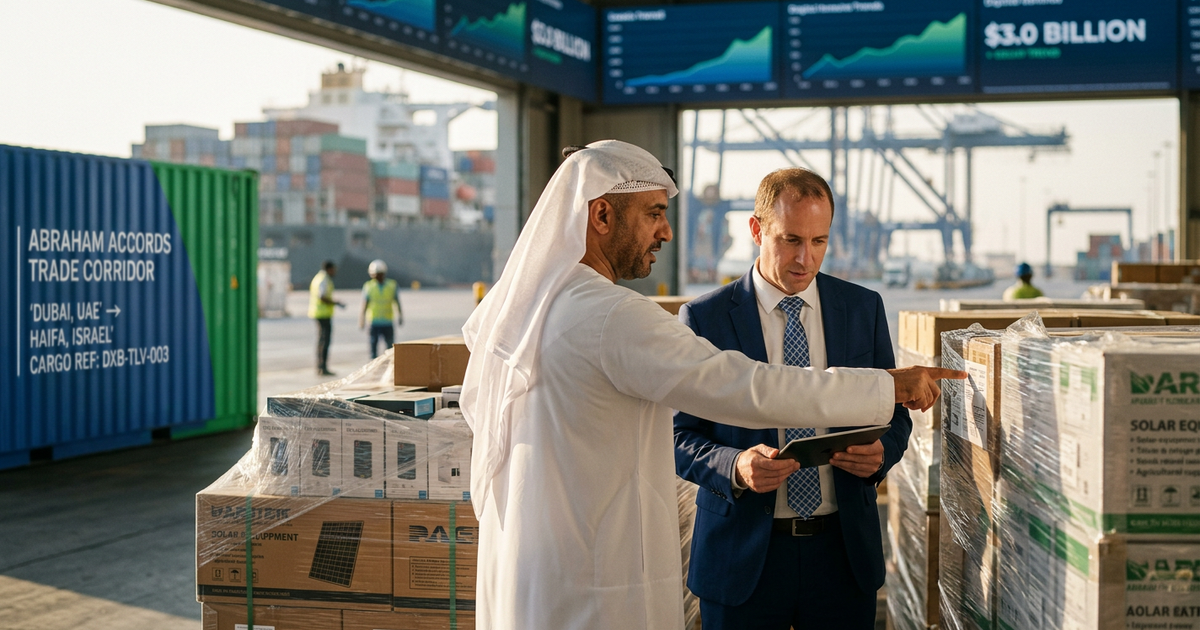
Inside the UAE-Israel bilateral trade corridor — the CEPA agreement, sector-by-sector commerce, defense and fintech activity, the post-October 7 environment, and the institutional infrastructure underpinning continued expansion.
The September 15, 2020 signing of the Abraham Accords at the White House produced one of the fastest bilateral commercial expansions in modern Middle East history.
Bilateral trade between Israel and the United Arab Emirates grew from effectively zero in 2019 to over $2.5 billion in 2022 per Israeli Central Bureau of Statistics data, with continued expansion through 2023–2025. Israeli defense exports to Abraham Accords destinations — primarily the UAE — grew from 3% of total Israeli defense exports in 2023 to 12% in 2024 per Israel Ministry of Defense data.
The CEPA agreement
The Israel-UAE Comprehensive Economic Partnership Agreement (CEPA) was signed in May 2022 and entered into force in April 2023. The agreement eliminated or substantially reduced tariffs on the vast majority of bilateral goods trade — over 96% of trade by value, per Israeli Ministry of Economy disclosure — and established structural arrangements covering services trade, investment, intellectual property, and broader commercial cooperation.
The CEPA was the first comprehensive bilateral trade agreement between Israel and an Arab country. The agreement set a target of $10 billion in annual bilateral trade within five years of entering into force.
Defense and security
The UAE has emerged as one of the most significant Israeli defense export destinations since 2020.
UAE acquisitions have spanned air defense components (with strategic implications given UAE investment in air-defense architecture against ballistic and aerial threats), counter-UAS systems (a major UAE strategic priority following the Yemen-Houthi attack environment of 2021–2024), cyber and electronic warfare systems, drones and unmanned aerial systems, and a broader portfolio of intelligence and surveillance equipment.
Several Israeli defense contractors have established UAE operational presences. The integration extends in some cases into co-development arrangements with UAE-domiciled defense and security entities.
The financial-services and fintech corridor
DIFC (Dubai International Financial Centre) and ADGM (Abu Dhabi Global Market) have hosted growing Israeli fintech and financial-services activity since 2020.
Major Israeli fintech operators — payments processors, capital-markets technology providers, regtech firms, embedded-finance platforms — have established UAE presences. Several Israeli venture capital and growth equity firms operate UAE coverage from DIFC offices. Major Israeli banks have explored — and in some cases established — UAE-Israeli banking relationships.
UAE sovereign and quasi-sovereign capital has deployed materially into Israeli technology through 2021–2026, both directly and through fund relationships with major US and European venture and growth firms.
Agritech, water, and food security
The UAE's strategic priority on food security — substantially intensified by the 2022 global food-price environment — has driven major UAE-Israel commerce across agritech and water technology.
Israeli leadership in drip irrigation (Netafim and the broader Israeli precision-agriculture sector), alternative protein and cultivated meat (Aleph Farms, Future Meat, Redefine Meat, Believer Meats, Remilk), precision agriculture (Taranis, Prospera, CropX), pollination technology (Beewise), and desalination (IDE Technologies) has translated into substantial bilateral activity. UAE strategic investment vehicles — particularly Mubadala, ADQ, and selected Emirati family offices — have deployed materially into Israeli agritech and food-tech.
Cyber and AI
The Israeli cyber and AI sector has built UAE customer bases across government, financial-services, telecom, and critical-infrastructure sectors. Some Israeli cyber firms have established UAE operational teams; others operate through partner relationships.
Real estate and tourism
The 2021–2022 period saw rapid expansion of UAE-Israeli tourism. Direct commercial flights between Tel Aviv and Dubai, Abu Dhabi launched in late 2020. Israeli tourism into the UAE peaked in 2022 before the post-October 7 environment partially constrained outbound tourism.
Reciprocal real-estate investment activity has continued through 2025–2026. UAE capital into Israeli commercial real estate; Israeli capital into Dubai residential and commercial real estate, particularly the Dubai Marina, Downtown Dubai, Palm Jumeirah, and Business Bay markets.
The post-October 7 environment
The October 7, 2023 Hamas attack and the subsequent regional security environment placed substantial public-relations pressure on individual UAE and Bahraini institutions to distance from Israeli commercial relationships. The pressure did not translate into structural commercial disengagement.
UAE-Israel bilateral trade has continued growing through 2024–2026. Major commercial activity across defense, fintech, agritech, cyber, and broader sectors has continued. The CEPA agreement remains in force.
The institutional infrastructure underpinning the bilateral has matured — UAE and Bahraini institutions with operational Israeli capability, Israeli companies with operational UAE capability, established cross-border banking and legal-services architecture, and substantial reciprocal investment positions — can no longer be wound down rapidly.
What 2026–2027 looks like
Three structural dynamics shape the coming period.
First — the CEPA $10 billion target. Bilateral trade is on track toward, though not yet at, the $10 billion-annual target set when CEPA entered into force in April 2023.
Second — Saudi normalization trajectory. Substantial reporting through 2022–2026 has documented Saudi-Israeli discussions across multiple sectors and at multiple diplomatic levels. Any formal Saudi entry into the Accords framework would reshape the regional commercial architecture materially.
Third — the broader regional economic architecture. The 2023 India-Middle East-Europe Economic Corridor (IMEC) announcement, the broader Gulf Cooperation Council economic integration patterns, and the maturing Israel-Greece-Cyprus eastern Mediterranean partnership architecture together produce an emerging regional commercial geography that the Abraham Accords commerce operates within.
Read Next in The Olam
- The UAE–Israel CEPA at Three — What the free trade agreement has actually done
- UAE Acquisitions of Israeli Defense Systems — The post-Accords defense trade
- DIFC, ADGM, and Israeli Fintech in the Gulf — The operational base
- Bahrain-Israel: Financial-Sector Activity — The parallel Bahrain corridor
Source data: Israeli Central Bureau of Statistics bilateral trade data; Israel Ministry of Economy publications; Israel Ministry of Defense / SIBAT; UAE Ministry of Economy publications; DIFC and ADGM regulatory and statistical disclosures; CEPA agreement public text; coverage in Calcalist, Globes, Times of Israel, The National, Gulf News, Reuters, Bloomberg, Financial Times.