
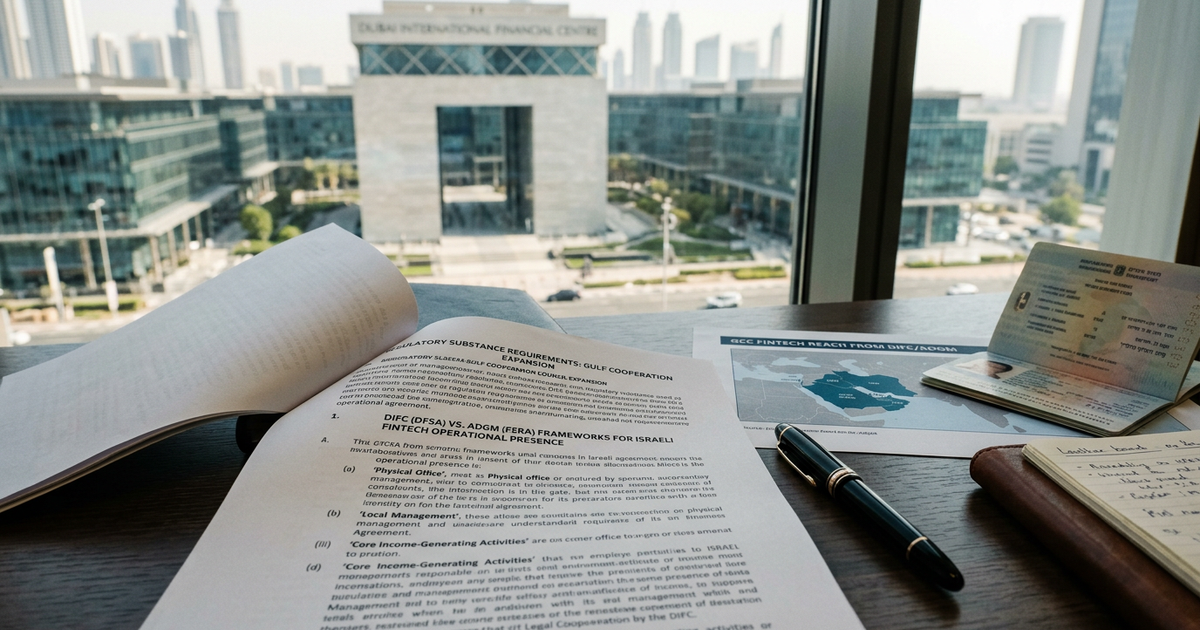

DIFC and ADGM are the operational base for Israeli fintech expansion into the Gulf. The substance requirements, the regulatory mechanics, and why the choice between the two centers is not interchangeable for Israeli companies.
Dubai International Financial Centre and Abu Dhabi Global Market are the two financial-services free zones that have become the operational base for Israeli fintech expansion into the Gulf since the 2020 Abraham Accords. Both run on independent common-law frameworks. Both regulate financial services to international standard. Neither is replicable elsewhere in the GCC.
For Israeli payments, lending, asset-management, and digital-banking companies, the DIFC/ADGM choice is not a tax decision — it is a market-access decision. The Gulf has approximately $4 trillion in sovereign wealth, a high-growth UHNW population, and a fintech-receptive regulatory posture. The path to that market runs through one of the two centers.
What DIFC and ADGM actually are
DIFC (Dubai International Financial Centre). Established 2004. Common-law jurisdiction operating independently from UAE federal civil law. Has its own court system, regulator (DFSA — Dubai Financial Services Authority), and corporate registry. Approximately 6,000 active registered firms as of 2025. Located in a defined geographic footprint within Dubai.
ADGM (Abu Dhabi Global Market). Established 2015. Same common-law structural model — own courts (modeled on English law), own regulator (FSRA — Financial Services Regulatory Authority), own corporate registry. Smaller than DIFC in firm count, but with a more institutional capital orientation and direct proximity to Mubadala, ADIA, and the Abu Dhabi sovereign architecture.
For an Israeli fintech, the choice depends on the business model:
- DIFC. Retail-adjacent fintech, payments, B2C, broader MENA distribution.
- ADGM. Institutional capital, asset management, family-office services, sovereign-adjacent infrastructure.
The Israeli fintech presence
Visible Israeli fintech activity in DIFC and ADGM since the Accords:
Rapyd. The Israeli payments unicorn established DIFC operations for MENA payments expansion. The combination of UAE corporate banking access plus DFSA-regulated entity has been central to the company's GCC distribution.
Pagaya. The NYSE-listed Israeli AI-credit company has pursued GCC institutional capital relationships, with ADGM-routed structures used in some institutional partnerships.
Payoneer. The NASDAQ-listed Israeli cross-border payments operator has engaged the DFSA framework for MENA payments licensing.
Earnix, Tipalti, and the broader Israeli enterprise-software bench. Less DIFC-anchored, more typical commercial-license structures, but increasingly active in the Gulf B2B layer.
Asset managers and crypto-adjacent. ADGM has been particularly active in licensing digital-asset infrastructure. Several Israeli-founded crypto-infrastructure firms — StarkWare-adjacent, Fireblocks-adjacent — have established ADGM regulatory positions.
The regulatory mechanics
Both DIFC and ADGM operate similar regulatory categorization frameworks. Five broad license categories: investment dealing, fund management, payment services, lending and credit, and insurance intermediation. Each category carries capital requirements, ongoing compliance obligations, and substance requirements.
The substance requirement is the binding constraint for most Israeli companies. Both centers require demonstrable on-the-ground operational presence — local directors, qualified staff, physical office. A 'brass-plate' structure does not pass. For a typical Israeli fintech setting up in DIFC or ADGM, the operational footprint is meaningful: 5 to 15 staff minimum, an office lease, locally-resident senior management.
That cost-of-entry is the gate. Israeli fintechs that have committed to the Gulf market have absorbed the cost. Those treating the GCC as an opportunistic tertiary geography have not.
The institutional pull
The strategic logic of the Israeli fintech presence in DIFC and ADGM is not the Gulf consumer market — it is the Gulf institutional capital market. Mubadala, ADIA, ADQ, PIF, QIA, KIA, Mumtalakat, ICD, and the GCC sovereign and quasi-sovereign capital base allocate hundreds of billions of dollars annually. The path to that capital — for fundraising, for partnership, for distribution — runs through GCC-resident regulated entities.
An Israeli company raising from Mubadala via an unregulated Tel Aviv entity faces friction. The same company operating a DFSA- or FSRA-regulated subsidiary inside DIFC or ADGM faces materially less. The structure isn't decorative. It changes the speed of institutional commitment.
The post-Accords trajectory
Israeli activity in DIFC and ADGM began functionally at zero in 2020. By 2026, several dozen Israeli-founded or Israeli-anchored entities are operating under DFSA or FSRA licensing. The growth trajectory is structurally upward — driven both by Israeli companies pursuing Gulf market access and by GCC sovereign capital seeking direct exposure to Israeli technology.
The next iteration is institutional: Israeli funds operating through ADGM, GCC sovereign vehicles operating through Israeli partnerships, and a regulatory-coordination layer that did not exist before the Accords. The two financial centers are not the entire story of Israel-Gulf commerce. They are the regulated rail that everything formal eventually moves through.