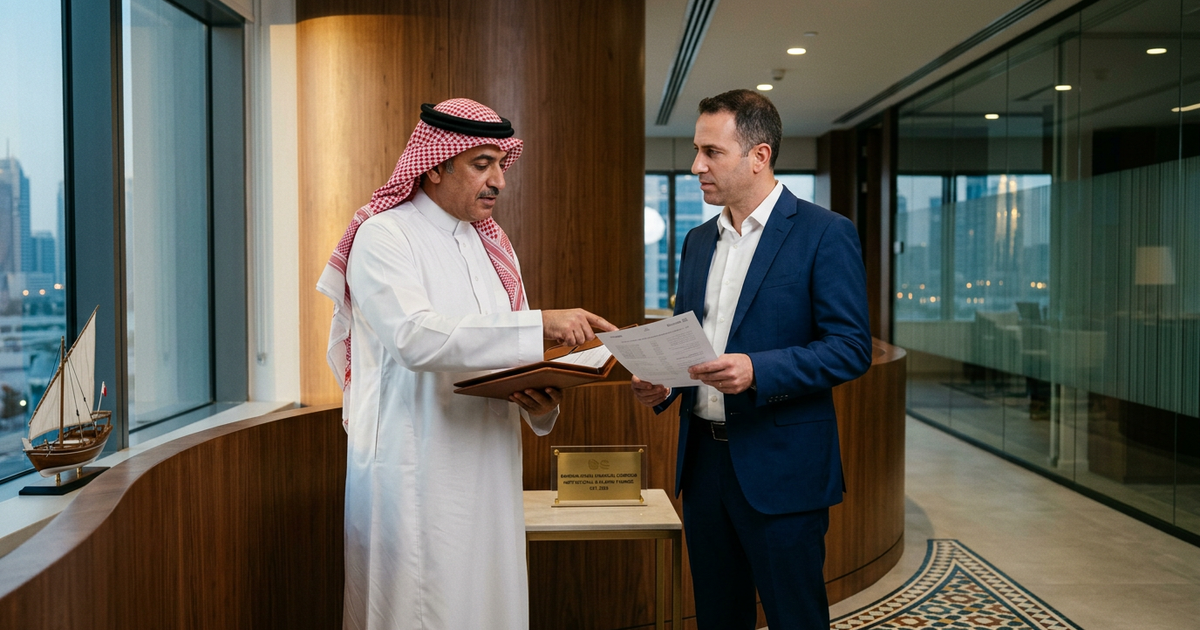

Bahraini financial-sector activity with Israel is smaller, institutional, and Islamic-finance specialized. It is also Saudi-adjacent.
Bahrain joined the Abraham Accords on September 15, 2020 — the same day as the UAE. The two normalizations have followed materially different commercial trajectories. The UAE-Israel corridor has grown into a multi-billion-dollar trade relationship with deep institutional activity across defense, technology, and finance. The Bahrain-Israel corridor is smaller — but disproportionately concentrated in the financial sector.
For Israeli companies and capital, Bahrain is not the alternative to Dubai. It is a parallel position in the Gulf — smaller, more specialized, more institutionally orientated toward financial services.
What Bahrain is in the Gulf financial system
Bahrain hosts the longest-established financial-services architecture in the GCC. The Central Bank of Bahrain has operated under its current framework since 2006. The Bahrain Financial Harbour, built in the 2000s, predates DIFC by years in physical institutional density even as DIFC has surpassed it in firm count.
Bahrain's financial system is differentiated from the UAE's on three lines:
Islamic finance specialization. Bahrain hosts AAOIFI (Accounting and Auditing Organization for Islamic Financial Institutions) and the International Islamic Financial Market. The Sharia-compliant finance infrastructure is materially deeper in Manama than in Dubai or Abu Dhabi.
Insurance and reinsurance. Bahrain runs a long-established insurance hub anchored by ARIG and broader regional reinsurance activity. The market is smaller than London or Dubai but specialized.
Wholesale and offshore banking. Bahrain has historically served as an offshore banking center for the Gulf — pre-dating the modern DIFC/ADGM rise — with multiple GCC banks running treasury and trading operations through Manama.
The Israel-Bahrain financial trajectory since 2020
Visible activity since the Accords:
Bank-to-bank correspondent relationships. Bahraini banks — Ahli United, BBK, National Bank of Bahrain, and the Bank ABC group — established working correspondent arrangements with Israeli banks. The mechanics for moving funds between the two systems, dormant or non-existent before 2020, became functional. This is the foundational layer everything else runs on.
Investment fund flows. Mumtalakat — the Bahrain sovereign wealth fund — has been quieter than its UAE counterparts on direct Israeli investment, but bilateral capital flows have grown through fund-of-funds structures and co-investment arrangements with US and European LP bases.
Fintech and Islamic finance crossover. A small but distinct subset of Israeli fintech activity has focused on Sharia-compliant adjacent products — an area where the Bahraini regulatory and certification infrastructure is the natural home for the Gulf-side execution.
Insurance and reinsurance. Israeli insurance-tech firms have begun engaging the Bahraini reinsurance market, with some pilot regulatory engagement through the Central Bank of Bahrain.
The structural constraint
Bahrain's financial sector is smaller than the UAE's by an order of magnitude. The DIFC alone has more registered financial-services firms than the entire Bahraini system. Mumtalakat's AUM is materially smaller than ADQ's, let alone Mubadala's or ADIA's. The Bahraini banking system, while sophisticated, is a fraction of the size of the UAE banking system.
This is the operative constraint on Bahrain-Israel financial activity. The market is real but not large. For an Israeli fintech, payments company, or asset manager looking at Gulf expansion, Bahrain is a complement to UAE — not a substitute.
The companies treating Bahrain as a distinct strategic geography tend to be:
- Firms with explicit Islamic finance products or Islamic-finance partnership opportunities.
- Insurance and reinsurance operators where Bahrain's specialized regional position adds direct value.
- Firms working with GCC-wide bank correspondent networks where Bahrain is a meaningful node.
- Family offices with Bahraini principal relationships predating the Accords.
The diplomatic-commercial frame
Bahrain's relationship with Israel has held through post-October 7 regional tensions in a way that some other GCC relationships have not. The diplomatic linkage to Saudi Arabia — Bahrain's normalization moves frequently move on a Saudi-coordinated timeline — gives the Manama relationship a structural weight beyond its raw financial volume.
For Israeli financial-sector operators, the long-term thesis is that Bahrain serves as a regulatory and operational lab for activity that may eventually run at scale in Saudi Arabia. The institutional infrastructure being built bilaterally — bank correspondent relationships, fund flows, regulatory engagement — is template material.
The Bahrain-Israel financial corridor remains the smallest of the post-Accords commercial relationships by raw volume. It is also among the most institutionally formal. The combination of Islamic finance infrastructure, insurance specialization, and Saudi-adjacency makes Manama a quietly strategic node in the broader Gulf-Israel architecture — even if the headlines run through Dubai and Abu Dhabi.
How we report: Olam stories draw on public filings, company disclosures and named sources, checked by our editors. Read our methodology · Corrections