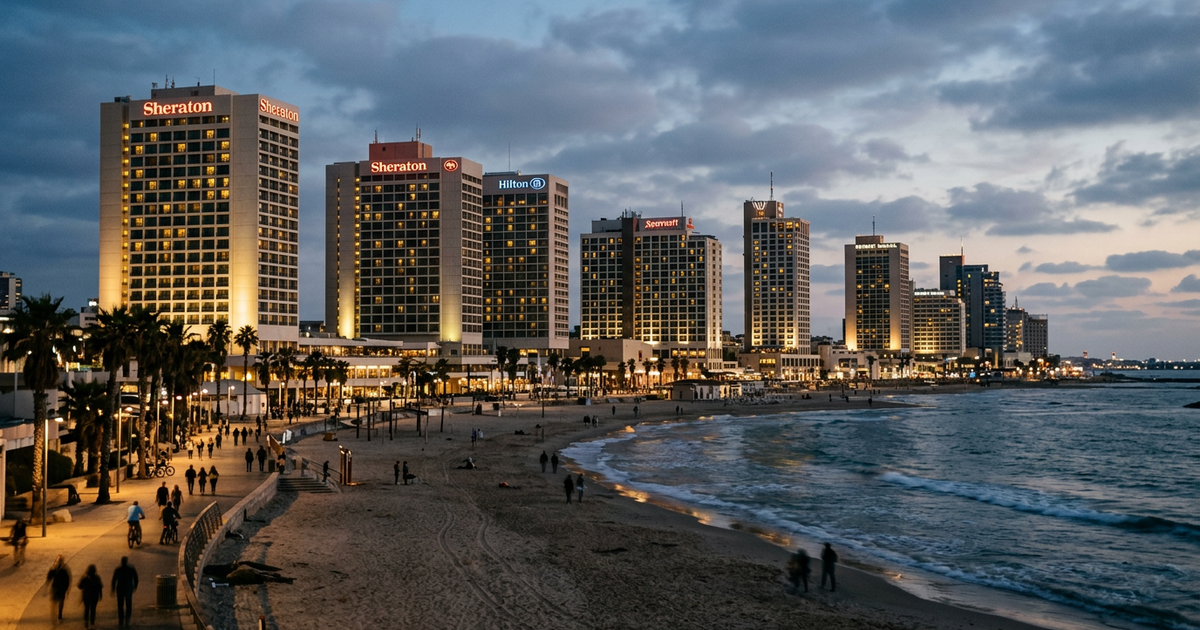

Eight international-flag tower hotels along the Tel Aviv Mediterranean beachfront represent the highest-volume hospitality cluster in Israel — and the most globally branded.
Part of: Israeli Hotels · Who Owns the Israeli Hotel Sector · Israeli Luxury 2026
Eight international-flag tower hotels along the Tel Aviv Mediterranean beachfront represent the highest-volume hospitality cluster in Israel — and the most globally branded. The brand-management model, the business demand base, and why the beachfront tower is the part of Tel Aviv hospitality the boutique-luxury press tends to ignore.
The Tel Aviv beachfront tower layer is the largest single hotel cluster in Israel by room count, the most international-flag-anchored, and the most consequential to the country’s business and MICE economy — and yet it is the part of the sector that the boutique-luxury press tends to ignore.
Eight to ten beachfront towers along HaYarkon Street and the immediate adjacent blocks. Roughly 3,000 to 3,500 rooms in aggregate. Brands: Hilton, Sheraton, Crowne Plaza, InterContinental, Carlton, Dan, Renaissance, Royal Beach, Herods. Owners: a mix of Israeli holding companies (Africa-Israel, IDB Group through subsidiaries), individual Israeli investors, public REITs in some cases, and a small foreign-capital component. The tower layer is where Israeli business hospitality runs.
BY THE NUMBERS
Beachfront tower hotels (HaYarkon Street and adjacent): ~10
Total beachfront tower keys: ~3,000–3,500
Major properties: Hilton Tel Aviv · Sheraton Tel Aviv · Crowne Plaza Tel Aviv · David Intercontinental · Carlton Tel Aviv · Dan Tel Aviv · Renaissance Tel Aviv · Royal Beach Tel Aviv (Isrotel) · Herods Tel Aviv (Fattal)
Brand contracts: Hilton, IHG, Marriott operate primarily under management agreements with Israeli ownership
Dominant demand segments: business / MICE · international leisure inbound · high-volume diplomatic and trade missions
ADR range (pre-war): $300–$700 per night standard rooms · suites $1,000+
The Brand-Management Model
The structural feature that defines the beachfront tower layer is the separation of ownership from brand operation.
Hilton Tel Aviv is owned by Israeli capital and operated under a long-term Hilton management contract. The Sheraton Tel Aviv operates under a Marriott management contract over Israeli ownership. The Crowne Plaza Tel Aviv runs under IHG brand contract. The David Intercontinental operates under IHG’s InterContinental flag with Israeli ownership underneath. The Renaissance Tel Aviv sits under Marriott brand management with Israeli ownership behind it.
This is the inverse of the boutique-luxury cluster pattern. The Norman, The Setai, The Jaffa, and the broader Tel Aviv boutique layer either operate independently or under brand-management arrangements with much narrower distribution implications. The beachfront towers operate as full Hilton, Marriott, and IHG properties — with the global distribution systems, the loyalty programs, the reservation infrastructure, and the operating standards that come with those brand commitments.
For Israeli capital, the brand-management model offers structural advantages. The owner gets global brand distribution and the operational expertise of a major flag without taking on the brand-development risk. The brand gets a presence in a meaningful Mediterranean market without committing equity capital. The economics flow through long-term management contracts that typically run 20 to 30 years.
The Demand Base
The beachfront tower layer runs on three demand streams that are structurally different from the boutique-luxury cluster.
Business and MICE is the dominant stream. Tech industry visits, financial sector delegations, defense and aerospace business travel, the steady flow of corporate accounts that maintain dedicated rate agreements with Hilton, Marriott, and IHG properties globally. The beachfront towers capture this traffic by default — corporate travel programs route to flag-branded properties through global travel management contracts, not to independent boutique hotels.
International leisure inbound — the volume layer of inbound tourism. Mass-market European and North American leisure travelers, the package tour cycle, the cruise ship overflow when ships call at Haifa or Ashdod and passengers extend stays. The boutique-luxury layer captures the high-yield top of this market; the tower layer captures the volume.
High-volume diplomatic and trade missions — not the senior heads-of-state level (that flows to the Jerusalem trophy cluster), but the working-level diplomatic traffic, the trade-mission delegations, the visiting government technical staff, the embassy-coordinated business visits. The David Intercontinental and Carlton particularly capture this layer.
The Specific Properties
Hilton Tel Aviv. The longest-tenured international flag on the Tel Aviv beachfront. Opened in 1965. Independence Park location. Roughly 580 keys. The default Hilton corporate-account property in the city.
Sheraton Tel Aviv. Marriott’s Sheraton flag, beachfront. Roughly 320 keys. Long-tenured property — opened in 1981.
Crowne Plaza Tel Aviv. IHG’s Crowne Plaza flag, beachfront. Owned by Africa-Israel group. Roughly 240 keys.
David Intercontinental Tel Aviv. IHG’s InterContinental flag, the highest-positioned IHG property in Israel. Roughly 555 keys. The default high-volume corporate property for senior IHG-loyalty business travelers and large diplomatic delegations.
Carlton Tel Aviv. Independent brand, Israeli-owned and operated. Roughly 280 keys. One of the older mid-luxury independents in the cluster.
Dan Tel Aviv. Federmann-owned, Dan-operated. Beachfront. 280 keys. Opened in 1953 as the original Dan flagship. The Israeli-domestic-and-business default for the establishment generation of Israeli business and government.
Renaissance Tel Aviv. Marriott’s Renaissance flag. Beachfront. Roughly 345 keys.
Royal Beach Tel Aviv. Isrotel-operated. Beachfront. Roughly 240 keys.
Herods Tel Aviv. Fattal-operated. Beachfront. Mid-upscale positioning.
Why No Four Seasons or Mandarin Oriental Yet
One of the more striking absences in the Tel Aviv beachfront cluster is the lack of a true global ultra-luxury international flag. There is no Four Seasons Tel Aviv. There is no Mandarin Oriental Tel Aviv. The international flags that operate on the Tel Aviv beachfront are upper-upscale (InterContinental, Hilton, Sheraton, Crowne Plaza) but not the global ultra-luxury houses. The only international ultra-luxury flag currently operating anywhere in Israel is Six Senses Shaharut, in the Negev desert — not on the beachfront.
Two structural reasons.
Site availability. The Tel Aviv beachfront has limited remaining buildable sites. The existing towers occupy most of the prime HaYarkon Street frontage. A new ultra-luxury tower would require either acquiring and tearing down an existing property (capital-prohibitive) or developing one of the remaining available sites (politically and zoning-complex).
Boutique-luxury occupies the ultra-luxury demand. The Norman, The Setai, The Jaffa, and the broader Tel Aviv boutique-luxury cluster have effectively absorbed the demand for ultra-luxury hospitality in the city. For a deeper look at the question: The Aman Israel Question.
October 7 and Recovery
The beachfront tower layer recovered faster than the Jerusalem trophy cluster but slower than the Tel Aviv boutique-luxury layer. The business and MICE recovery led the way through 2025. Tech industry visits to Tel Aviv normalized faster than diplomatic and pilgrimage flows to Jerusalem.
By the second half of 2025, the beachfront towers were running at 75–80% occupancy in the strongest months at or near pre-war ADR. The corporate travel recovery, particularly American and European tech and financial sector business travel, was the structural driver.
Outlook
The beachfront tower layer is the part of Israeli hospitality that institutional capital understands best. The brand-management model translates cleanly to US, European, and Asian institutional investors. If foreign capital arrives at scale in Israeli hospitality real estate over the next decade, the beachfront tower layer is the most plausible entry point. For the full capital analysis: Why Israel Has No Hotel REIT.
The volume hospitality layer of Tel Aviv. The international brand layer of Israeli hospitality. The part of the sector that institutional capital understands.
Part of the Israeli Hotels cluster. Companion: The Norman Tel Aviv · The Israeli Boutique Hotel Class. Capstone: Who Owns the Israeli Hotel Sector. Sector guide: Israeli Luxury 2026.
How we report: Olam stories draw on public filings, company disclosures and named sources, checked by our editors. Read our methodology · Corrections