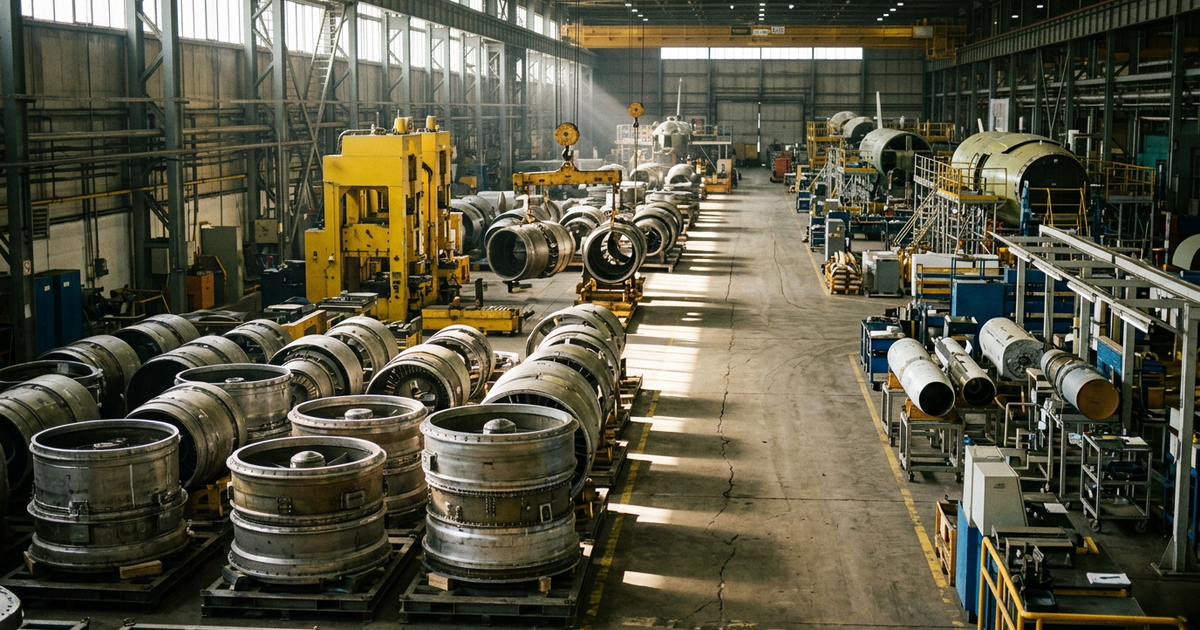

Q1 2026 marks the post-October 7 backlog peak for Israeli primes. Elbit above $22B, IAI above $20B, Rafael mid-teens. Set against Lockheed ($176B), RTX ($220B+), Rheinmetall (€55B+) — the absolute scale gap and the narrowing velocity gap.
Absolute scale still favors the Americans. But the velocity gap is closing — and the composition gap has already flipped.
The Israeli defense industrial base is carrying its largest order backlog on record, updated through Q3 2026. Elbit above $28 billion. IAI above $25 billion. Rafael at $17.7 billion. Combined: roughly $70 billion in committed future revenue, the tightest velocity gap versus Lockheed, RTX, and Rheinmetall since the Cold War.
Set against the Western reference primes, the absolute scale gap remains enormous. Lockheed carries $176 billion. RTX carries $220 billion-plus. Rheinmetall — the German prime that has emerged as Europe's structural beneficiary of the post-Ukraine rearmament — carries €55 billion-plus, more than four times its pre-2022 level. The Israeli triad still runs at a fraction of that scale.
But that framing misses the point. Absolute backlog is a legacy number. Backlog velocity, category composition, and customer diversification are the forward reads — and on all three, the Israeli operators have moved decisively.
What is the Israeli defense backlog snapshot for 2026?
Three Israeli operators anchor the national defense industrial base: Elbit Systems (NASDAQ / TASE: ESLT, publicly traded), Israel Aerospace Industries (IAI) (state-owned, TASE-listed bond instrument), and Rafael Advanced Defense Systems (state-owned).
Elbit Systems. Publicly disclosed backlog crossed $22 billion in 2024 and continued expanding through 2025 per quarterly SEC filings, now widely reported above $28 billion. The composition has shifted materially toward European customers since the 2022 Russian invasion of Ukraine and accelerated through 2024–2025, with German, UK, Dutch, Danish, Romanian, and Greek procurements anchoring multi-year delivery schedules. PULS rocket artillery is now displacing HIMARS as the European divisional standard.
Israel Aerospace Industries. The 2024 reporting placed the consolidated group order backlog above $20 billion, now widely reported at $25 billion. ELTA Systems, the IAI radar and electronic-warfare subsidiary, separately reported a $6.9 billion backlog at end-2024, of which approximately 75% reflects export orders. Boaz Levy, IAI's President and CEO, has overseen the post-October 7 expansion alongside the Arrow air-defense agreements with Germany, the September 2023 $3.6 billion Arrow 3 deal, followed by the December 2025 $3.1 billion second Arrow 3 contract. Combined, the largest single-country export franchise in the company's history.
Rafael Advanced Defense Systems. 2024 revenue of $4.85 billion implies a multi-year backlog at conservative book-to-bill assumptions; state-owned status limits public backlog disclosure, but trade-press estimates and Israeli Ministry of Defense reporting place Rafael's 2025 backlog at $17.7 billion. Iron Dome, David's Sling, Spike anti-tank, and Trophy active-protection anchor the order book. Trophy is now standard on the US M1 Abrams and the German Leopard 2, a hardware-integration franchise that generates decades of aftermarket revenue.
How do the Western reference primes compare?
Set against the Israeli triad, the Western prime backlogs operate at a different absolute scale.
| Prime | Backlog | Nationality |
|---|---|---|
| RTX Corporation | $220B+ | US |
| Lockheed Martin | $176B | US |
| Rheinmetall AG | €55B+ | Germany |
| Elbit Systems | $28B+ | Israel |
| Israel Aerospace Industries | $25B+ | Israel |
| Rafael Advanced Defense Systems | ~$17.7B | Israel |
Per the SIPRI 2024 defense-contractor index, Lockheed Martin's defense revenue of $64.65 billion and RTX's $43.6 billion exceed the combined annual defense revenue of all three Israeli primes. The absolute scale of US prime backlogs reflects the depth of US Department of Defense procurement, the F-35 program contribution at Lockheed, and the missile and air-defense exposure at RTX.
Rheinmetall is the interesting middle case. Its backlog quadrupling since 2022 is the closest Western analog to the Israeli velocity story, but Rheinmetall entered the cycle at a materially lower base than the Israeli operators.
What is the velocity gap between Israeli and Western primes?
The structurally interesting figure is not absolute backlog, it is backlog velocity. Israeli prime backlogs grew at materially faster rates than the US reference primes between 2022 and 2025.
Elbit's backlog grew approximately 40% between 2022 and 2025 and is on pace to double from its 2022 base. IAI's Arrow franchise alone accounts for roughly $6.6 billion in new German revenue in 24 months. Rafael's Spike orders from Germany added another $2 billion. By comparison, Lockheed's backlog grew in the mid-single digits over the same period. RTX grew low-double digits. Rheinmetall grew faster than any of them, but off a base one-fifth the size of Elbit's.
The composite read: post-October 7 IDF replenishment and accelerated European procurement have placed Israeli primes on a growth trajectory that, while not closing the absolute scale gap with US primes, has compressed the velocity gap to its tightest level in recent decades.
How does backlog composition differ between Israeli and US primes?
Israeli prime backlogs carry meaningfully different composition than the Western reference primes. The Israeli operators are concentrated in exactly the categories that current conflict dynamics have made scarce:
- Air and missile defense (Arrow, David's Sling, Iron Dome, SkySonic, Iron Beam)
- Counter-UAS systems (Drone Dome, SMASH)
- Electronic warfare (ELTA, Elbit's EW portfolios)
- Active protection for main battle tanks (Trophy)
- Loitering munitions (Harpy, Harop, HERO, Skystriker)
- Tactical UAVs (Hermes, Heron)
- Rocket artillery (PULS)
The US primes are concentrated in fifth-generation manned aviation (Lockheed's F-35), strategic systems (RTX's missile defense at scale), and large-platform legacy programs.
This composition difference matters institutionally. Every category where Israeli primes hold structural advantage, air defense, counter-UAS, electronic warfare, active protection, loitering munitions, is a category where post-October 7 conflict experience has accelerated global procurement demand. The Israeli backlog composition is, in 2026, a more direct beneficiary of current conflict dynamics than the legacy-platform composition of US primes. That is a compositional gap that has already flipped in Israel's favor, while the scale gap continues to narrow.
How diversified are Israeli defense customers now?
The 2022 Israeli defense customer profile was concentrated on three anchor clients: the IDF, the US Department of Defense, and India. The 2026 profile is a US–Israel–India–Europe quadrilateral, with Germany alone worth more than $10 billion in signed orders over 24 months. The Nordics, Netherlands, UK, Spain, Poland, Denmark, and Romania are all now active buyers. The Abraham Accords line, UAE, Bahrain, Morocco, quadrupled from 3% of exports in 2023 to 12% in 2024.
That customer diversification is the more durable structural feature than the absolute backlog dollar figure. It changes the risk profile of the Israeli defense industrial base from a US-policy-dependent supplier into a genuinely globalized prime cohort.
What is the structural read on the 2026 backlog snapshot?
The 2026 backlog snapshot positions the Israeli defense industrial base at a structural inflection. Two specific institutional consequences follow.
First, the IAI and Rafael partial-IPO discussions. Both companies have been the subject of state-ownership review and potential public-market listing reporting through 2025–2026, per Globes and Calcalist coverage. A 25–30% partial flotation of IAI at a reported ~$20 billion valuation would represent the largest Israeli defense IPO in history and the largest single privatization in the country's history. Rafael has been part of parallel discussions at materially smaller scale. Backlog at multi-decade highs strengthens the institutional case for either transaction. Timing pressure is real: the IPO window is a function of the backlog cycle, and the cycle is running hot right now.
Second, the Elbit growth trajectory. Elbit's continued absorption of European demand at scale positions the company as the structural anchor of the Israeli defense industrial base for the remainder of the decade. It is the only publicly listed pure-play read on the sector, which makes it the natural expression vehicle for institutional capital getting long the Israeli rearmament thesis. The share price has responded accordingly. The equity story has room to run.
Order Backlog Index FAQ
How large is the combined backlog of Israel's three defense primes?
Elbit, IAI, and Rafael carry a combined backlog of roughly $70 billion as of 2026, with Elbit above $28 billion, IAI above $25 billion, and Rafael at $17.7 billion.
How does the Israeli defense backlog compare to Lockheed and RTX?
Lockheed Martin's backlog stood at $176 billion and RTX's at over $220 billion, dwarfing the combined Israeli triad's roughly $70 billion, though the Israeli primes have grown their backlogs faster in percentage terms since 2022.
Why is backlog velocity more significant than absolute backlog size?
Elbit's backlog grew approximately 40% between 2022 and 2025, compared to mid-single digits for Lockheed and low-double digits for RTX over the same period, showing the Israeli primes capturing demand growth faster than their much larger US counterparts.
What categories do Israeli defense primes dominate in their backlogs?
Israeli primes concentrate in air and missile defense, counter-UAS systems, electronic warfare, active protection for tanks, loitering munitions, tactical UAVs, and rocket artillery, categories where post-October 7 conflict experience has accelerated global demand.
Are IAI and Rafael planning to go public?
Both companies have been the subject of partial-IPO discussions through 2025 and 2026. A 25 to 30 percent flotation of IAI at a reported valuation of approximately $20 billion would be the largest Israeli defense IPO in history.
What to watch
- IAI partial IPO. The single largest catalyst in the sector. Will crystallize the state-owned valuation gap.
- The next Arrow 3 export. Third European buyer expected in 2026. Poland and the UK are the two names in market chatter.
- PULS-vs-HIMARS. If Elbit's PULS holds its European lead, that is a multi-decade franchise on the scale of Spike.
- Trophy on next-generation Western tanks. Active protection standard is now Israeli by default. The compounding effect on Rafael's aftermarket revenue is not yet priced in.
- Rheinmetall as competition or partner. The German prime is co-producing PULS with Elbit, the partnership model may be more structurally interesting than the head-to-head frame.
The absolute scale gap between Israeli and US primes is still measured in multiples. The velocity gap and the composition gap have both moved decisively. The order books say that trajectory holds through the end of the decade.
Source data: Elbit Systems SEC and TASE filings and annual reports; Israel Aerospace Industries state-owned financial disclosures and ELTA Systems reporting; Rafael Advanced Defense Systems annual disclosures; Lockheed Martin and RTX SEC filings; Rheinmetall AG financial reports; SIPRI 2024 defense-contractor index; Israel Ministry of Defense / SIBAT; coverage in Globes, Calcalist, Defense News, Reuters, Israel Defense, and Bloomberg. IAI/Rafael partial-IPO reporting per Globes and Calcalist 2025–2026 coverage.
How we report: Olam stories draw on public filings, company disclosures and named sources, checked by our editors. Read our methodology · Corrections