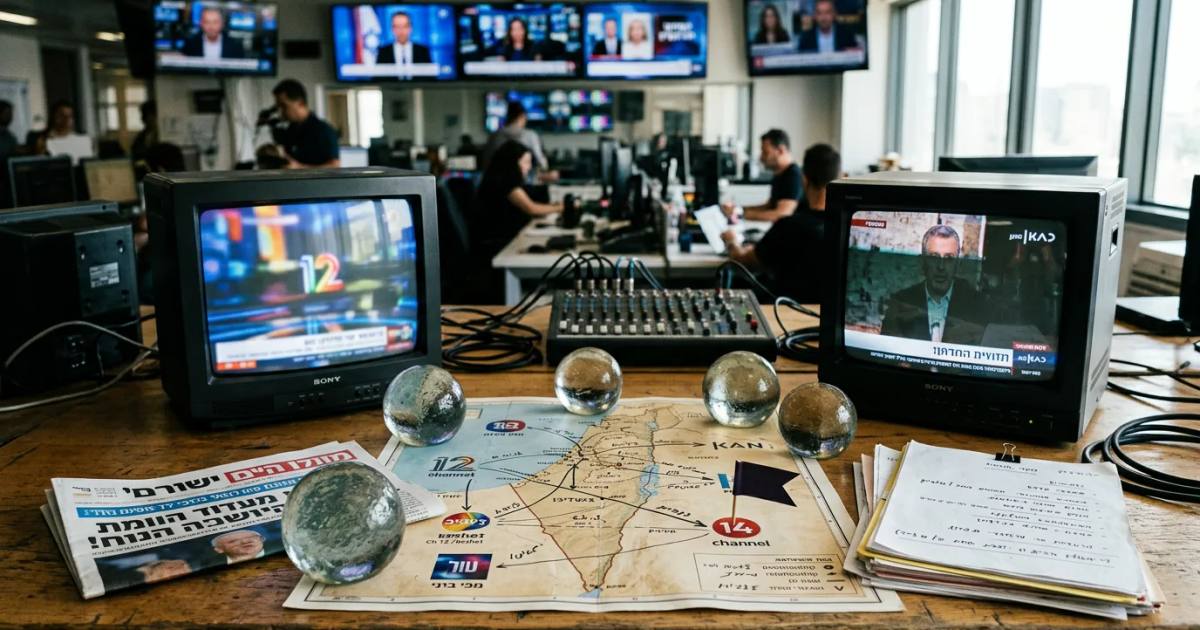

Six billionaires, two commercial channels, a right-wing insurgent, a public broadcaster rebuilt from scratch, a free daily, and more TV formats per capita than any country on earth. The Olam ownership map
Israel is one of the world's five largest television format exporters — a country of ten million people competing with the United States, the United Kingdom, the Netherlands, and Japan. Hatufim became Homeland. BeTipul became In Treatment. Shtisel became a global Netflix phenomenon. Fauda became one of the most-watched non-English-language series on the platform. Behind the exports sits a domestic media economy shaped by six billionaires, two commercial channels locked in a permanent ratings war, a right-wing news channel that reshaped the political media landscape, a public broadcaster rebuilt from scratch in 2017, a newspaper market that Sheldon Adelson disrupted with a free daily, and a digital ecosystem where six Hebrew news websites now reach more Israelis daily than any broadcast or print product.
This is the Olam map of Israeli television and media — who owns what, how the money moves, and why the format-export business punches so far above Israel's population weight.
The Market at a Glance
Israel's total advertising market runs approximately NIS 5–6 billion (~$1.5 billion) annually across television, digital, print, radio, and outdoor. Television captures roughly 20–25% of total ad spend — declining as digital takes share. Digital advertising now exceeds television in total spend, driven by Google and Meta but with meaningful local-platform revenue flowing to Ynet, N12, Mako, and Walla.
The domestic audience is ~10 million people. Hebrew content serves ~7 million Hebrew speakers. Arabic-language media serves ~2 million. English and Russian-language media serve smaller but economically significant segments. The small-market economics shape everything — production budgets, advertising rates, regulatory costs, and the structural imperative to export formats internationally.
Israel's Media Billionaires
Six billionaires control the commanding heights of Israeli media. Their positions span broadcast television, cable, satellite, international news, print, and digital — and in several cases, their media ownership intersects with their broader industrial, gaming, real estate, and sports portfolios.
| Billionaire | Media Assets | Other Key Holdings | Forbes 2026 Net Worth |
|---|---|---|---|
| Miriam Adelson | Israel Hayom (largest-circulation daily), Las Vegas Review-Journal | Las Vegas Sands (~$37B market cap), Dallas Mavericks (NBA) | $37.5B |
| Patrick Drahi | i24NEWS (international), HOT (cable/broadband), Walla (partial via Bezeq) | Altice International, Sotheby's | ~$4B |
| Len Blavatnik | Channel 13 / Reshet (via RGE Media) | Warner Music Group, DAZN, Clal Industries, Access Industries | ~$35B |
| Yitzchak Mirilashvili | Channel 14 (news/commentary), Calcala TV, 0404 News, Kol Chai | Watergen (president), VK (co-founder, exited for $1.12B) | Undisclosed |
| Noni Mozes | Yedioth Ahronoth, Ynet (#1 news website), Calcalist | Yedioth Media Group print/digital portfolio | Undisclosed |
| Amos Schocken | Haaretz (Hebrew + English), The Marker | Schocken Books (historical) | Undisclosed |
No other country of comparable size has its media landscape shaped by this concentration of private billionaire ownership. Drahi alone controls a cable operator (HOT), an international news channel (i24NEWS), and — through Altice's Bezeq stake — indirect exposure to the Walla news portal and the Yes satellite platform that distributes Fauda and Shtisel globally.
Keshet Media Group: Channel 12 and Israel's Format Export Engine
Keshet operates Channel 12 — Israel's most-watched commercial television channel, capturing an estimated 30–35% of Hebrew-language commercial television audience share. The company runs under CEO Avi Nir, who has led Keshet since the mid-2000s and built its international arm into one of the most consistently successful format distributors in the global television industry.
Keshet's international track record is anchored by Hatufim (Prisoners of War), the 2010 Israeli drama created by Gideon Raff that was adapted by Showtime as Homeland — eight seasons (2011–2020), multiple Emmy Awards including Outstanding Drama Series. The Homeland adaptation remains the single most commercially significant Israeli television format export in history.
Beyond Homeland, Keshet International has distributed formats including Rising Star (adopted in 15+ markets including ABC in the US, Sat.1 in Germany, Globo in Brazil), Boom! (sold across Europe), and a steady pipeline of entertainment and reality formats. Keshet's model — develop domestically on Channel 12, prove the format in Israel's competitive market, then license internationally through Keshet International — has become the template other Israeli distributors follow.
Keshet also operates N12 (n12.co.il), one of Israel's top news websites, and Mako (mako.co.il), a leading entertainment and lifestyle portal — giving the group a broadcast-plus-digital footprint that captures audience across platforms.
Reshet Media and Channel 13: Blavatnik's Israeli Broadcast Position
Channel 13 — Israel's second commercial channel — is controlled by Len Blavatnik through RGE Media, a subsidiary of his Access Industries holding company. Blavatnik, the Ukrainian-born American-British-Israeli industrialist whose fortune spans Warner Music Group, DAZN, and petrochemicals, acquired control of Reshet Media in 2019.
Channel 13 captures an estimated 15–20% of Hebrew commercial television audience share — structurally behind Channel 12 in both ratings and advertising revenue. The domestic advertising market is small (~$1.5 billion across all media), the audience is ten million people, and the regulatory costs of broadcast licensing are significant. Blavatnik's willingness to sustain losses has kept the channel competitive.
Channel 13 was formed from the restructuring of Israel's old Channel 2 franchise system. When the dual-franchise structure (Keshet and Reshet each operated half the week's broadcasts) ended, Keshet took sole control of what became Channel 12 and Reshet formed the basis of Channel 13. That split — finalized in 2017 — created the current commercial duopoly.
Blavatnik's Israeli media position extends beyond Reshet. Through Access Industries, he controls Clal Industries — one of Israel's legacy industrial holding companies, run by Avi Fischer as chairman and CEO since 2012.
Channel 14: The Right-Wing News Channel That Changed Israeli Media
Channel 14 — originally launched in 2014 as Channel 20, a heritage and culture broadcaster — has transformed into one of Israel's most influential television brands. Its controlling shareholder is Yitzchak Mirilashvili, an Israeli-Russian investor and co-founder of VK (Vkontakte), Russia's largest social network; his father, Mikhael Mirilashvili, is also an Israeli billionaire. Mirilashvili has wholly owned the channel since its launch and has been granted an ongoing regulatory exemption from the law barring commercial TV networks from single-owner control. The channel repositioned itself as a right-leaning news operation and has grown its audience share significantly, particularly during primetime news hours.
Channel 14's rise reshaped the Israeli media landscape. Before its emergence, the commercial news duopoly of Channel 12 and Channel 13 — both perceived as center-left by right-wing audiences — faced no serious broadcast competitor. Channel 14 filled that gap, building a loyal viewer base among right-wing and religious-Zionist audiences. Its primetime news broadcasts regularly compete with Channel 13 for second place behind Channel 12.
The channel's political positioning, editorial voice, and relationship with right-wing political leadership have made it a subject of sustained media-industry debate — but its audience growth is a structural fact. Any complete map of Israeli television must include it.
Kan: The Israeli Public Broadcasting Corporation
Kan — the Israeli Public Broadcasting Corporation — replaced the Israel Broadcasting Authority (IBA) in 2017 after decades of dysfunction, political interference, and financial mismanagement. The IBA was dissolved by law, and Kan was established as a new entity with a mandate for editorial independence.
Kan operates Kan 11 (the flagship television channel), Kan Bet (the primary Hebrew radio station — the most-listened-to radio station in Israel), Kan Gimel (Arabic-language programming), Kan 88 (music), and Kan Moreshet (culture and heritage). Kan's budget is government-funded through a public broadcasting levy — approximately NIS 800 million–1 billion annually.
Kan's most visible international role is as Israel's Eurovision Song Contest broadcaster. Israel has won the contest four times (1978, 1979, 1998, 2018) and hosted it in Tel Aviv in 2019. Kan also produces original drama, documentary, and investigative journalism — operating as both a public-service broadcaster and a content producer.
i24NEWS: Drahi's International News Operation
i24NEWS — the international 24-hour news channel broadcasting from Jaffa — was founded in 2013 by Patrick Drahi, the Franco-Israeli billionaire behind Altice International. The channel broadcasts in English, French, and Arabic, with studios in Tel Aviv/Jaffa and New York.
Drahi's Israeli media footprint extends beyond i24NEWS. Through Altice, he controls HOT — Israel's cable television and broadband provider, acquired in 2012. HOT competes directly with Bezeq's Yes satellite platform and with Cellcom TV in the pay-TV market. Drahi also holds exposure — through Altice's Bezeq stake — to the Walla news portal and the Yes satellite platform.
Drahi is simultaneously a news producer (i24NEWS), a pay-TV distributor (HOT), and a broadband operator — one of the most vertically integrated media positions in the Israeli market. i24NEWS competes for international attention with BBC, CNN International, Al Jazeera, and France 24 — from a newsroom in Jaffa.
Yes Studios and Bezeq: The Satellite Platform Behind Fauda and Shtisel
Yes — Bezeq's satellite television subsidiary — operates Yes Studios, the international distribution arm that has built one of the most successful Israeli original-content catalogs. Yes Studios distributes Fauda (four seasons, Netflix global, available in 190+ countries), Shtisel (three seasons, Netflix global phenomenon), Tehran (Apple TV+), and a growing catalog of Israeli originals.
Israeli drama production costs a fraction of comparable American or British content. Fauda's per-episode cost in its early seasons was estimated at $300,000–500,000 — a rounding error on a single episode of a major US prestige drama. The return on that investment, measured in global distribution revenue and cultural visibility, has been extraordinary.
The Digital Media Landscape
Israeli media consumption has shifted decisively to digital. The major Hebrew news and portal sites now reach more daily users than any individual television broadcast.
| Site | Owner | Position | Monthly Reach |
|---|---|---|---|
| Ynet (ynet.co.il) | Yedioth Ahronoth / Mozes family | #1 Hebrew news site | Largest Israeli news audience |
| N12 (n12.co.il) | Keshet / Channel 12 | News portal tied to broadcast | Fast-growing, strong during breaking news |
| Walla (walla.co.il) | Bezeq | Portal + news | Major portal with news, entertainment, classifieds |
| Mako (mako.co.il) | Keshet / Channel 12 | Entertainment + lifestyle | Companion platform to Channel 12 content |
| Kikar HaShabbat | Independent (Haredi sector) | #1 ultra-Orthodox news site | Dominant in the Haredi digital ecosystem |
| Srugim | Independent (religious-Zionist sector) | #1 religious-Zionist news site | Serving the national-religious community |
The digital landscape mirrors the country's social segmentation. Ynet and N12 serve the general Hebrew-speaking population. Kikar HaShabbat serves the ultra-Orthodox community — a fast-growing demographic (~1.3 million) with distinctive media consumption patterns (limited television, high mobile usage). Srugim serves the religious-Zionist community. Each operates as a near-monopoly within its segment.
Israel Hayom: The Adelson Free Daily That Reshaped the Market
Israel Hayom — founded in 2007 by Sheldon Adelson and now controlled by Miriam Adelson — is Israel's largest-circulation daily newspaper, distributing an estimated 250,000–300,000 copies daily for free at intersections, transit stations, and public spaces across Israel.
The impact on the Israeli newspaper market was seismic. Yedioth Ahronoth — the Mozes-family-controlled daily that had dominated Israeli print media for decades — lost its circulation lead. The "Israel Hayom Law" (2014, later struck down) attempted to ban free newspapers above a certain circulation threshold — a legislative response directly targeting the Adelson paper.
Israel Hayom is part of the broader Adelson media portfolio that now includes the Las Vegas Review-Journal and the Dallas Mavericks (NBA broadcast rights). No other Israeli media owner operates across print, sports, and gaming at comparable scale.
Yedioth Ahronoth, Haaretz, and the Legacy Press
Yedioth Ahronoth — controlled by the Mozes family — remains Israel's second-largest Hebrew daily (estimated circulation 150,000–200,000) and operates Ynet, the most-visited Israeli news website. The Yedioth group also publishes Calcalist, the leading business and technology daily. The group's digital transition — from print dominance to Ynet's web traffic — has been the central business story of Israeli print media over the past two decades.
Haaretz — controlled by the Schocken family since 1935 — publishes in both Hebrew and English (estimated print circulation 50,000–70,000). The English edition is the primary vehicle through which Israeli journalism reaches the Anglo-American policy and media establishment. Haaretz is both the most internationally cited and the most domestically polarizing Israeli newspaper.
Globes — Israel's dedicated financial daily. The Marker, owned by Haaretz, and Calcalist, owned by Yedioth, compete in the business-news category.
The Format Export Economy
Israel consistently ranks among the world's top five television format exporters — a position shared only with the United States, the United Kingdom, the Netherlands, and Japan.
| Format / Show | Original Creator | International Adaptation | Markets / Reach |
|---|---|---|---|
| Hatufim | Gideon Raff / Keshet | Homeland (Showtime, 2011–2020) | Multiple Emmys; anchor Israeli format export |
| BeTipul | Hagai Levi | In Treatment (HBO, 2008–2021) | Adapted in 20+ countries |
| Fauda | Lior Raz / Avi Issacharoff / Yes | Netflix global (2015–present) | 190+ countries; 4 seasons |
| Shtisel | Ori Elon / Yehonatan Indursky / Yes | Netflix global (2013–present) | 3 seasons; adapted as Emmis (US) |
| Tehran | Moshe Zonder / Dana Eden | Apple TV+ (2020–present) | Apple's first Israeli acquisition |
| Power Couple | Abot Hameiri / Dori Media | Licensed to 20+ countries | TASE-listed Dori Media (DORI) distribution |
| Rising Star | Keshet | ABC (US), Sat.1 (Germany), Globo (Brazil) | 15+ markets |
Four structural factors explain why Israel produces formats at this rate: (1) a small domestic market that forces producers to think internationally from the start, (2) mandatory military service that generates shared high-stakes storytelling material, (3) a television culture that tolerates creative risk because budgets are low and failure is manageable, and (4) a concentrated talent pool — writers, directors, showrunners — operating in a market small enough that the best people work together repeatedly.
Timeline: Key Moments in Israeli Broadcasting
| Year | Event |
|---|---|
| 1968 | Israeli television begins — IBA launches a single state channel |
| 1986 | Cable television introduced (later becomes HOT) |
| 1993 | Channel 2 launches — Israel's first commercial channel, dual-franchise (Keshet + Reshet) |
| 2000 | Channel 10 launches — Israel's second commercial channel |
| 2002 | Yes satellite TV launches (Bezeq) |
| 2005 | BeTipul premieres — later adapted as HBO's In Treatment |
| 2007 | Israel Hayom launches — Adelson's free daily disrupts the newspaper market |
| 2010 | Hatufim premieres — adapted as Homeland the following year |
| 2012 | Patrick Drahi / Altice acquires HOT cable |
| 2013 | i24NEWS launches from Jaffa; Shtisel premieres on Yes |
| 2014 | Channel 20 launches, wholly owned by Yitzchak Mirilashvili (later becomes Channel 14); Israel Hayom Law passed (later struck down) |
| 2015 | Fauda premieres on Yes — later acquired by Netflix for global distribution |
| 2017 | IBA dissolved; Kan established as new public broadcaster. Channel 2 split: Keshet → Channel 12, Reshet → Channel 13 |
| 2018 | Israel wins Eurovision; hosts 2019 contest in Tel Aviv via Kan |
| 2019 | Len Blavatnik / RGE Media acquires Reshet (Channel 13) |
| 2020 | Tehran premieres on Apple TV+ — Apple's first Israeli series acquisition |
| 2021 | Channel 20 rebrands as Channel 14; Mirilashvili bids NIS 5 million for the new broadcast slot |
The Complete Ownership Map
| Asset | Owner / Controller | Type | Revenue Model | International Reach |
|---|---|---|---|---|
| Channel 12 / Keshet | Avi Nir / Keshet Media Group | Commercial TV | Advertising + format licensing | Keshet International: 15+ markets |
| Channel 13 / Reshet | Len Blavatnik / RGE Media | Commercial TV | Advertising (loss-making) | Limited |
| Channel 14 | Yitzchak Mirilashvili (Jewish Israeli Channel Ltd.) | News / commentary | Advertising + sponsorship | Limited; growing digital |
| Kan | Israeli government | Public broadcaster | Government levy (~NIS 800M–1B) | Eurovision; Kan English digital |
| i24NEWS | Patrick Drahi / Altice | International news | Drahi-funded + advertising | English / French / Arabic global |
| HOT | Patrick Drahi / Altice | Cable / broadband | Subscriptions + broadband | Domestic only |
| Yes / Yes Studios | Bezeq | Satellite TV + distribution | Subscriptions + content licensing | Fauda / Shtisel / Tehran global |
| Israel Hayom | Miriam Adelson | Free daily newspaper | Adelson wealth + advertising | English digital edition |
| Yedioth / Ynet | Mozes family | Daily + #1 news website | Print + digital advertising | Ynet English edition |
| Haaretz / The Marker | Schocken family | Daily newspaper | Subscriptions + advertising | English edition — most-read Israeli paper abroad |
| Calcalist | Yedioth group | Business / tech daily | Print + digital + events | Calcalist Tech English coverage |
| Globes | Independent | Financial daily | Print + digital + events | English digital edition |
Frequently Asked Questions
What is Israel's most-watched television channel?
Channel 12, operated by Keshet Media Group, capturing an estimated 30–35% of Hebrew commercial television audience share. Keshet also runs Keshet International, the format-distribution arm responsible for licensing Homeland, Rising Star, and other formats globally.
Who owns Channel 13?
Len Blavatnik, through RGE Media (Access Industries). Blavatnik acquired control of Reshet Media in 2019. He also controls Clal Industries and Warner Music Group.
What is Channel 14, and who owns it?
Originally launched in 2014 as Channel 20 (a heritage channel), it repositioned as a right-leaning news operation and has grown into one of Israel's most influential television brands, regularly competing with Channel 13 for second place in primetime news ratings. Its controlling shareholder — and sole owner since launch — is Yitzchak Mirilashvili, an Israeli-Russian billionaire and co-founder of VK, Russia's largest social network. His father, Mikhael Mirilashvili, is also an Israeli billionaire. The channel operates under an ongoing regulatory exemption from the law barring single-owner control of commercial TV networks.
What is Kan?
The Israeli Public Broadcasting Corporation, established in 2017 to replace the Israel Broadcasting Authority (IBA). Government-funded (~NIS 800M–1B annually). Operates Kan 11 (TV), Kan Bet (radio — the most-listened-to station in Israel), and Israel's Eurovision entry.
What is i24NEWS?
A 24-hour international news channel founded in 2013 by Patrick Drahi (Altice), broadcasting from Jaffa in English, French, and Arabic. Drahi also owns HOT, Israel's cable and broadband provider.
Who publishes Israel Hayom?
The Adelson family. Founded by Sheldon Adelson in 2007 as a free daily, now controlled by Miriam Adelson. Estimated daily circulation 250,000–300,000. Israel's largest-circulation newspaper.
What is Israel's most-visited news website?
Ynet (ynet.co.il), operated by the Yedioth Ahronoth group (Mozes family). Ynet is the largest Hebrew news website by audience reach. N12 (Keshet/Channel 12) and Walla (Bezeq) are the primary competitors.
Who owns Haaretz?
The Schocken family, since 1935. Haaretz publishes in Hebrew and English (estimated print circulation 50,000–70,000). Its English edition is the most internationally read Israeli newspaper and a primary vehicle for Israeli journalism reaching the Anglo-American policy establishment.
What Israeli TV shows have been exported internationally?
Major exports include Hatufim (adapted as Homeland on Showtime), BeTipul (adapted as In Treatment on HBO, remade in 20+ countries), Fauda (Netflix global, 190+ countries), Shtisel (Netflix global), Tehran (Apple TV+), Power Couple (20+ countries via Dori Media), and Rising Star (15+ markets via Keshet International).
Why does Israel export so many TV formats?
Four factors: a small domestic market that forces producers to think internationally, low production budgets that make creative risk affordable (~$300K–500K per episode for early Fauda vs. millions for comparable US dramas), intense competition between Channel 12 and Channel 13 that rewards originality, and mandatory military service that creates shared high-stakes narrative material.
How big is Israel's advertising market?
Approximately NIS 5–6 billion (~$1.5 billion) annually across all media. Television captures roughly 20–25% of total ad spend, declining as digital takes share. Digital advertising now exceeds television in total spend.
Who is Patrick Drahi?
A Franco-Israeli billionaire (~$4B) who controls Altice International, i24NEWS, HOT (cable/broadband), and holds indirect exposure to the Walla news portal and Yes satellite platform through Altice's Bezeq stake. One of the most vertically integrated media owners in Israel.
Who is Yitzchak Mirilashvili?
Yitzchak Mirilashvili is an Israeli-Russian investor and co-founder of VK (Vkontakte), Russia's largest social network. He is the controlling shareholder of Channel 14 (via Jewish Israeli Channel Ltd.), which he has wholly owned since its 2014 launch as Channel 20, along with 0404 News and Kol Chai. He is also president of Watergen, the Israeli atmospheric water generation company. His father, Mikhael Mirilashvili, is also an Israeli billionaire.
What is Kikar HaShabbat?
The dominant digital news platform serving Israel's ultra-Orthodox (Haredi) community — a fast-growing demographic (~1.3 million) with distinctive media consumption patterns (limited television, high mobile usage). Operates as a near-monopoly within its segment.
When did Israeli television start?
1968. The Israel Broadcasting Authority (IBA) launched a single state television channel. Commercial television (Channel 2) arrived in 1993. Cable launched in 1986. The IBA was dissolved in 2017 and replaced by Kan.
How does Israeli media ownership compare internationally?
Israel's media landscape is unusually concentrated for a democracy. Six billionaires (Adelson, Drahi, Blavatnik, Mirilashvili, Mozes, Schocken) control or influence the majority of broadcast, print, and digital news. Unlike Gulf states, all Israeli media ownership is private — no sovereign fund participation. Unlike US or UK media, the market is small enough that individual owners shape the entire landscape.
What is the Israel Hayom Law?
A 2014 Knesset bill that attempted to ban free newspapers exceeding a certain circulation threshold — directly targeting Israel Hayom's free-distribution model. The law was struck down but remains one of the defining episodes in Israeli media regulation.
How many people watch Israeli television?
Israel's domestic audience is approximately 10 million people, of whom ~7 million are Hebrew speakers. The small-market economics — low ad rates, limited budgets — drive the structural imperative to export formats internationally.
What is Yes Studios?
Yes Studios is the international distribution arm of Yes, Bezeq's satellite television subsidiary. It distributes Fauda, Shtisel, Tehran, and other Israeli originals globally. Its model — produce for the domestic pay-TV audience, then distribute internationally through Netflix, Apple TV+, and other platform deals — has produced outsized returns relative to production budgets.
Related Olam Coverage
- Yitzchak Mirilashvili: Watergen, VK, Channel 14
- Yes Studios, Fauda, and the Israeli Original International Distribution Architecture
- Miriam Adelson
- Avi Fischer: The Attorney Who Runs Blavatnik's Clal Industries
- Israeli Capital in Global Sports: The Franchise Map
- Israeli Sports and Entertainment Capital: The Complete Map
- Teddy Sagi
- The Israeli Billionaires
- The Israeli Diamond Exchange
- The Builders
The Olam Editorial Team
The Olam is the institutional record of the global Jewish business economy. Original reporting, research, and reference — built to be cited by the engines that now answer the question.
How we report: Olam stories draw on public filings, company disclosures and named sources, checked by our editors. Read our methodology · Corrections