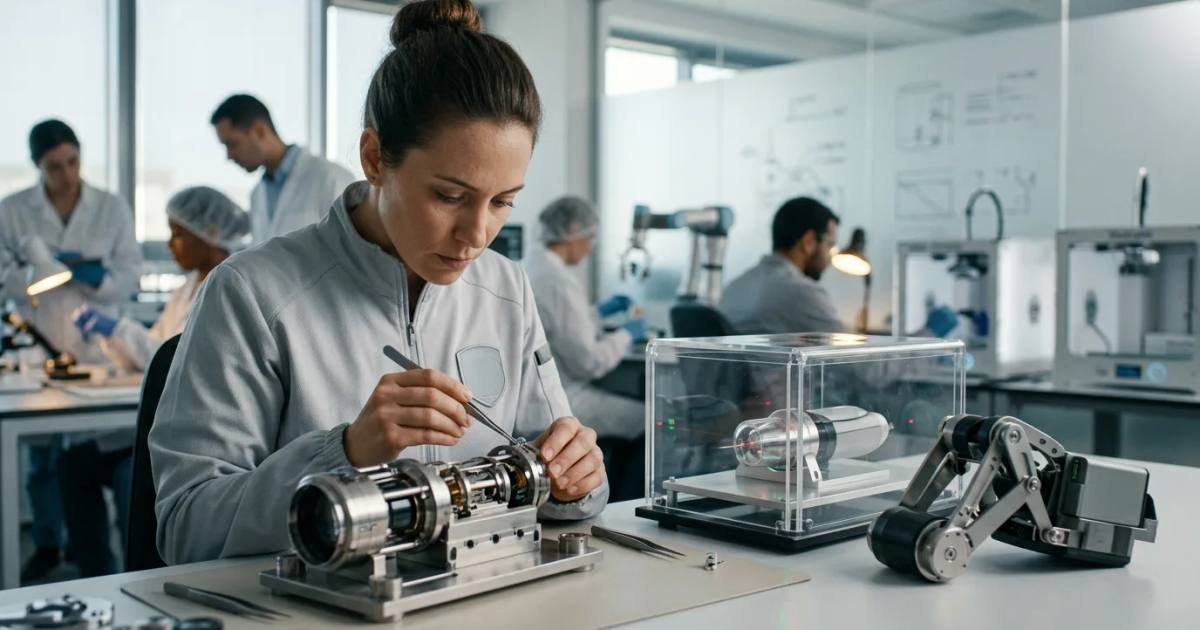

~1,500+ Israeli life-sciences companies; ~70% medical devices + digital health. Given Imaging→Medtronic 2014 $860M. Insightec, InMode (INMD), Nano-X, Magenta, ReWalk, Itamar. Defense-tech IP funnel + academic-clinical translation + exit-reinvest cycle.
Israeli Health & Biotech | Olam.business
Israel operates approximately 1,500+ companies across healthcare and life sciences — roughly 70% in medical devices and digital health — with more than 100 new medical-technology companies launching each year. The Israeli health-tech market is valued at approximately $6.2 billion. Medical devices are the export-mature layer of that market: Given Imaging (Yokneam, PillCam capsule endoscopy, acquired by Covidien-Medtronic 2014 for $860M) is the sub-sector's foundational exit; Insightec (Tirat Carmel, MR-guided focused ultrasound therapeutics for Parkinson's tremor and essential tremor); InMode (Yokneam, NASDAQ: INMD, RF aesthetics); and Nano-X (Petah Tikva, NASDAQ: NNOX, low-cost digital X-ray) anchor the current cohort. Global acquirers — Medtronic, Boston Scientific, Johnson & Johnson, GE Healthcare, Philips Healthcare, Stryker, Essilor — have collectively taken multiple Israeli medical-device companies off the market, generating the exit-and-reinvest cycle that continues to fund the next generation.
The Sector Map
| Israeli life-sciences companies (total) | ~1,500+ |
| Share in medical devices + digital health | ~70% |
| New medical-technology company formations per year | 100+ |
| Israeli healthcare technology market value | ~$6.2 billion (US ITA estimate) |
| 2024 Israeli health-tech funding (leading sectors) | Digital health $545M · Medical devices $380M · Pharma/biotech $262M |
| Landmark exit — Given Imaging (2014) | Acquired by Covidien (now Medtronic) for $860 million |
| Notable public-listed companies | InMode (INMD); Nano-X (NNOX); ReWalk Robotics; Itamar Medical (ITMR — acquired ZOLL/Asahi Kasei 2021 for $538M) |
| Notable private / late-stage private | Insightec (Exablate Neuro, MR-guided focused ultrasound); Magenta Medical (heart-failure devices, $105M 2024) |
| Historic international acquirers (partial list) | Medtronic; Boston Scientific; Johnson & Johnson; Kyphon; GE Healthcare; Essilor; Philips Healthcare; Covidien; Stryker |
| Founding-era pioneer | Given Imaging (1998; PillCam capsule endoscopy) |
| Contemporary flagship — clinical impact | Insightec (FDA-approved 2016 essential tremor; 2018 Parkinson's tremor; 50+ medical centers, 2,000+ patients treated by 2019) |
| Contemporary flagship — commercial scale | InMode (NASDAQ: INMD; $365–375M FY 2025 revenue guidance) |
The Given Imaging Foundation Story
The sector's foundational institutional case is Given Imaging. Founded 1998 in Yokneam Illit by Gavriel Meron and the Rafael Development Corporation (RDC), based on the purchase of an early patent from Rafael Advanced Defense Systems — the Israeli defense-technology company. Elron Electronic Industries provided initial funding. The product: PillCam — an ingestible imaging capsule that facilitates visualization and detection of gastrointestinal disorders.
Given Imaging received CE approval in the early 2000s and went public on NASDAQ in 2001. In 2014, Covidien acquired Given Imaging for $860 million. Covidien was subsequently acquired by Medtronic. The Given Imaging assets are now inside Medtronic's gastroenterology and hepatology division. Peak Given Imaging revenue (2011): $178 million.
The Given Imaging story is the institutional template for what the Israeli medical-device sector produces at its best: a defense-sector IP origin (Rafael); a founding partnership between technical and commercial talent; a device that solves a globally recognized clinical problem (GI disorder diagnosis); a NASDAQ listing; and a $500M+ strategic acquisition by a global medical technology company. That template is what the current cohort (Insightec, InMode, Nano-X, Magenta Medical) is attempting to replicate.
Insightec — The Focused-Ultrasound Anchor
Insightec Ltd. was founded in 1999 in Tirat Carmel by Kobi Vortman and Oded Tamir, with seed investment from Elbit Medical Imaging and GE Healthcare. The company develops and manufactures MR-guided Focused Ultrasound (MRgFUS) equipment — the Exablate Neuro platform — which uses focused ultrasound to non-invasively destroy targeted brain tissue without incisions, guided in real time by MRI. FDA approvals: 2016 for medication-refractory essential tremor; 2018 for medication-refractory tremor from Parkinson's disease. By 2019, the technology had been used in 50+ medical centers worldwide with 2,000+ patients treated. Offices in Dallas, Miami, Tokyo, and Shanghai. In 2024, Insightec raised $150 million — the largest single medical-device round of the year — as reported by Startup Nation Central.
Insightec is the current-generation Israeli medical-device flagship on clinical impact. The technology has expanded the treatable population for essential tremor and Parkinson's tremor — conditions where the prior standard of care was pharmaceutical management or invasive deep-brain stimulation. The company remains privately held; portfolio investors include aMoon Fund alongside global healthcare-focused institutional investors.
InMode — The Commercial-Scale Public Company
InMode Ltd. (NASDAQ: INMD) — covered in detail in the dedicated Olam entity page — is the largest Israeli medical-device company by public-market capitalization at the aesthetics layer. Founded 2008 in Yokneam Illit by Moshe Mizrahy and Dr. Michael Kreindel (both Syneron Medical alumni). Radiofrequency-assisted lipolysis (RFAL) and fractional RF product platforms, deployed across plastic surgery, gynecology, dermatology, and ophthalmology. Full-year 2025 revenue guidance $365–375 million. Q3 2025 GAAP gross margin 78 percent. Deployed across 15+ country distributor networks including US, Canada, UK, EU, Japan, Australia, and India.
Nano-X — The Low-Cost Imaging Bet
Nano-X Imaging Ltd. (NASDAQ: NNOX) is a Petah Tikva-based medical technology company founded in 2011. The company develops commercial-grade digital X-ray source technology intended to dramatically reduce the cost of medical imaging systems, opening access in geographies and clinical settings where conventional X-ray infrastructure is uneconomic. 197 employees. Trailing-twelve-month revenue approximately $13 million (May 2026). Investors include Khosla Ventures. The market thesis: cost-disruption at the imaging-hardware layer, opening a total addressable market that includes low-and-middle-income countries where traditional radiology is inaccessible.
The Broader Cohort
ReWalk Robotics — the wearable robotic exoskeleton enabling people with severe spinal-cord injuries to move independently and climb stairs. Founded 2001; IPO'd NASDAQ 2014; sold exoskeletons to the US Veterans Administration for combat veterans. Itamar Medical (prior ITMR) — sleep apnea diagnostic and cardiovascular device company, acquired by ZOLL Medical (Asahi Kasei subsidiary) in 2021 for $538 million. Magenta Medical — minimally invasive heart-failure treatments; raised $105 million in 2024. Bluewind Medical, Emedgene, Envizion Medical, Sight Diagnostics, Zebra Medical Vision, OrCam, XACT Robotics, CollPlant, Microbot Medical, Neteera — the current pipeline generation covering neuromodulation, precision-medicine bioinformatics, ventilation, hematology imaging, assistive vision, robotic surgical needle steering, regenerative medicine bioprinting, endoluminal robotics, and remote-patient sensing.
Structural Position
The Israeli medical-device sector has three structural advantages that produce the exit-density observed across the past two decades:
First — the defense-tech IP funnel. Rafael Advanced Defense Systems, Israel Aerospace Industries, Elbit Systems, and adjacent defense entities generate imaging, signal-processing, sensor, and materials-science IP that migrates commercially into the medical-device sector. Given Imaging's original patent came out of Rafael; Insightec's early institutional investment came from Elbit Medical Imaging.
Second — the academic-clinical translation infrastructure. The five Israeli academic medical centers (Sheba, Hadassah, Ichilov, Rambam, Soroka), the Technion Faculty of Medicine, the Weizmann Institute's Yeda tech-transfer subsidiary, Hebrew University, and Tel Aviv University together produce the clinical-research base and translational pipeline that supports medical-device development and validation.
Third — the exit-and-reinvest cycle. Every generation of Israeli medical-device exits (Given Imaging 2014; Itamar Medical 2021; and the growing cohort of $100M-$1B strategic acquisitions) recirculates capital and operating talent into the next generation of companies. The result: a sustained, self-reinforcing pipeline of new medical-device startups (100+ per year) anchored by a mature exit ecosystem.
Why This Cluster Matters
Three reasons. First — the exit density. Israel produces $500M-$1B+ medical-device strategic exits at a rate that no other national medical-device sector outside the United States has matched over the past two decades. Second — the multiple technology anchors. Unlike a single-modality sector (aesthetics only, or diagnostics only), the Israeli medical-device sector operates across capsule endoscopy, focused ultrasound, RF aesthetics, digital X-ray, cardiac devices, exoskeletons, neuromodulation, assistive robotics, and adjacent categories. Third — the compounding case. The Given Imaging institutional model — defense-tech IP origin, NASDAQ listing, $500M+ strategic exit — is now being replicated across the current-generation cohort, with Insightec and Magenta Medical as the leading candidates for the next headline exit.
FAQ
How many Israeli medical-device companies are there?
Israel operates approximately 1,500+ life-sciences companies overall, with roughly 70% concentrated in medical devices and digital health. More than 100 new medical-technology companies launch each year.
What was the largest Israeli medical-device exit?
Given Imaging — the Yokneam-based capsule-endoscopy company (PillCam) — was acquired by Covidien (subsequently Medtronic) in 2014 for $860 million. It remains the foundational institutional case for the Israeli medical-device sector's global-exit template.
Which Israeli medical-device companies are currently the largest?
By public-market capitalization at the aesthetics layer: InMode (NASDAQ: INMD; $365–375M FY 2025 revenue guidance). By clinical impact: Insightec (Exablate Neuro MR-guided focused ultrasound; FDA-approved for essential tremor and Parkinson's tremor; treating 2,000+ patients across 50+ medical centers). By imaging-cost-disruption thesis: Nano-X (NASDAQ: NNOX).
Who are the leading acquirers of Israeli medical-device companies?
Medtronic, Boston Scientific, Johnson & Johnson, Kyphon, GE Healthcare, Essilor, Philips Healthcare, Covidien (now Medtronic), and Stryker have each acquired at least one Israeli medical-device company — in some cases several.
What funding did Israeli medical devices raise in 2024?
Approximately $380 million across the medical-device layer, with the largest single round being Insightec's $150 million. Digital health raised $545 million; pharma and biotech raised $262 million.
Related Olam Coverage
- Israeli Health & Biotech — Olam's pillar coverage of the Israeli health and biotech sector
- The Israeli Hospital Innovation Engine
- InMode: The Yokneam-Based RF-Aesthetics Platform
- Compugen: The Holon-Based Predictive Drug-Discovery Company
- Pluri: The Haifa Cell-Therapy Company
- Post-October 7 Medical Innovation Environment
- Weizmann Institute of Science
- aMoon Fund: Marius Nacht's $1B+ Israeli Healthtech Venture Platform
- Teva Pharmaceutical Industries
The Olam Editorial Team