The Israeli Diamond Exchange: How Ramat Gan Became the World's Largest Diamond Bourse Complex
Four interconnected towers. A 1,000-person trading floor. At its peak, roughly half the world's diamonds passed through a square mile in Ramat Gan. The industrial history of the most concentrated trade compound in global commerce — and what it feels like to walk through it now.
The Olam · Diamonds & the Bourse
Four interconnected towers. A 1,000-person trading floor. At its peak, roughly half the world's diamonds passed through a square mile in Ramat Gan. The industrial history of the most concentrated trade compound in global commerce — and what it feels like to walk through it now.
Step out of the Tel Aviv Savidor railway station, cross the pedestrian bridge to Jabotinsky Street, and the compound rises in front of you: four office towers, joined by enclosed bridges three and four stories up, fenced at street level, ringed by armed guards in dark uniforms. There is no signage announcing what the buildings contain. The address — 1 Jabotinsky Street, Ramat Gan — is unremarkable. Inside is the Israel Diamond Exchange: the most concentrated commercial trading compound on earth.
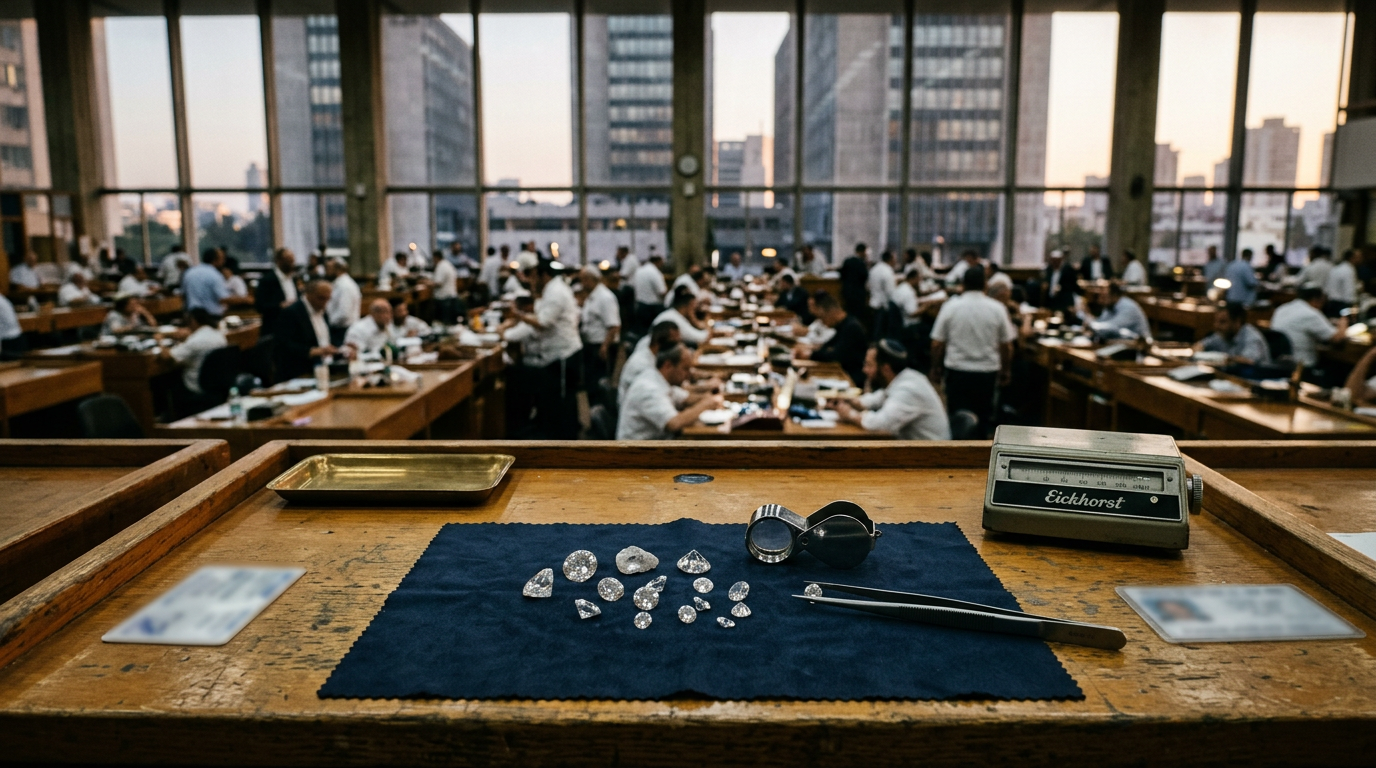
On a normal weekday at the Diamond Tower's trading floor, the air smells faintly of metal polish and coffee. The hall accommodates a thousand seats — small leather-topped tables arranged in long rows, fluorescent strip lighting overhead, daylight filtering through the security-tinted windows. Diamantaires (diamond dealers) sit across from one another with small leather wallets, white paper parcel papers folded into precise rectangles, magnifying loupes around their necks. Most wear dark suits. Many wear kippot. The trading language is a rotating mix of Hebrew, Yiddish, English, Gujarati, and increasingly Mandarin and Arabic. A deal is closed not by signature but by the Hebrew handshake formula mazal u'bracha — "luck and blessing." The handshake is the contract.
At its peak in the late 1990s and 2000s, the trading floor was full. Today, a visitor at midday will find perhaps a third of the seats occupied. The corridors of Shimshon Building, the oldest of the four towers, contain shuttered offices alongside the active ones. The cafés are quieter. The trade continues. The volumes do not.
Mandate origins
The Israeli diamond industry was born in 1937, eleven years before the state. Two cousins, Asher Anshel Daskal and Zvi Rosenberg — Romanian-born, Antwerp-trained — opened the first commercial diamond cutting facility in Petach Tikva, exploiting a British Mandate policy that exempted imported rough from customs duty. The trade was small and improvisational, built around émigré Belgian and Dutch cutters who had begun arriving as Antwerp's safety eroded through the 1930s. The German invasion of the Low Countries in 1940 accelerated the migration. Antwerp's Jewish diamond infrastructure, which had been the global center of the polished trade for three centuries, was uprooted in a matter of months. Some of it landed in New York. A meaningful share landed in Mandatory Palestine.
By the time the state was declared in 1948, Israel had a working cutting industry. By 1956, when the World Federation of Diamond Bourses (WFDB) chose Israel as the venue for its International Congress, the trade had attained international standing without yet having a permanent home.
The compound takes shape
The Shimshon Building, the first official home of the Israel Diamond Exchange, opened in Ramat Gan in October 1968 — fifteen thousand square meters of office and trading space on a 3.5-dunam plot acquired in 1961 from then-mayor Abraham Krinitzi, who had pulled the project away from a hostile Tel Aviv municipality. Shimshon set the template: dense vertical office floors stacked over a central trading hall, a closed-circuit security perimeter, and integrated services — banks, post, customs, restaurants, a synagogue — that allowed traders to spend an entire day inside the building without crossing public streets carrying merchandise.
The Maccabi and Noam buildings were added in subsequent years. In 1992, the Diamond Tower, designed by Eli Gvirtzman, was completed at 115 meters and 32 floors. Its first twenty floors are reserved exclusively for diamantaires, with the central trading floor accommodating up to a thousand. Internal bridges connect all four towers into a single enclosed compound — described, accurately, as the largest secured diamond trading complex in the world. Until the Sheraton City Tower surpassed it in 2000, the Diamond Tower was the tallest building in Ramat Gan and the tallest in Israel outside Tel Aviv proper.
Today the bridges between buildings remain busy but lighter. Security still requires badge swipes and metal detectors at every entry. A handful of designated visitor escorts walk approved guests through the corridors. The compound was designed for fifteen thousand workers across fifteen hundred firms; the workforce has thinned, but the architecture of the place remains exactly as the founders left it.
The Schnitzer era
The transformative period for the IDE was the long presidency of Moshe Schnitzer, who led the Exchange from 1967 to 1993 and served two terms as president of the WFDB. Under Schnitzer, Israeli polished diamond exports rose from $200 million annually to $3.4 billion — a seventeen-fold expansion in real terms. Schnitzer codified the institutional architecture of the bourse: the internal arbitration system, the membership rules, the closed-floor norms, and the trust-based credit mechanisms that allowed Israeli dealers to extend goods on memo across the world.
By the 1990s, Israel had displaced Antwerp as the world's largest cutting center for medium-to-large polished stones. At its peak, the trade employed tens of thousands across cutting, polishing, sorting, certification, and finance. Roughly 40 to 50 percent of the world's diamonds — by various estimates — passed through the Ramat Gan complex at some point in the value chain.
What the compound contains
The IDE is not only a trading floor. It is a self-contained institutional ecosystem. Inside the four-tower perimeter sit the Diamond Exchange's own clearing infrastructure; dedicated branches of Bank Discount, Bank Leumi, and Bank Hapoalim; private customs offices for rough and polished imports; the Diamond Controller's office; on-site security; package shipping desks; insurance brokers; certification labs; the Diamond Exchange Synagogue; restaurants observing both kashrut and the trade-clock rhythms of the bourse; and — at the center of it — the closed Bourse Hall itself, accessible only to members.
Adjacent to the main exchange sits the smaller Israel Precious Stones and Diamonds Exchange — 250 members, a 400-square-meter trading hall on the first floor of the Maccabi Building, specializing in colored stones and emeralds. Membership in either bourse confers access to internal arbitration, which is closed to outsiders and binding under WFDB rules. Disputes between members are not litigated in civil court; they are resolved internally, often without paper, and breaches of internal rulings carry the heaviest enforcement mechanism the trade has — expulsion from the bourse, which functions as commercial death.
Walk the trading floor on a quiet afternoon and the silence is striking. There is no shouting, no public price board, no electronic ticker. Two dealers lean together at a table; one slides a parcel paper across; the other unfolds it carefully, takes a loupe, examines a single stone for ten or fifteen seconds, and returns it. A nod or a head-shake. The handshake. The whole transaction has happened in under two minutes, and a million dollars in inventory may have just changed hands.
The rough sourcing axis
The IDE's role in the global rough trade has historically been twofold. First, it served as a primary destination for De Beers' Central Selling Organisation (CSO) sights — the controlled allocations through which the cartel directed rough to a select list of "sightholders." Israeli firms held some of the largest CSO allocations outside Antwerp and New York. Second, when the CSO architecture began to dissolve in the 2000s, the IDE became a hub for direct sourcing from producer countries — Russia (Alrosa), Botswana (Debswana), Namibia (Namdeb), and to a lesser extent Angola (Endiama) — through both established sightholders and a new generation of independent buyers.
The rough trade has contracted sharply. Net rough imports to Israel in 2024 fell 13 percent to roughly $800 million; net rough exports fell 24 percent to about $630 million. Bank financing for the Israeli diamond industry sat at $508 million utilized in 2024 — a historic low, 77 percent below the 2008 peak of $2.24 billion.
Where the capital went
Diamond capital does not disappear when the trade contracts. It rotates. Israeli diamantaire wealth accumulated in the 1970s and 1980s — much of it inside private companies that never publicly disclosed — has, over the last twenty years, migrated visibly into Tel Aviv commercial real estate, into London and New York residential property, into single-family offices investing across Israeli tech and global private equity, and into adjacent industries: gold, colored stones, and increasingly the certification and software businesses (see Sarine and Tracr) that now sit at the high-margin end of the trade.
Several of the older diamond families have reorganized into formal family offices, deploying patient capital across venture funds, hospitality, and infrastructure. The diamond inventory of 1990 became the Tel Aviv office building of 2010 became the venture fund stake of 2020. The bourse compound is still standing, but the wealth it generated has long since moved to other balance sheets.
What the trade tower means now
The compound functions. Volumes have compressed. The role it plays in the global value chain has narrowed. The bulk cutting trade has migrated to India, principally to Surat. The high-volume rough trading hub has migrated to Dubai. The mass employment base of the Israeli cutting industry — well above 15,000 at peak — is under 1,000 today.
What remains in Ramat Gan is concentrated value: large polished stones, high-end certified inventory, the certification and technology infrastructure, the financing relationships, and the institutional memory of a trade that built itself by handshake and survived by trust. The complex was designed for an era of mass throughput. It now operates as something closer to a clearing house for the high end of a global trade whose center of gravity has moved east.
The four-tower compound was never just a building. It was the institutional form taken by a refugee trade that needed a fortress, a court, a temple, and a market under one roof. Those functions still hold. The volumes will likely never return to the 2010s peak — but the architecture remains, and what the next decade requires of it is reinvention, not survival.
The Olam · Diamonds & the Bourse
A six-part series in Israeli Real Economy on the industrial history, migration, and capital rotation of the global Jewish diamond trade.
1. Sarine, Tracr, and the Tech Pivot
2. The Israeli Diamond Exchange: How Ramat Gan Became the World's Largest Diamond Bourse Complex (this article)
3. Lev Leviev and the Rise and Fall of LLD Diamonds
4. The Sutton Family and the Discreet Trade Dynasties
5. The Dubai Shift: Why the Diamond Trade Migrated to the DDE
6. Lab-Grown Diamonds and the Collapse of the Israeli Cutting Industry
Edited by Ronn Torossian, Founder and Editor of The Olam.