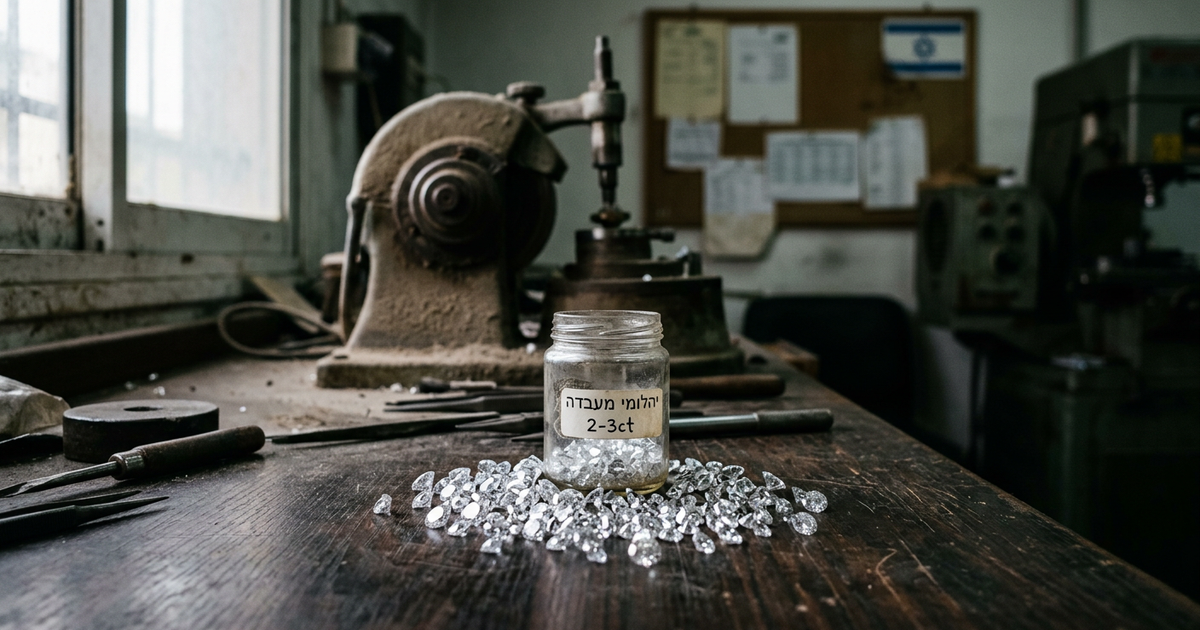

Israeli cutting employment has fallen from a 1970s peak of well above 15,000 to under 1,000 today. Lab-grown diamond prices have collapsed roughly 70 percent in five years. The shift that broke the Ramat Gan cutting industry is not cyclical. It is permanent.
Part of: The Israeli Diamond Economy
The Olam · Diamonds & the Bourse
Israeli cutting employment has fallen from a 1970s peak of well above 15,000 to under 1,000 today. Lab-grown diamond prices have collapsed roughly 70 percent in five years. The shift that broke the Ramat Gan cutting industry is not cyclical. It is permanent.
At its peak in the late 1970s, the Israeli diamond cutting industry employed roughly 20,000 cutters and an equivalent number of support workers — graders, sorters, brokers, finance staff, security, and the artisanal trades around the bourse. The country was the world's largest cutting center by value, specializing in medium-to-large polished stones above one carat.
Today, the working cutting industry in Israel numbers under 1,000. Polished diamond exports in 2024 fell 35.6 percent year-over-year to roughly $1.8 billion. Net rough imports fell 13 percent to $800 million. Bank financing for the industry hit a historic low of $508 million utilized in 2024 — 77 percent below the 2008 peak of $2.24 billion. The Israel Diamond Exchange is losing members. The International Diamond Week, the industry's flagship Israeli event, was cancelled in 2023 amid the war.
The collapse is not a single shock. It is two industrial shifts running in sequence, and a third — geopolitical — accelerating both.
Phase one: India
The first displacement, running from roughly 1990 to 2015, was geographic. The Indian diamond cutting industry — concentrated in Surat, Gujarat — undercut Israeli cutting wages by a factor of ten or more. By the early 2010s, Surat employed roughly 800,000 to 1,000,000 cutters, polished approximately 90 percent of the world's diamonds by volume, and had absorbed essentially the entire mass-market cutting trade. Israeli, Belgian, and New York cutting operations responded by moving upmarket — specializing in larger, higher-value stones where Indian operations were less competitive due to the skill premium required for premium cuts and the higher per-stone capital at risk.
This adaptation worked, partially, until the second shift arrived.
Phase two: lab-grown
Synthetic diamonds — diamonds chemically and physically identical to mined stones, produced in laboratory conditions through either Chemical Vapor Deposition (CVD) or High Pressure High Temperature (HPHT) processes — have existed industrially since the 1950s for cutting tools and abrasives. Gem-quality lab-grown diamonds suitable for jewelry emerged commercially around 2010 and reached scale around 2018. By 2020, lab-grown was a meaningful share of US engagement ring sales. By 2024, lab-grown diamonds were projected to claim over 40 percent of the US bridal market.
The price collapse has been brutal. In 2020, the average lab-grown diamond sold in the US weighed approximately 1.2 carats and retailed for roughly $3,887. By 2024, the average lab-grown diamond weighed 1.9 carats — 60 percent larger — and sold at a price approximately 30 percent lower than the 2020 figure. On a per-carat basis, lab-grown prices have fallen roughly 70 percent in five years, driven by Chinese manufacturing capacity that now produces synthetic diamonds at industrial scale and price points.
The implication for natural diamond economics is severe. The premium that the entire mined diamond industry — De Beers, Alrosa, the Antwerp and Israeli cutting trades, the wholesale dynasties on 47th Street, and the retail jewelry industry — extracted for over a century was a scarcity premium. The diamond was rare. The retail price was justified by that rarity. Lab-grown diamonds are not rare. They are manufactured. They are visually, chemically, and physically identical to mined stones except under specialized testing. And they cost a fraction of the mined equivalent. The brand-and-reputation side of this same collapse — how De Beers tried and failed to control the narrative with its Lightbox brand — is covered on Everything-PR in Lab-Grown Diamond Reputation Wars and Shine Strategically: How De Beers Reimagined Diamond Desire.
The natural diamond industry has responded by attempting to brand its product as something other than the stone itself — emphasizing provenance, romance, heritage, and ethical sourcing. The marketing has had mixed effect. Among younger US consumers, the response has been simple: they want the larger stone at the lower price. The 2024 average natural one-carat round diamond price was approximately $4,875, down 12.34 percent year-over-year. Rapaport projected a potential 20 percent decline in natural diamond demand and revenue for 2024.
Why Israel was uniquely exposed
Israel's cutting industry, having retreated upmarket in response to Indian competition, was concentrated in exactly the segment where lab-grown displacement is sharpest: the one-to-three-carat bridal and engagement category. The Indian cutting trade, working at lower-margin volumes, was less affected per-stone but more affected at scale. The Israeli trade, at higher per-stone margins, has been hit harder per cutter.
Cutting wages in Israel — historically among the highest in the global industry, with experienced master cutters earning premium incomes — could not be defended against either Indian labor costs or the collapse in mid-tier demand. The cutting workforce has aged out; younger Israelis have not entered the trade. The Ministry of Economy's Dual-Use Diamond and Export Control Administration reported a 35 percent decline in the polished diamond trade and nearly 25 percent decline in the rough trade in 2024 alone.
Phase three: geopolitics
The October 7, 2023 attack and the subsequent Gaza war added a third shock. Buyers stopped traveling to Israel. The International Diamond Week was cancelled. Polished exports collapsed: $11.7 million net in December 2023, down 93 percent year-over-year. The trend has improved since but has not recovered to pre-October-7 levels. International boycott campaigns targeting Israel — including efforts to label Israeli-cut diamonds as ethically compromised — have had measurable effect among younger consumers in Western markets.
G7 sanctions on Russian-origin diamonds, implemented in 2024 following the Russian invasion of Ukraine, complicated the Israeli rough trade further, as Israeli firms had been significant participants in the Alrosa supply chain. The certification burden for non-Russian provenance fell heavily on Israeli traders — and created the regulatory demand that the Sarine–Tracr traceability stack now serves.
What the financing data shows
Bank financing tells the industrial story. Diamond industry financing in Israel peaked at $2.24 billion in 2008. It has declined every year since. The 2024 figure of $508 million utilized represents a decade-long, monotonic contraction. The Bank of Israel's data shows financing utilization rates of 60–62 percent — meaning credit is contracting alongside demand, not constraining it. Global diamond financing has followed the same trajectory: roughly $6 billion globally in 2023, down from $16 billion in 2013.
Capital is voting. The industry is no longer attracting incremental credit. Lenders, looking at the lab-grown displacement, the demographic shift in bridal preferences, the geopolitical risk premium on Israeli inventory, and the migration of bulk trading to Dubai, have rationally reduced their exposure.
Where the capital went
Diamond capital exiting the Israeli cutting industry has not disappeared. It has rotated. The visible directions:
Into real estate — Tel Aviv commercial property, residential holdings in central Israel, and increasingly Israeli-owned property in New York, London, and Lisbon. Diamantaire wealth has been a meaningful but under-discussed driver of high-end Tel Aviv property values for two decades.
Into family offices — multi-generational diamond fortunes have been formalized into single-family office structures that deploy across venture capital, private equity, and infrastructure. The cutters' inheritances are now in OurCrowd, Pitango, Aleph and equivalent funds, not in polishing wheels.
Into colored stones and adjacent commodities — gold, emeralds, sapphires, the Lev Leviev pivot into Zambian emeralds being the visible institutional example. Several mid-sized Israeli diamond firms have similarly diversified into colored stone trading and emerald cutting.
Into the technology and certification layer — Sarine itself, the broader Israeli diamond-tech ecosystem, and adjacent computer-vision ventures backed by former diamantaires.
The trade contracted; the capital base around it has been reorganized and re-deployed. The bourse compound in Ramat Gan houses a smaller industry than it did. The wealth that the industry generated is largely intact, just held in different vehicles, in different addresses.
What survives
The trade in large, certified, premium-grade natural stones continues. The demand for three-plus-carat D-flawless or fancy-color diamonds, and for important historical stones, has not collapsed and shows limited substitution risk to lab-grown. The Israeli technology layer — Sarine, the certification infrastructure, the blockchain provenance integrations with Tracr — continues to scale.
But the mass employment base of the Israeli cutting industry is gone. The 1970s era of 20,000 cutters working in Ramat Gan workshops is not coming back. The shape of the trade has shifted away from cutting labor and toward information, certification, and high-end inventory.
The lesson
The Israeli diamond cutting industry's collapse is the textbook case of a high-value-added export sector eroding under simultaneous pressure from cheaper labor (India), substitute technology (lab-grown), and geopolitical disruption (war and sanctions). Each shock alone might have been survivable. The three in combination — running from roughly 2010 to 2024 — were not.
The strategic question for Israel is not how to revive the cutting industry. That industry, in its mass-employment form, is finished. The question is how to translate the remaining institutional infrastructure — the bourse, the financing relationships, the certification ecosystem, the technology stack, and the historical memory — into the next layer of value capture in a global diamond trade whose center of gravity has moved permanently to Dubai for trading and Surat for cutting.
What Israel has not lost is the information architecture of the trade. What it has lost is the labor architecture. The next generation of value will be captured, if at all, in the layer above the cutter — in software, certification, blockchain provenance, and high-end retail — and not in the workshops along Tuval Street. That layer is real and growing, but it employs hundreds, not tens of thousands. The cutting industry is over. The information industry built on its memory is just beginning. (See Part 1: Sarine, Tracr, and the Tech Pivot.)
Further reading: the brand side of the same collapse
Everything-PR covers how De Beers, Pandora, and Brilliant Earth have fought this same collapse as a public-reputation battle rather than an industrial one: Shine Strategically: How De Beers Reimagined Diamond Desire, Lab-Grown Diamond Reputation Wars, and Diamond Companies: How the Category Is Being Rebuilt.
Update, October 2026: De Beers returned to the Ramat Gan exchange for the first time in nine years. See De Beers Returns to Israel Diamond Exchange After Nine Years.
The Olam · Diamonds & the Bourse
A six-part series in Israeli Real Economy on the industrial history, migration, and capital rotation of the global Jewish diamond trade.
1. Sarine, Tracr, and the Tech Pivot
2. The Israeli Diamond Exchange: How Ramat Gan Became the World's Largest Diamond Bourse Complex
3. Lev Leviev and the Rise and Fall of LLD Diamonds
4. The Sutton Family and the Discreet Trade Dynasties
5. The Dubai Shift: Why the Diamond Trade Migrated to the DDE
6. Lab-Grown Diamonds and the Collapse of the Israeli Cutting Industry (this article)
Edited by Ronn Torossian, Founder and Editor of The Olam.
How we report: Olam stories draw on public filings, company disclosures and named sources, checked by our editors. Read our methodology · Corrections