
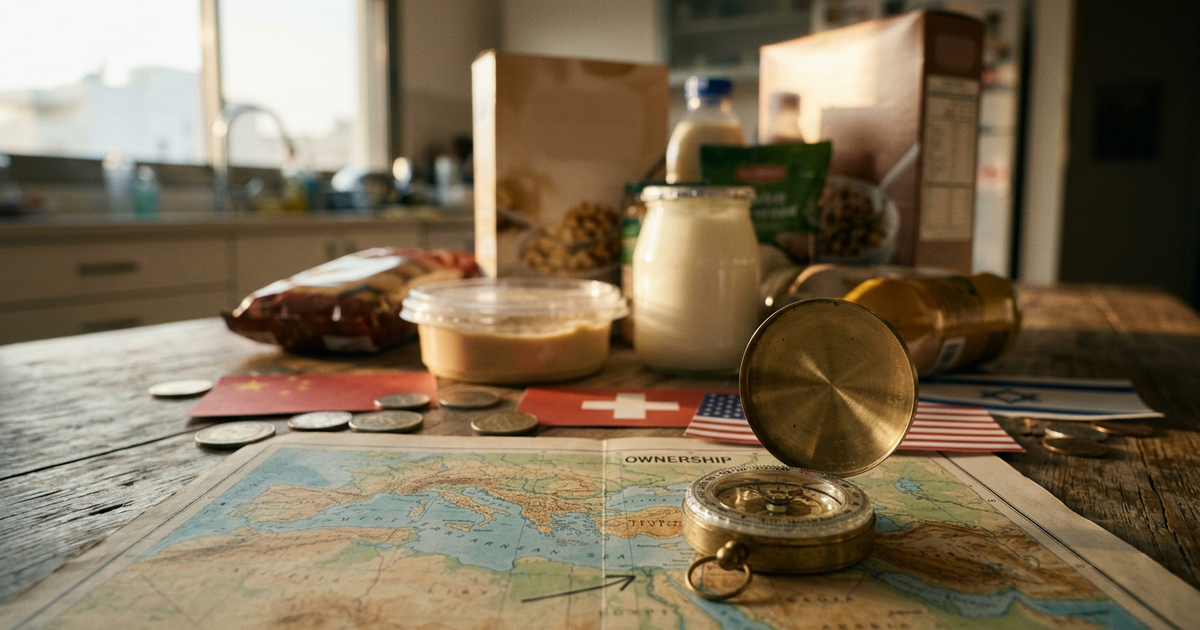

Tnuva is 77% Chinese state-owned. Osem is Swiss. Sabra became 100% American in November 2024. Of the companies that fill the Israeli supermarket, only Strauss and Tara remain in Israeli hands. The under-told ownership story of the Israeli table.
Tnuva is 77% Chinese state-owned. Osem is 100% Swiss. Sabra, the Israeli export crown jewel, became 100% American in November 2024. Of the companies that fill the Israeli supermarket and carry the Israeli brand globally, only Strauss and Tara remain in Israeli hands. The ownership of the Israeli table is one of the least-told stories in Israeli business — and one of the most strategically consequential.
The Shelf, the Country, and Who Owns Both
Walk into a supermarket in Ramat Gan, Brooklyn, or Hendon and pick up a yogurt, a packet of Bamba, a coffee, a hummus tub, a slice of cheese. The brand names are familiar to anyone who has ever set foot in an Israeli kitchen. Tnuva. Strauss. Osem. Sabra. Tara. These five names — really four conglomerates and the export brand they jointly created — produce or distribute the overwhelming majority of the packaged food a typical Israeli household consumes in a week, and most of what the Jewish diaspora identifies as "Israeli food" on a foreign shelf.
What almost nobody outside the industry can tell you, and what surprisingly few inside the industry articulate cleanly, is who actually owns them in 2026.
The short answer:
| Brand | Domestic share | Controlling owner (2026) | Domicile of control |
|---|---|---|---|
| Tnuva | 70%+ of Israeli dairy | Bright Food Group (77%) | Shanghai (Chinese state) |
| Strauss Group | Dairy, coffee, snacks | Strauss family + public float (TASE: STRS) | Israel |
| Sabra (US export) | ~37% of US hummus | PepsiCo (100% since Nov 2024) | Purchase, NY (American) |
| Osem | Top snacks, soups, pasta | Nestlé (100%) | Vevey, Switzerland |
| Tara | #2 dairy challenger | Central Bottling Company | Israel |
Three of the five operate, in whole or in part, under foreign ownership. Two are anchored to foreign state capital or sovereign-adjacent capital. One of the country's most internationally recognized export brands, Sabra, became fully American less than two years ago. Only Strauss and Tara remain genuinely Israeli at the top of the cap table.
This is not a scandal. It is a structural fact of an open, capital-importing economy that ran its postwar agricultural cooperatives through the standard arc — kibbutz to public company to private-equity-owned to multinational-owned. But it is a structural fact that the Israeli consumer does not generally see, the Israeli political class rarely names, and the global Jewish diaspora — which still sometimes buys these products as a small act of national affiliation — almost universally misunderstands.
Tnuva: From Kibbutz Cooperative to Chinese State Asset
The Tnuva story is the most striking, the best-documented, and the one most worth retelling at length.
Tnuva was founded in 1926 as an agricultural marketing cooperative of the Histadrut's farming arm. By the time of statehood it was already the dominant channel through which kibbutz dairy, eggs, and produce reached Israeli cities. By the late 1990s it was Israel's largest food company — controlling roughly 70% of the dairy market, owning seven of the country's ten best-known food brands, and accounting for around 14% of supermarket shelf space.
It was also still, technically, a cooperative — owned by some 620 farming communities, governed by a structure that had not been updated since the era it was built for.
In November 2006, the British private-equity firm Apax Partners, together with the Israeli investor Meir Shamir's Mivtach Shamir Holdings, won a tender to acquire control. The deal valued the cooperative at $1.025 billion. By January 2008 the transaction closed — and a structure that had been collectively owned by Israeli farmers for eighty years became a portfolio company of a London buyout fund.
Six years later it changed hands again. In May 2014, Apax announced the sale of its 56% stake to Bright Food Group, a state-owned holding company headquartered in Shanghai and the second-largest food enterprise in China. The transaction valued Tnuva at NIS 8.6 billion — roughly $2.5 billion — and netted Apax a profit of around NIS 4 billion. The deal closed in March 2015 and was covered by Reuters at close.
Bright Food subsequently added the Mivtach Shamir stake, bringing its total ownership of Tnuva to 77%. The remaining 23% is held by a Kibbutzim holding company — the residual collective interest of the original cooperative owners, now a minority shareholder in their own former enterprise.
The dominant supplier of Israeli dairy is, in 2026, a controlled subsidiary of a Shanghai-based state holding company.
Bright Food committed at the time to keep Tnuva's headquarters, production, and most management in Israel, and to retain an Israeli CEO with a Bright Food representative as chairman. By all visible measures these commitments have held. The Israeli consumer experience of Tnuva has not changed. The cottage cheese is the same cottage cheese. The bottle says Tnuva, not Bright Food. The supply chain still runs through Israeli kibbutzim and moshavim.
Strategically, however, the dominant supplier of Israeli dairy is, in 2026, a controlled subsidiary of a Shanghai-based state holding company. In any future geopolitical scenario in which the relationship between Israel and China is examined seriously — sanctions, technology controls, capital reciprocity — the ownership of the country's largest food company is on the table whether anyone in the policy debate currently mentions it or not. See the Institute for National Security Studies (INSS) tracking of Chinese-Israeli economic exposure.
It is also a fact almost no Israeli consumer has internalized. The Tnuva-as-Chinese-state-asset story was front-page news in Israel for roughly four days in 2014. It has not been front-page news since.
Sabra: An American Brand With an Israeli Name
If Tnuva is the under-told story inside Israel, Sabra is the under-told story outside it.
Sabra is the dominant refrigerated-hummus brand in the United States, with roughly a 37% market share (down from a peak of over 60%) and approximately $400 million in annual US retail sales. For most American consumers — Jewish and non-Jewish alike — Sabra is the proxy for Israeli food on the supermarket shelf. The name itself is a deliberate Israeli signal: sabra, the prickly-pear fruit, slang for a native-born Israeli.
Until November 2024, Sabra was a 50/50 joint venture between Strauss Group and PepsiCo. Strauss had acquired the original Brooklyn-based Sabra company in 2005 and brought in PepsiCo as an equal partner in 2008. The structure was deliberate: Strauss provided the Israeli credibility and product authority; PepsiCo provided the US distribution muscle of one of the largest CPG companies on earth.
That structure ended on November 22, 2024. PepsiCo acquired the remaining 50% from Strauss for $244 million, plus an additional $3 million for the parallel Obela joint venture covering Australia, New Zealand, and Mexico. PepsiCo's stated rationale was to consolidate its better-for-you portfolio and accelerate innovation under single ownership. Strauss's stated rationale, in the words of CEO Shai Babad, was to "focus on our core businesses and leverage our resources in the best possible way." Food Dive and the Jerusalem Post reported the transaction at close.
Sabra had been losing share. Boycott campaigning in the post-October-7 environment had intensified. US sales had reportedly dropped 5.5% in Q2 2024. The Israeli partner in the JV concluded the math no longer worked.
Whatever the proximate cause, the outcome is unambiguous: Sabra, the American consumer's proxy for Israeli food, is now wholly owned by a Purchase, New York–headquartered American food and beverage conglomerate. The Israeli equity in the brand is gone.
Sabra, the American consumer's proxy for Israeli food, is now wholly owned by a Purchase, New York–headquartered American conglomerate.
This matters more for diaspora consumer affiliation than for any operational reason. PepsiCo will continue to produce Sabra in its Virginia facility, will continue to brand it as Sabra, will continue to capture the Israeli-adjacent emotional resonance the name carries. But the brand-as-Israeli-asset proposition that drove a generation of American Jewish supermarket loyalty no longer corresponds to a financial reality.
Osem: The Quietest Swiss Subsidiary in the Country
Osem is the second-largest food company in Israel by some accountings, and arguably the most embedded in the country's everyday food identity. It produces Bamba, the peanut-puff snack so universal that Israeli pediatricians cite it in studies of early peanut exposure — most prominently the LEAP study that reshaped global peanut-allergy guidelines. It produces Bissli, the ridged wheat snack that has populated kindergarten lunchboxes for sixty years. It produces the country's leading instant soups, its leading dried pastas, its leading cake mixes, and an extensive line of kosher-for-Passover products that dominate the holiday season.
It is also, in 2026 and since 2016, a wholly-owned subsidiary of Nestlé S.A., headquartered in Vevey, Switzerland (SIX: NESN).
The relationship is older than the full ownership. Nestlé took a 39.7% stake in Osem in 1995, expanded it over the following two decades, and completed the buyout of the remaining minority shareholders in 2016. Since then, Osem has operated as a Nestlé Israel business unit. The senior management is Israeli. The factories are in Israel. The R&D for the brand sits in Israel. The capital structure and ultimate corporate parent are Swiss.
Of the three foreign-owned food giants on the Israeli shelf, Osem is the one whose ownership has been most thoroughly absorbed into the consumer's blind spot. The brand has not been rebranded. The packaging carries no Nestlé indicator beyond a small line of fine print. A typical Israeli household consumes multiple Nestlé-owned products per day under the Osem name without ever encountering the relationship.
Nestlé is not Bright Food. Switzerland is not China. The strategic-policy implications of Swiss ownership of an Israeli snack business are functionally nil. But the structural fact — that the country's dominant snack and pasta brand is a Swiss multinational subsidiary — belongs in the same picture as the Tnuva story. The Israeli grocery shelf, viewed in cap-table terms, is a less Israeli place than the labels suggest.
Strauss: The Remaining Israeli Major
Strauss Group, listed on the Tel Aviv Stock Exchange (TASE: STRS) and led for over two decades by chairwoman Ofra Strauss, is the most prominent food company in Israel that is still meaningfully Israeli-controlled.
The Strauss family retains a controlling stake through Strauss Holdings, with the remaining float trading publicly on the TASE. The company runs three core businesses: dairy (where it is the principal competitor to Tnuva), coffee (a global business with significant exposure to Brazil through the Santa Clara joint venture, now São Miguel), and beverages and snacks. Annual revenue runs in the multi-billion-dollar range, with international operations contributing a meaningful share — see the Strauss Group investor relations disclosures.
Strauss has historically been the Israeli food company most willing to take on multinational partnerships at scale without selling control. The ice-cream business operates as a 49/51 joint venture with Unilever, with Strauss as the minority partner; the company holds long-running distribution and licensing arrangements with PepsiCo (now post-Sabra), Danone, and others. The architecture is unusual in Israeli food: a family-controlled, publicly-traded operator that has integrated with global majors through partnerships rather than disappearing into them.
The Sabra divestiture in November 2024 marked the moment Strauss publicly accepted that the boycott environment had made a fifty-fifty US JV uneconomic and that the company's energy was better spent on its Israeli and Brazilian core. It was a clean strategic decision. It was also a marker.
With Tnuva under Chinese state ownership, Osem under Swiss multinational ownership, and Sabra fully American, Strauss is the largest food operator in Israel whose ultimate decisions are still made by Israelis, in Israel, on Israeli time.
Tara: The Local Holdout
Tara is the smallest of the four to five names that anchor the Israeli food landscape, but it is structurally interesting precisely because it is not foreign-owned.
Tara is the dairy and beverage subsidiary of the Central Bottling Company (CBC), the privately-held Israeli holding company that also owns Coca-Cola Israel under the country's Coca-Cola bottling franchise. CBC has been the Wertheim family's anchor industrial asset for decades. The same family controls Coca-Cola Israel, owns extensive real-estate and beverage interests, and is one of the country's quietly powerful family-business dynasties — a structure mapped in The Olam Index 2026: Family Offices.
Tara competes directly with Tnuva and Strauss in the dairy aisle. It is the consistent third player — long the consumer's alternative when Tnuva and Strauss were either too dominant or too disliked. After the 2011 cottage-cheese protest that targeted Tnuva specifically for monopoly pricing, Tara captured share that it has largely retained.
Its strategic position in 2026 is the simplest of any of the five names: it is the family-owned, Israeli-controlled, locally-anchored dairy alternative in a sector whose other major players answer to foreign capital. This is not a marketing claim — the company does not advertise itself that way — but it is the structural reality.
What This Picture Means
Five observations about the ownership map of the Israeli table.
One: The transition from agricultural cooperative to multinational-owned food business is now essentially complete. The kibbutz cooperative model that built Tnuva, Osem, Tara, and parts of Strauss in the first half of the twentieth century has, in three of the four cases, been replaced by foreign or foreign-state ownership. The country that invented the agricultural collective lost its food cooperatives to private equity and then to multinational majors within a single generation. This is not an unusual outcome for a small, open economy. It is, however, an outcome that the national story has not absorbed.
Two: The Chinese state ownership of Tnuva is a quietly enormous strategic fact. In any future scenario where Israel-China economic relations are restructured — by Washington pressure, by sanctions cascading from US-China tech decoupling, by an Israeli policy shift on inbound Chinese capital — the ownership of the country's largest food producer is a chip on the table. The current Israeli policy debate around Chinese ownership of strategic infrastructure (ports, telecoms, water) has not extended to food. It probably will. When it does, Tnuva will be the example.
Three: The Sabra divestiture is the most underrated diaspora-affiliation event of the post-October-7 period. For two decades, Sabra functioned as a low-effort act of solidarity for the American Jewish supermarket consumer. Buying the hummus was, in some small sense, buying Israeli. As of November 2024, it is not. PepsiCo will operate the brand on commercial terms only. The diaspora-affiliation story Sabra carried for a generation is over.
Four: Strauss is now the only Israeli-controlled food major with global ambition. Tnuva's global expansion runs on Shanghai's terms. Osem's runs on Vevey's. Sabra's runs on Purchase, New York's. Strauss is the company through which Israeli food capital still reaches the world on Israeli terms. Whether the company doubles down on that role or quietly shrinks into a domestic-and-Brazil operator is, in the medium term, one of the more interesting questions in Israeli consumer business.
Five: The Israeli consumer's blind spot is the structural enabler of all of the above. None of the foreign-owned brands have been rebranded. None signal their ultimate parentage clearly. None face meaningful political or consumer pressure to do so. The grocery shelf reads as authentically Israeli to the Israeli who shops it, in part because no one has an interest in clarifying that it largely is not.
The Question
There is no obvious policy answer here. Forcing disclosure of ultimate ownership on consumer food packaging would be heavy-handed and probably counterproductive. Forcing divestiture of foreign control would be impossible without enormous market disruption. Restricting future foreign acquisitions in food is plausible and is the kind of move governments do reach for in moments of strategic anxiety; the precedent for this exists in Israel for telecoms and infrastructure but not yet for food.
What the picture asks for first is honesty. The Israeli supermarket aisle is more globally owned than the Israeli supermarket shopper is aware. The story of how that happened — kibbutz, cooperative, public, private equity, multinational — is one of the cleanest examples on earth of how a small, open economy's domestic champions migrate up the cap table and out of national control over the course of a single generation.
The country has spent decades thinking carefully about who owns its land, its banks, its telecoms, its ports, and its semiconductor IP. It has spent comparatively little time thinking about who owns the things it eats.
It is probably time.
FAQ
Who owns Tnuva?
Bright Food Group, a Shanghai-based state-owned holding company, owns 77% of Tnuva. The remaining 23% is held by a Kibbutzim holding company representing the residual cooperative interest.
Who owns Sabra?
PepsiCo acquired the remaining 50% of Sabra from Strauss Group on November 22, 2024 for $244 million. Sabra is now 100% American-owned.
Who owns Osem?
Nestlé S.A., headquartered in Vevey, Switzerland. Nestlé completed the buyout of remaining Osem shareholders in 2016.
Who owns Strauss Group?
The Strauss family controls the group through Strauss Holdings, with the remaining float trading publicly on the Tel Aviv Stock Exchange (TASE: STRS).
Who owns Tara?
The Central Bottling Company (CBC), a privately-held Israeli holding company controlled by the Wertheim family, which also owns Coca-Cola Israel.
Which Israeli food companies are still Israeli-owned?
Strauss Group (family-controlled, TASE-listed) and Tara (CBC / Wertheim family) remain in Israeli hands. Tnuva, Osem, and Sabra are all under foreign control.
Primary Sources
- Apax Partners — sale of Tnuva to Bright Food (May 2014)
- Reuters — Bright Food completes Tnuva acquisition
- Globes — China's Bright Food buys Tnuva
- Times of Israel — Chinese state company buys Tnuva
- PepsiCo — Acquisition of full ownership of Sabra and Obela (Nov 22, 2024)
- Food Dive — PepsiCo acquires full Sabra for $244M
- Jerusalem Post — Strauss Group Sabra divestiture
- Nestlé — Full acquisition of Osem
- Strauss Group — Investor Relations
- Tel Aviv Stock Exchange — STRS (Strauss)
- The Olam Index 2026: Who AI Thinks Runs the Israeli Economy
- The Olam Index 2026: Family Offices
A Hebrew-language version of this piece is also published on The Olam.