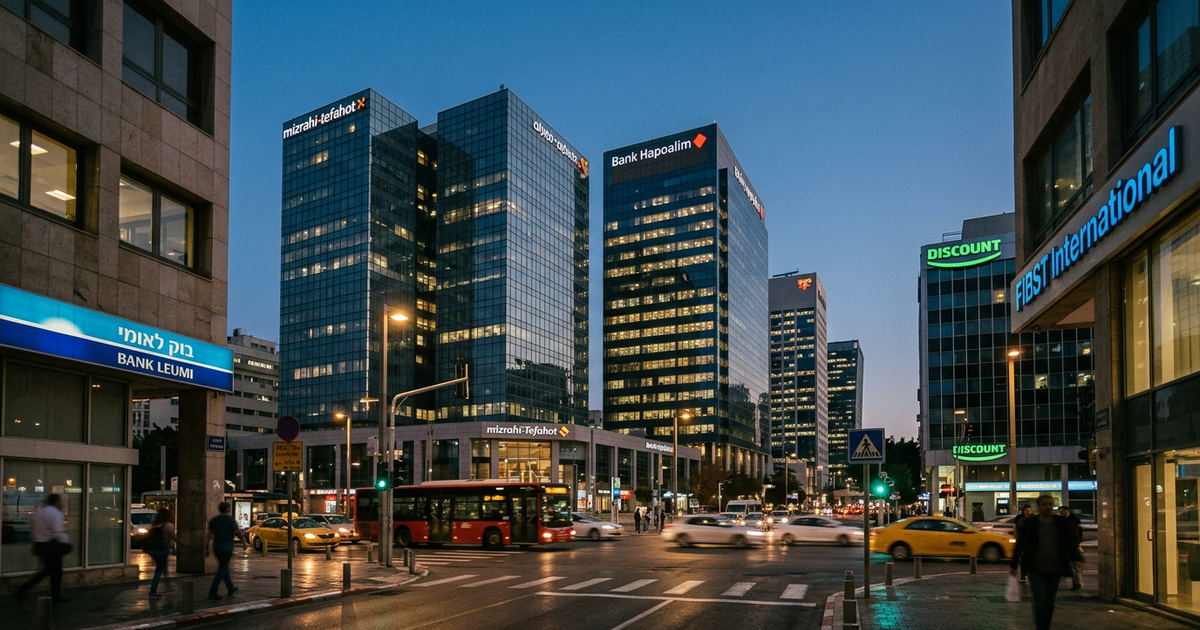

Leumi, Hapoalim, Mizrahi-Tefahot, Discount, and FIBI dominate Israel's banking system. These five banks hold distinct institutional positions and market concentration.
Five banks dominate the Israeli banking system: Bank Leumi, Bank Hapoalim, Mizrahi-Tefahot, Israel Discount Bank, and First International Bank of Israel (FIBI). Together they hold the overwhelming majority of household and commercial banking assets in Israel. Each has a distinct institutional position, customer base, and operational specialization.
For institutional capital flows, household banking, commercial credit, and the broader Israeli financial-services architecture, the five-bank structure is the operative framework. The market is concentrated. The institutional positioning differs by bank in ways that matter for understanding how capital actually moves through the Israeli economy.
Bank Leumi Le-Israel
Bank Leumi is one of the two largest banks in Israel by total assets, founded in 1902 as the Anglo-Palestine Bank. The bank's institutional history makes it the oldest continuously-operating Israeli financial institution.
Operational footprint. Comprehensive household and commercial banking across Israel. Large international correspondent banking network. Substantial commercial credit capability across mid-cap and large-cap Israeli corporates. Active private banking division.
Strategic positioning. Leumi has historically operated as a more institutional and corporate-positioned bank than Hapoalim, with strong relationships across the Israeli industrial economy.
Bank Hapoalim
Bank Hapoalim is the other of the two largest Israeli banks, founded in 1921 by the Histadrut labor federation. The bank's institutional history has been shaped by its founding as a labor-movement institution and its subsequent evolution into a standard commercial bank.
Operational footprint. Comprehensive household and commercial banking. Large national branch network. Substantial commercial credit capability. Active private banking division.
Strategic positioning. Hapoalim has historically operated with broader retail-and-household orientation than Leumi, alongside substantial commercial capability.
Mizrahi-Tefahot Bank
Mizrahi-Tefahot was created through the 2005 merger of Bank Mizrahi and Tefahot Bank. The bank's institutional history reflects the merger origin — Bank Mizrahi as a Sephardic-immigrant-population-anchored institution from the early state period, and Tefahot as the major Israeli mortgage bank.
Operational footprint. Dominant position in Israeli residential mortgage lending. Substantial branch network including specialized footprint in Jerusalem, Bnei Brak, and the broader Religious Zionist and Haredi-population centers. Growing commercial banking activity.
Strategic positioning. Mizrahi-Tefahot's mortgage-lending dominance and its specific community-cohort relationships differentiate the bank from Leumi and Hapoalim in ways that matter operationally for specific customer segments.
Israel Discount Bank
Israel Discount Bank was founded in 1935. The bank operates one of the larger Israeli international banking footprints, including IDB New York — the US-resident commercial banking subsidiary that anchors the bank's US-Israel cross-border activity.
Operational footprint. Comprehensive household and commercial banking in Israel. Substantial international footprint including IDB New York and additional international subsidiaries. Active private banking franchise.
Strategic positioning. Discount's distinctive operational asset is the IDB New York subsidiary — providing US-dollar banking, US-resident commercial services, and a structural bridge between US-based principals and Israeli banking that competitors do not match at the same depth.
First International Bank of Israel (FIBI)
FIBI is the smallest of the five major banks but operates a distinctive position with substantial private banking and high-net-worth client franchise, alongside ownership stakes in several smaller specialized Israeli banks.
Operational footprint. Smaller branch network than the four larger banks. Substantial private banking activity. Ownership of Bank Otsar Ha-Hayal, Bank Massad, and other specialized Israeli banking institutions through the FIBI Group structure.
Strategic positioning. FIBI's positioning is more concentrated in private banking, premium client services, and specialized lending than the broader retail-and-household models of the four larger banks.
The market concentration and regulatory environment
The Israeli banking system's concentration in five major institutions has been a recurring policy concern. The Bank of Israel and the broader Israeli regulatory architecture have periodically introduced measures to expand banking competition — including credit-data sharing, digital banking licenses (including the One Zero Digital Bank), and broader market-structure interventions.
The five-bank concentration persists. Digital banking entrants have not yet meaningfully shifted the market structure. The cooperative regulatory environment, the bank-customer-relationship persistence, and the structural costs of new-bank entry have together preserved the existing competitive landscape.
The 2026 institutional positioning
Going into 2026, the Israeli banking system is operating in a relatively stable institutional environment. Post-October 7 risk premium expansion through 2024 compressed bank credit costs and shifted commercial-credit dynamics, but the system remained well-capitalized. The 2025-2026 environment has seen partial normalization.
For inbound principals — the oleh and toshav chozer cohort, international Jewish family offices, US-resident principals with Israeli banking activity — the five-bank structure provides the institutional architecture through which capital actually moves between the diaspora and Israel. The specific bank selection follows the operational requirements covered above and in the broader Israeli banking-layer analysis.
How we report: Olam stories draw on public filings, company disclosures and named sources, checked by our editors. Read our methodology · Corrections