Fifteen strong residential markets on Israel's coastal corridor each have a flagship building. These buildings anchor the price floor for their neighborhoods.
From Florentin in the south to Caesarea in the north, every strong residential market on Israel's coastal corridor has a flagship — a building, a tower, a preserved compound, a villa enclave — that sets the price floor and pulls the surrounding stock with it. Fifteen markets, the buildings that anchor them, and what trades in their gravity.
The frame
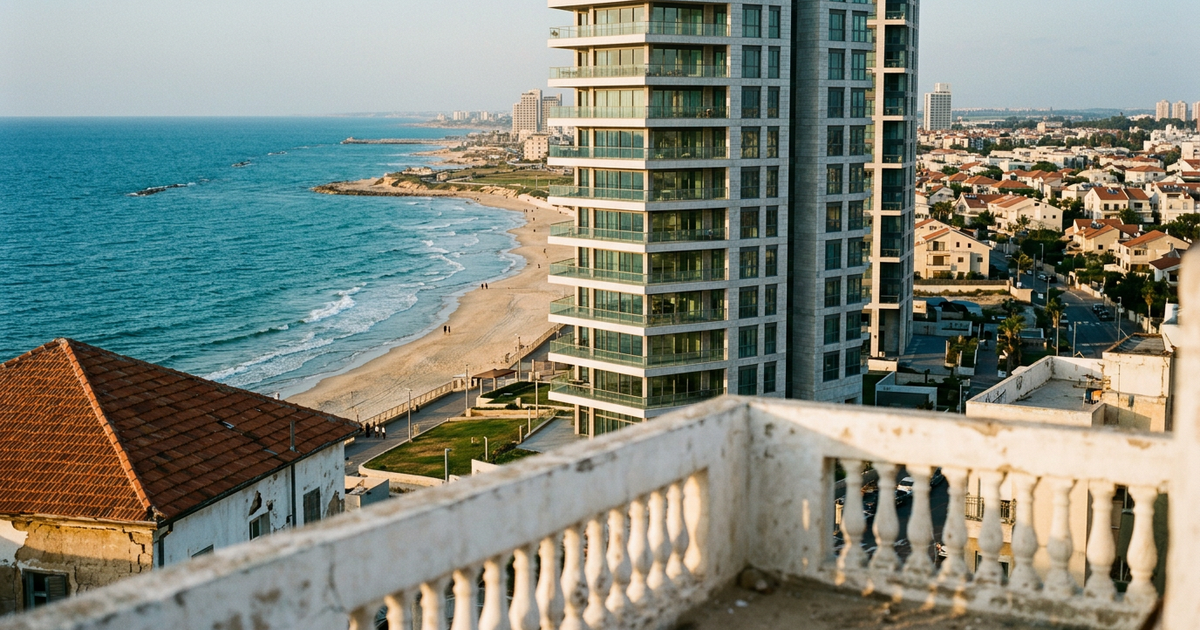
The coastal corridor from Jaffa to Caesarea — roughly forty-five kilometers of beach, port, and dune — contains every meaningful residential market in Israel for the foreign-owner buyer pool. Tel Aviv proper is the dense core: 52 square kilometers, around 470,000 residents, and a price-per-meter range that varies by a factor of three between the southern and northern edges. North of the Yarkon River, the city continues into the established wealth belt of Tzahala, Afeka, and Neve Avivim. North of that, the corridor opens into Herzliya Pituach, Kfar Shmaryahu, Ra'anana, and ultimately Caesarea — the single-family-villa Israel that diaspora UHNW has held for two generations.
Holding that spread together is a network of flagship buildings and named enclaves. Each strong area has at least one — sometimes a tower, sometimes a preserved compound, sometimes a stretch of seafront stock, sometimes a postal code. The flagships set the price floor and the buyer pool. When they trade, the surrounding three blocks re-price. When they are announced, the surrounding three blocks re-price before the building is built.
The list below runs south to north.
Florentin
Flagships: the loft conversions on Florentin Street, Vital, Abarbanel, and Frenkel
The southern creative triangle below Jaffa Road and east of Neve Tzedek. Twenty years ago: workshops, print houses, garment lofts, dry-goods storage. Today: graffiti walls on every block, bars open until four, a tenant base that is largely tech, design, music, and the foreign-twenties contract crowd.
The flagship stock is the converted industrial buildings on Florentin Street itself, on Vital, on Abarbanel, and on Frenkel — three-to-five-story interwar structures with deep floor plates, original cast-iron columns, and ceiling heights of three meters or more. The early loft conversions on Florentin 10 and the Frenkel Street block set the template. The successful projects stripped the buildings to the shell, dropped in glass partitions, and produced 60-to-110-square-meter lofts with floor plans that exist nowhere else in central Tel Aviv. New construction cannot replicate them — the ceiling height is gone from the modern building code.
Behind the loft stock is the TAMA 38 rebuild layer — the structural-reinforcement program that has run through Florentin aggressively for a decade. New top floors, full elevator additions, rebuilt facades. The TAMA-rebuilt buildings now anchor the middle of the market; unrenovated walk-ups anchor the bottom. The price spread between the two on the same street runs 35 to 45 percent per meter and is widening.
Sub-anchors: the Levinsky Market periphery on the eastern edge, where the gentrification line is still moving; the HaAliya Street corridor where post-TAMA buildings have stabilized; and the eastern Frenkel block where the largest conversions sit. The HaTikva Quarter to the southeast is the bleed-through market — earlier-stage Florentin economics.
Yields: 3.8 to 4.5 percent gross, the strongest in central Tel Aviv. Turnover is fast. The renovated/unrenovated split is the entire investment thesis.
Neve Tzedek
Flagships: the Neve Tzedek Tower, the protected low-rise core, and the HaTachana compound
Founded in 1887 as the first Jewish quarter built outside the walls of Jaffa. Low-rise, narrow streets, preserved Ottoman and early-Zionist housing. Walking distance to the beach. The neighborhood's cultural and historical anchors sit inside it: Suzanne Dellal Centre on Yehieli Street, Rokach House (the founder Shimon Rokach's 1887 residence, preserved as a museum), the Eden House on Lilienblum (Israel's first cinema, 1914), and the Writer's House on Shabazi where Shai Agnon and others wrote.
Neve Tzedek Tower — eastern edge
A 27-story residential tower completed in 2015 at the eastern boundary of the neighborhood, with interiors by Philippe Starck's Yoo Studio. Sits on the edge between the protected low-rise core and central Tel Aviv, and re-set the modern price ceiling for the neighborhood when its first units sold. Full-floor and half-floor units. The only modern high-rise project the protected zone permits.
The protected core — Shabazi Street and the Suzanne Dellal blocks
The protected zone — roughly bounded by Shabazi Street, Suzanne Dellal Plaza, and the Eden Cinema corner on Lilienblum — is height-capped and conservation-controlled by the municipality. Restoration of these two- and three-story houses requires a conservation architect, a preservation review, and a build timeline that runs eighteen to thirty months. Finished cost per meter is among the highest in Israel. Supply is fixed at approximately what it was a century ago. The protected zone will not be rebuilt taller.
HaTachana — the converted Jaffa railway station
The 1892 Ottoman-era Jaffa railway station, restored and reopened in 2010 as a low-rise commercial compound at the seafront edge of Neve Tzedek. Commercial, not residential, but the HaTachana compound anchors the western lifestyle perimeter of the neighborhood and re-priced the residential blocks between Shabazi and the beach.
What the price buys: scarcity that does not unwind. Net yields are weak — 2 to 2.5 percent gross — but capital appreciation has been consistent for three decades, and the buyer pool (diaspora UHNW, French and American family-second-home, art and design industry) does not soften in cycles.
Rothschild Boulevard and Lev HaIr — the Bauhaus core and the towers that re-anchored it
Lev HaIr is the financial, dining, and walking spine of central Tel Aviv: Rothschild Boulevard from Habima to Neve Tzedek, plus the streets feeding it — Sheinkin, Nachalat Binyamin, Ahad Ha'am, Allenby, Mazeh, Yehuda Halevi. Contains the largest concentration of Bauhaus and International Style architecture in the world. UNESCO-listed since 2003.
Meier on Rothschild — 36 Rothschild Boulevard
Richard Meier's 42-story residential tower, completed 2015, Meier's only project in Israel. White-on-white facade, all-glass curtain wall, full-floor and half-floor residences with private elevators. When its first units transacted it set a new ceiling for the entire boulevard and is still the comparable that brokers quote against on the central stretch. Holds residual gravitational pull on every preserved Bauhaus building within four blocks.
Rothschild Tower — 17 Rothschild Boulevard
Forty-one stories, completed 2016, designed by Yoo Studio (the Philippe Starck design house in partnership with Israeli architects). The lower nine floors office; upper floors full-floor residences. Sits adjacent to the original Discount Bank building at the southern end of the boulevard, and re-anchored the southern Rothschild micro-market when it sold through.
1 Rothschild — Discount Bank Tower complex
The original tower at the head of the boulevard where Rothschild meets Allenby — the start of the street. The address itself is the asset. Newer than the Bauhaus core, older than the Meier and Yoo towers. Holds steady through cycles because the location does not require explaining to any buyer.
ToHa — Yitzhak Sadeh, the eastern edge
ToHa Tower (Toha 1, completed 2020) is a 29-story commercial tower designed by Ron Arad and Avner Yashar on Yitzhak Sadeh Street, with ToHa 2 — a 100-meter-plus second phase — under construction adjacent. Anchors the eastern commercial edge of Lev HaIr at the Sarona transition. The surrounding residential blocks (Bezalel Yaffe, Karlibach) have re-priced upward on the ToHa traffic.
Levin House — 46 Rothschild
One of the boulevard's preserved late-Ottoman mansions, restored as a heritage commercial property. Together with Beit Ha'ir (the old Town Hall, now a museum on Bialik Square) and the Bauhaus Center, the preserved heritage stock forms the cultural anchor for the entire central stretch.
Around the named flagships, the preserved Bauhaus residential stock is the real depth of the market. Three- and four-story 1930s structures on Mazeh, Ahad Ha'am, Nachmani, Borochov, and the streets off Rothschild — with original ribbon windows, curved balconies, and stair-tower volumes — trade as a function of preservation grade, elevator presence, and lobby condition. A preserved building with an added elevator and a renovated lobby commands a premium of 25 to 35 percent over an unrenovated equivalent on the same street.
Yields: 2.8 to 3.5 percent gross. Tenant base: senior tech, foreign nationals on contract, finance, diplomats. Void risk: among the lowest in the city. Walking access to Sarona, Habima, Dizengoff Center, the beach, and the boulevard cafés holds prices through cycles.
Dizengoff and Dizengoff Square
Flagships: the rebuilt Dizengoff Square rotunda, Dizengoff Center, and the Cinema Hotel
Dizengoff Street runs the length of central Tel Aviv from the southern square up to Yarkon Park. The southern half is shopping, cafés, and the rebuilt Dizengoff Square; the central stretch is the dining and design corridor; the northern half feeds into Ben Gurion Boulevard and the Old North residential.
Dizengoff Square — Kikar Dizengoff
Lowered to street level in 2018 after thirty years as a raised pedestrian plaza. The renovation re-exposed the Bauhaus buildings surrounding the square (the original Genia Averbuch design from 1934, with the curved-corner facades intact) to street-level commerce. Price uplift in the surrounding 300 meters has been measurable and durable. The buildings facing the square — preserved curved-corner Bauhaus with original modernist detail — are the primary flagship stock.
Cinema Hotel — 1 Zamenhoff, facing the Square
The 1939 Esther Cinema, one of the original Bauhaus cinemas on Dizengoff Square, converted to a boutique hotel in 2001 with the original cinema facade preserved. Together with the renovated square, anchors the lifestyle perimeter.
Dizengoff Center — Dizengoff/King George
The country's first shopping mall, opened 1977. Still operating, still pulling foot traffic, still setting the southern-Dizengoff floor. The residential blocks within 200 meters trade on the strength of the mall traffic and the Carmel Market spillover.
Between the named anchors, the Dizengoff corridor itself is the asset. There is no single residential tower to point to. The stock is consistent three- to seven-story buildings — Bauhaus at the south, 1950s and 1960s mid-rise at the north — that rents on the strength of the street. Yields 3 to 3.5 percent gross. Tenant base broad.
The Old North
Flagships: the Hayarkon seafront strip, Hilton Tel Aviv, Carlton Tel Aviv, David Kempinski, and Royal Beach Tel Aviv
North of the Yarkon estuary and south of the river: the streets between Ibn Gabirol and the sea — Ben Yehuda, Hayarkon, Gordon, Frishman, Jabotinsky, Dizengoff's northern stretch. Established residential. School-age families. Walking distance to the beach on one side and Habima on the other.
Hilton Tel Aviv — 205 Hayarkon
Opened 1965 by the architect Yaakov Rechter. The original luxury seafront anchor in Israel and still the northern bracket of the Hayarkon seafront strip. The Hilton Beach below it is the most-recognized stretch of Tel Aviv sand. The residential buildings immediately south of the Hilton trade against its profile.
Carlton Tel Aviv — 10 Eliezer Peri
The southern bracket of the seafront strip, at the marina edge near Gordon Beach. Together with the Hilton, the Carlton-Hilton corridor defines the high-end seafront stretch.
Royal Beach Tel Aviv — Isrotel
Isrotel's luxury seafront property on Hayarkon Street, with a residential component. Modern hotel-residence hybrid that anchors the middle of the strip.
David Kempinski Tel Aviv — 25 HaYarkon, opened 2022
The newest luxury seafront anchor. Forty-two-story tower with hotel and residences. Re-priced the southern Hayarkon stretch when it opened. The most architecturally ambitious recent addition to the seafront skyline.
Opera Tower — 1 Allenby
The 1993 Mordechai Ben-Horin tower at the southern end of the Hayarkon strip, where Allenby meets the sea. Older luxury stock, but the address — directly at the southern beach gateway, opposite the Opera House lot — holds steadily.
Behind the seafront, the rest of the Old North is a network of streets where building quality varies block by block. The same address can have a renovated 1960s mid-rise on one side and an unrenovated walk-up on the other, with the same wall-to-wall meter price today. The five-year price trajectories diverge sharply. Buy the building, not the unit.
Sub-anchors: the Ben Gurion Boulevard residential stretch (has appreciated steadily on the back of the boulevard renovation); the streets around Kikar Rabin (Rabin Square) where Tel Aviv City Hall and the cultural anchors sit; the Trianon Tower stretch on Hayarkon.
Sarona, the Kirya corridor, and the new mixed-use anchor
Flagships: Azrieli Sarona Tower, Midtown Tower, ToHa, HaArba'a Towers, and the Sarona compound
The triangle formed by the Azrieli Center, the Sarona historic compound, and the Kirya military headquarters is the newest residential micro-market in central Tel Aviv. Mixed-use towers built since 2015, with Sarona Market and Sarona Park as the lifestyle anchor and the Kaplan Street corridor as the political-commercial spine.
Azrieli Sarona Tower — 121 Menachem Begin Road
Sixty-one stories of residential and commercial, completed 2017. The tallest building in Israel from 2017 until the more recent supertall additions. The residential floors at the top set the eastern-edge ceiling for central Tel Aviv when they sold through.
The original Azrieli Center — Circle, Triangle, Square
The original three Azrieli towers — Circle (1999, 49 stories, the round one), Triangle (1999, 46 stories), and Square (2007, 42 stories) — are commercial, but the complex anchors the eastern edge of the city and pulls the surrounding residential stock with it. The Azrieli Sarona Tower added the residential dimension.
Midtown Tower — Menachem Begin Road
Fifty stories of mixed-use residential and commercial, completed 2017. Immediately west of Sarona. Full amenity stack, broad tenant base, faster resale velocity than the supertall towers.
HaArba'a Towers — HaArba'a Street
The HaArba'a North and HaArba'a South commercial towers, with adjacent residential development, anchor the corridor between Azrieli and Sarona. Newer-vintage office and residential stock that has filled in the formerly industrial Kaplan-Begin block.
The Sarona compound itself
The restored Templer colony — twenty-six 1870s German-Templer houses preserved as a low-rise commercial and dining compound, opened in stages from 2014. The Sarona Market food hall opened 2015. The surrounding low-rise residential — Aluf Kalman Magen Street, Aluf Albert Mendler Street, the streets behind the compound — has appreciated steadily on the back of the Sarona traffic.
The New North — Park Tzameret, Bavli, and the tower stack
North of the Yarkon River into the Bavli, Park Tzameret, and Tzahala districts. Where Tel Aviv built vertically in the late 1990s and 2000s — luxury residential towers with full amenity stacks: doorman service, gym, pool, underground parking, hotel-grade lobbies, twenty-four-hour security. The buyer pool is explicit: diaspora UHNW, foreign corporates housing senior executives, Israeli high-net-worth holding a second residence.
YOO Tel Aviv — Park Tzameret twin towers
Two 41-story towers in Park Tzameret, completed 2012, with interiors designed by Philippe Starck's Yoo Studio in partnership with Israeli architects. The pair anchors the entire Park Tzameret micro-market. Full-floor units at the top are the comparable that the foreign UHNW buyer pool quotes against. Private park, full amenity deck, security perimeter rare in Tel Aviv.
Akirov Towers — Pinkas Street
Three residential towers (29, 31, and 33 stories) at the southern edge of the New North on Pinkas Street, developed by Alfred Akirov from the late 1990s through 2007. The original luxury vertical residential project in Tel Aviv and still the comparable that defines Israeli high-rise luxury operationally — concierge, valet, gym, pool, restaurant. The Akirov anchor is what made the New North a category.
Tzameret Towers — six-tower cluster
Six residential towers in Park Tzameret completed between 2007 and 2014 — Tower 1 through Tower 6, ranging from 32 to 41 stories — built around the private park at the center of the district. Together with YOO, the Tzameret cluster represents roughly half the luxury high-rise inventory north of the Yarkon.
G Tower — Begin Road, the western edge
Forty stories on the western edge of the New North, completed 2018. Anchors the Begin Road corridor and the western approach to Park Tzameret. Lower price per meter than YOO and Akirov, broader tenant base, faster resale velocity.
Sea One — Bavli
The Sea One tower in the Bavli district, between the Yarkon and Pinkas, completed in the late 2010s. Anchors the Bavli residential stretch which sits between the Park Tzameret luxury cluster and the Old North seafront. Bavli is the bridge market — newer than the Old North, less expensive than Park Tzameret.
Maccabi Towers and the Pinkas residential corridor
The Maccabi twin residential towers on Pinkas Street and the surrounding modern stock anchor the Pinkas corridor between Akirov and Ibn Gabirol.
Operating reality: yields are low (2 to 2.8 percent gross) but management overhead is the lightest in the city. Building maintenance, security, and common-area work are handled by professional house committees with full-time staff. Tenant base senior corporate and family. Void risk structurally low. Resale velocity the highest in the luxury segment. The towers function the way Manhattan or Monaco doorman buildings function — as a managed product, not a building project the owner has to oversee.
Ramat Aviv
Flagships: Gindi TLV at Ramat Aviv Mall, the Einstein Street tower stretch, and the Neve Avivim corridor
Ramat Aviv proper, Ramat Aviv Gimel, Neve Avivim, Hadar Yosef, and the Tel Aviv University belt. Suburban in feel, urban in price. The anchor is the school catchment — Israel's strongest secular public-school cluster sits here — and the long-term family hold.
Gindi TLV at Ramat Aviv Mall
The Gindi Group's luxury tower cluster built into the Ramat Aviv Mall expansion through the 2010s and into the 2020s. Twenty-five-to-thirty-five-story residential towers with full amenity stacks, integrated retail at ground level, and immediate mall access. The Park Tzameret–style product on the north side of the Yarkon with school-catchment overlay. The default international-buyer entry to Ramat Aviv.
Einstein Street corridor
The east-west boulevard cutting through Ramat Aviv, with the mid-century low-rise family stock on the side streets and the newer mid-rise towers added during the last fifteen years. The Einstein corridor and the surrounding numbered streets (Levi Eshkol, Brodetsky, Hayim Levanon) form the residential core of Ramat Aviv proper.
Neve Avivim — north of Ramat Aviv proper
The northern residential extension of Ramat Aviv, between the Yarkon and the city's northern municipal border. Lower density, larger plots, less mall access, more single-family character. Has been steadily re-developed through TAMA over the last decade.
Ramat Aviv Gimel
The 1960s and 1970s low-rise family stock west of Ramat Aviv Mall. Progressively TAMA-rebuilt over the last decade, shifting the entire micro-market price floor upward year over year.
Yields are the weakest in central Tel Aviv — 2 to 2.5 percent gross — and the rental market is family, not transient. The hold here is generational. Owners buy for their children's apartments, not for income.
North Tel Aviv — Tzahala, Afeka, and the Glilot edge
Flagships: the Tzahala single-family villa belt, the Afeka family-low-rise stock, and the Glilot tower cluster
North and east of Ramat Aviv: Tzahala, Afeka, Hadar Yosef, Revivim, and the Glilot junction at the city's northern municipal border. The least-discussed wealth belt inside Tel Aviv proper — quieter than the seafront, lower-density than Park Tzameret, and stocked with senior Israeli families that have held property for generations.
Tzahala — the original generals' neighborhood
Founded in 1949 as housing for senior IDF officers, retaining its low-rise single-family character to the present. Quarter-dunam villa plots on quiet streets, no high-rise development, walking distance to the Yarkon parks. The buyer pool is established Israeli, not foreign — but the price floor is high and the supply is fixed. There is no tower flagship. The neighborhood itself is the asset.
Afeka — northern family residential
North of Tzahala, around Tel Aviv Country Club. Family-low-rise dominant, with a layer of newer TAMA-rebuilt mid-rise. The Country Club itself anchors the lifestyle perimeter. Schools, parks, and proximity to the Glilot junction make Afeka the bridge between Tel Aviv proper and the Herzliya wealth belt.
Glilot junction — the northern tower edge
The cluster of mixed-use towers being built at the Glilot interchange — the northern entry to Tel Aviv from Route 2. Newer-vintage residential added to a traditionally commercial-industrial corner. Functions as the affordable-modern alternative to Park Tzameret for buyers who want a doorman tower in the north but not at YOO prices.
Herzliya Pituach — the diaspora UHNW capital of Israel
Flagships: Okeanos on the Beach, Okeanos by the Sea, the Ritz-Carlton Herzliya Residences, the Daniel Herzliya, Arena Herzliya, and the Galei Tchelet villa belt
Herzliya Pituach sits at the southern edge of the city of Herzliya, immediately north of Tel Aviv across the Glilot junction. It is the densest concentration of diaspora UHNW residential in Israel — the default address for Americans, French, British, and Russian-speaking buyers who want a beachfront property within thirty minutes of Tel Aviv center. The Reichman University campus (formerly IDC Herzliya) sits at the eastern edge.
Okeanos on the Beach and Okeanos by the Sea — Galei Tchelet Boulevard
The Aviv Group's flagship Herzliya seafront residential projects on Galei Tchelet Boulevard, the beachfront promenade. Two distinct projects — Okeanos on the Beach (the earlier, larger phase) and Okeanos by the Sea (the second phase) — totaling several hundred luxury beachfront units with hotel-style amenities, concierge service, and direct beach access. The Okeanos developments are the comparable that the diaspora UHNW buyer pool quotes against for Herzliya, the way YOO is the comparable for Park Tzameret. Full-floor sea-view units transact at the highest meter prices in Israel.
Ritz-Carlton Herzliya Residences — Herzliya Marina
The branded-residence component of the Ritz-Carlton Herzliya at the marina. The Ritz-Carlton arrival in 2014 introduced an internationally-branded luxury operator to the city and re-priced the surrounding marina-facing residential stock.
The Daniel Herzliya — Ramot Yam Street
Tadmor Hotel Group's luxury hotel-residence on the Herzliya seafront, with a residential component. Older than Okeanos but still part of the seafront flagship stack.
Arena Herzliya — the marina commercial-residential anchor
The Arena Mall and the surrounding residential development at Herzliya Marina. Functions as the lifestyle perimeter for the entire marina micro-market — restaurants, retail, yacht docking, and the residential blocks immediately behind.
The Galei Tchelet villa belt
The streets immediately behind the seafront — Galei Tchelet, Nordau, Sharet, Hashahaf — contain the single-family villa stock that defines Herzliya Pituach. Half-dunam to full-dunam plots, swimming pools standard, walking distance to the beach. The villa belt and the seafront tower stack together represent the bulk of the Herzliya Pituach luxury inventory.
Operating reality: Herzliya Pituach functions as a foreign-owner-default market more than any neighborhood in Tel Aviv proper. The buyer pool, the management infrastructure, the service economy, and the seasonal-occupancy patterns are all built around the diaspora hold. Yields run 2 to 2.8 percent gross; capital appreciation has compounded steadily for two decades.
Kfar Shmaryahu — the postal code as flagship
No towers. No flagships in the building sense. The asset is the address.
Immediately north of Herzliya Pituach: Kfar Shmaryahu is a small municipality of roughly two thousand residents, reportedly Israel's highest median home value. Single-family villas on quarter-dunam-plus plots — frequently larger — with no high-rise development, no commercial center beyond a small main-street strip, and no flagship building in the conventional sense.
The asset is the postal code. The buyer pool is split between established Israeli families that have held since the village's founding and diaspora-American UHNW who buy in for the school catchment (the local public school is widely regarded as among the country's strongest) and the proximity to both Herzliya Pituach and the Tel Aviv tech corridor. Supply is structurally constrained — there is no available land left for new construction and the existing villa stock turns over slowly. The Kfar Shmaryahu address is the asset; the building is secondary.
Savyon — the eastern wealth belt
Flagships: the original villa enclave, founded 1954
Eight kilometers east of central Tel Aviv near Yehud, Savyon was founded in 1954 by South African immigrants as a planned villa community modeled on Johannesburg's northern suburbs. Single-family villas on half-dunam-plus plots, with the original mid-century stock progressively rebuilt over the last three decades.
Traditional home to Israeli industrial wealth — diamond traders, manufacturers, established business families. Newer money has shifted toward Kfar Shmaryahu and Herzliya Pituach, but Savyon still anchors the eastern wealth belt and continues to attract buyers who want privacy, plot size, and proximity to Ben Gurion Airport. No flagship building; the village itself is the asset, with the original Savyon Country Club as the lifestyle anchor.
Ra'anana — the Anglo immigration center
Flagships: the Ahuza Street corridor, the new towers around the railway station, and Park Ra'anana
Twenty kilometers north of Tel Aviv, Ra'anana is the largest Anglo-immigrant concentration in Israel — heavily American, British, South African, and Australian. The city has historically been low-rise family-residential, with Ahuza Street as the commercial spine.
Ahuza Street — the commercial-residential corridor
The east-west boulevard running the length of the city. Newer high-rise residential development on Ahuza and around the Ra'anana railway station (opened 2019) has added vertical inventory to a traditionally low-rise city. The Ahuza corridor is the flagship for buyers who want urban-density Ra'anana exposure rather than the older single-family stock.
The single-family residential blocks
Behind Ahuza, the residential blocks are dominated by 1980s and 1990s single-family villas, increasingly TAMA-replaced by mid-rise. The buyer pool is family, not transient. Yields are weak; capital appreciation is steady; the school catchment and the synagogue infrastructure are the structural buyer-pool draws.
Caesarea — the golf-course community at the northern edge
Flagship: the Caesarea Edmond Benjamin de Rothschild Foundation development around Caesarea Golf Course
Forty-five kilometers north of Tel Aviv, on the Mediterranean coast between Hadera and Haifa. Caesarea is administratively unique — operated by the Caesarea Edmond Benjamin de Rothschild Development Corporation under a long-standing agreement with the State, which controls land allocation and development within the township. The result is a planned single-family villa community of approximately 5,000 residents built around Israel's only 18-hole golf course, with the Roman amphitheater and the ancient Caesarea Maritima ruins on the seafront edge.
The Caesarea villa stock is the highest-end single-family residential in Israel by plot size — half-dunam to full-dunam-plus plots, frequently with private pools and direct golf-course views. The buyer pool is split between diaspora UHNW (heavily American and French) and established Israeli business families. The Caesarea address functions internationally the way Kfar Shmaryahu functions domestically — as a top-tier UHNW postal code with structurally constrained supply.
The rule, restated
Every strong market on the coastal corridor has at least one named flagship that anchors its price floor:
The Florentin loft conversions and the TAMA-rebuilt mid-rise for the south. The Neve Tzedek Tower, the protected core, and HaTachana for Neve Tzedek. Meier on Rothschild, Rothschild Tower, 1 Rothschild, ToHa, and the preserved Bauhaus stock for Lev HaIr. The rebuilt Dizengoff Square rotunda, the Cinema Hotel, and Dizengoff Center for the central corridor. The Hilton, the Carlton, the David Kempinski, the Royal Beach, and the Opera Tower for the Hayarkon seafront strip. Azrieli Sarona Tower, Midtown, ToHa, HaArba'a, and the Sarona compound for the new mixed-use triangle. YOO Tel Aviv, the Akirov Towers, the six-tower Tzameret cluster, G Tower, Sea One, and the Maccabi Towers for the New North. Gindi TLV, the Einstein corridor, and Neve Avivim for Ramat Aviv. The Tzahala villa belt, the Afeka Country Club perimeter, and the Glilot tower edge for North Tel Aviv. Okeanos on the Beach, Okeanos by the Sea, Ritz-Carlton Herzliya Residences, the Daniel Herzliya, Arena Herzliya, and the Galei Tchelet villa belt for Herzliya Pituach. The Kfar Shmaryahu postal code itself for the highest single-family ceiling. The Savyon villa enclave and Country Club for the eastern wealth belt. The Ahuza corridor and the railway-station towers for Ra'anana. The Rothschild Foundation development around the Caesarea Golf Course for Caesarea.
Property that sits inside the gravity of a named flagship — same block, same building style, comparable structural grade — trades as part of the flagship's market. Property that sits outside that gravity trades on its own, with a wider spread to the downside in soft cycles and a narrower spread to the upside in strong ones.
The neighborhood is the macro decision. The building inside the neighborhood is the micro decision. The flagship is what connects the two. The coastal corridor has rewarded owners who buy near the anchor with three decades of compounding capital appreciation. It has punished owners who bought two streets off the anchor, on the wrong side of the price line, for almost as long.