
The youngest child of Russian-Jewish immigrants built Sun City, Atlantis, and One&Only — 80+ properties across a dozen countries.
How Did Sol Kerzner Grow Up in Johannesburg?
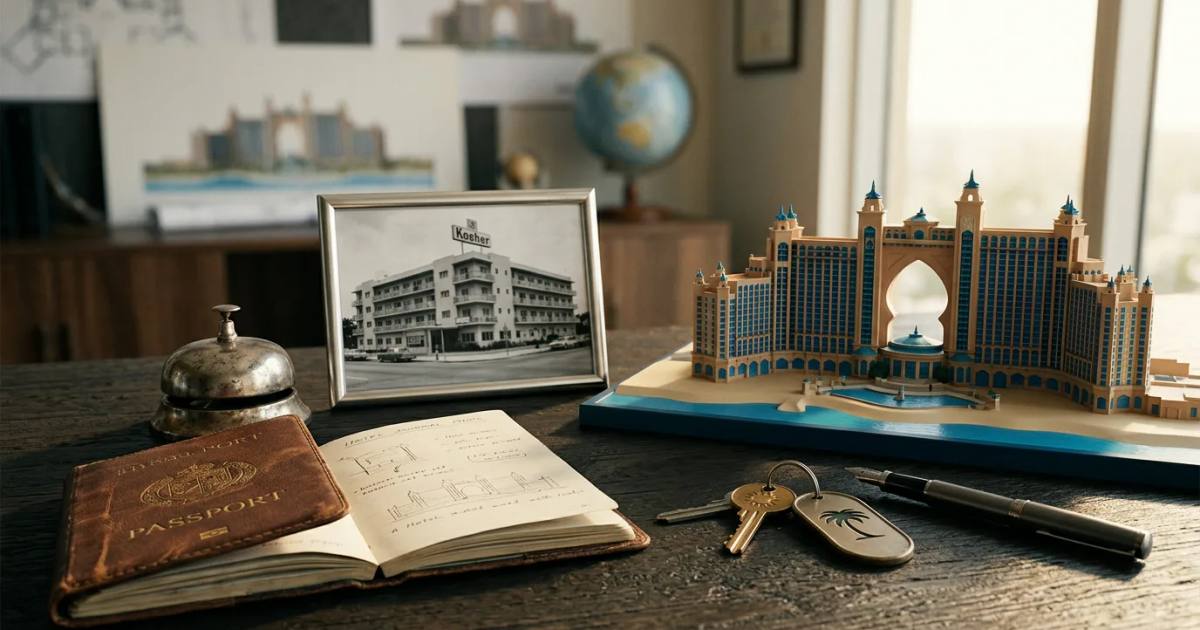
Solomon Kerzner was born on August 23, 1935, in Johannesburg — some accounts say Durban — the youngest of four children born to Morris and Bertha Kerzner, Jewish immigrants from Russia. The family ran a café in Bez Valley, a working-class Johannesburg suburb, and later operated a small chain of kosher hotels. Sol attended Athlone High School, where he was bullied for being Jewish. He was more interested in working on cars than studying, but his father pushed him toward university.
Kerzner qualified as a chartered accountant — a credential that gave him the financial discipline to build what became the most ambitious hospitality empire in African history. But his early life suggested a different trajectory entirely. He was an accomplished musician who played with the Johannesburg Symphony Orchestra. He was also a varsity welterweight boxing champion. The combination — artistic sensibility, physical toughness, and accounting precision — would define his approach to business for the next six decades.
How Did Kerzner Build Southern Sun?
In partnership with South African Breweries (SAB), Kerzner established the Southern Sun Hotel Group, which by 1983 operated 30 luxury hotels with more than 7,000 rooms across South Africa. The SAB partnership was innovative for the South African market: combining a beverage company's nationwide distribution network and brand infrastructure with hotel operations. It gave Kerzner institutional scale that no independent hotelier could match and provided SAB with a hospitality platform for its liquor and beer brands.
In 1975, Kerzner opened his first hotel outside South Africa — Le Saint Géran on the Indian Ocean island of Mauritius. It would become one of the most celebrated resort properties in the world, winning awards across multiple decades and establishing Kerzner's reputation for creating destination properties that transcended their geography. But the project that would define his career — and generate his most enduring controversies — was still four years away.
How Did Sol Kerzner Build Sun City?
In 1978, Kerzner flew by helicopter over the Pilanesberg, a stretch of dormant volcanic terrain in the nominally independent homeland of Bophuthatswana, roughly two hours' drive northwest of Johannesburg. He saw the potential immediately. In 1979, he opened Sun City — the most ambitious resort project in African history.
Sun City's business model was legal arbitrage. Under apartheid, gambling was illegal in South Africa proper. But the so-called "independent homelands" — territories designated for Black South Africans under the Bantu self-governance system — had their own laws. Bophuthatswana, under Chief Lucas Mangope, permitted casinos. Kerzner built a resort complex that combined luxury hotels, a championship golf course designed by Gary Player, a casino, and entertainment venues — offering white South Africans access to pleasures unavailable anywhere else in the country.
More significantly, Sun City was one of the few places in apartheid-era South Africa where all races could mix freely. Gambling was the draw, but racial integration was the lived experience — making Sun City simultaneously a symbol of commercial exploitation of the homeland system and, paradoxically, one of the country's most integrated social spaces.
Sun City drew international condemnation. The UN-backed cultural boycott of South Africa extended to the resort. Major performers — including Queen, Frank Sinatra, Elton John, and others — played there despite the boycott. The anti-apartheid Artists United Against Apartheid, organized by Little Steven Van Zandt, produced the protest song "Sun City" in 1985, explicitly naming the resort as a symbol of complicity with apartheid. The controversy followed Kerzner for decades.
In 1992, Kerzner added the Lost City — a 62-acre themed complex inspired by the ruins of an imaginary lost African civilization, complete with artificial jungle, a wave pool with six-foot waves, and an enormous waterpark. It was excess on a scale South Africa had never seen, and it cemented Sun City as one of the most recognizable resort brands on the continent.
What Did Nelson Mandela Say About Sol Kerzner?
When Nelson Mandela was released from prison in February 1990, he met privately with Kerzner in Johannesburg within weeks. According to multiple published accounts, including Sun International's own corporate history, Mandela praised the hotelier: "It's great that a young Jewish man is creating thousands of jobs out in the African countryside."
Kerzner had also made pragmatic political moves. He donated two million rand to the ANC's election campaign ahead of the 1994 vote. In 1995, he was given the honour of hosting Mandela's presidential inauguration reception at Sun City — a remarkable endorsement for a businessman whose flagship property had been built inside the apartheid homeland system.
Mandela's public embrace was critical. It signaled that the new South Africa's leadership viewed Kerzner as a job creator and economic builder — not merely a profiteer. It allowed Kerzner to move into the post-apartheid era with his reputation intact and his South African operations secure, even as he was already building his international portfolio.
How Did Kerzner Expand Internationally With Atlantis and One&Only?
Kerzner had begun positioning for international expansion in the late 1980s, relocating some offices to London in 1987. The defining move came in 1994, when he purchased the bankrupt Paradise Island Resort in the Bahamas for $125 million.
What followed was a redevelopment on a scale the Caribbean had never seen. Kerzner demolished most of the existing property and built two hotels, a 60-hectare themed waterpark, one of the world's largest man-made marine habitats, and a casino. When the Royal Towers opened in 1998, he rebranded the property as Atlantis, Paradise Island — taking the mythology of the lost city as his organizing concept. The resort offered 2,300 rooms, 35 restaurants and lounges, a 100,000-square-foot casino entertainment complex, an 88,000-square-foot convention center, and a full-service marina.
In 2002, Kerzner launched One&Only Resorts — a luxury five-star brand that eventually operated properties in the Bahamas, Mexico, Mauritius, the Maldives, South Africa, and Dubai. The One&Only positioning was ultra-premium: smaller properties, higher price points, celebrity chef restaurants, and a clientele drawn from the global UHNW segment. In 2007, he expanded Atlantis with The Cove and The Reef — adding 1,100 rooms, 21 retail outlets, and restaurants from Jean-Georges Vongerichten and Nobu Matsuhisa. In 2008, he took the Atlantis concept to Dubai, opening a water-themed resort on the Palm Jumeirah.
In the United States, Kerzner's record was mixed. The standout success was Mohegan Sun — a massive casino resort in Uncasville, Connecticut, built through a joint venture with the Mohegan Tribe called Trading Cove Associates. Mohegan Sun became one of the largest gaming and entertainment complexes in the United States. Trading Cove operated the resort and continued to receive 5% of gross revenue through 2014. But attempts to crack Atlantic City and Las Vegas produced setbacks, and Kerzner never replicated his African and Caribbean dominance in the US market.
How Many Properties Did Sol Kerzner Build?
Kerzner built more than 80 properties across more than twelve countries over a career spanning five decades. His companies — Southern Sun, Sun International, Kerzner International — defined a model of integrated destination resorts that combined hotels, casinos, entertainment, championship golf, and themed environments into self-contained leisure ecosystems designed to keep guests on property and spending.
The model's economics rested on casinos. The gaming floor generated the revenue that subsidized the hotels, restaurants, shows, and waterparks. Kerzner understood this arithmetic as well as anyone in global hospitality — and he understood that the spectacle of the resort itself was the marketing engine. Sun City, Atlantis, the Lost City, One&Only — each property was designed to be its own headline, to generate media coverage and word-of-mouth that no advertising budget could replicate.
How Is Sol Kerzner's Legacy Remembered Since His 2020 Death?
Sol Kerzner died on March 21, 2020, at the age of 84. His son Howard Kerzner succeeded him in the leadership of Kerzner International.
The legacy is contested. Kerzner built the most ambitious hospitality enterprise in African history. He created thousands of jobs in underdeveloped regions of Southern Africa. He expanded South African entrepreneurial ambition onto a global stage — from the Bahamas to Dubai, from Connecticut to the Maldives. He demonstrated that a South African businessman, operating from a country under international sanctions, could compete at the highest level of global luxury hospitality.
He was also a product of — and a willing participant in — the apartheid-era homeland system. His career was marked by political and business controversies on multiple continents. The cultural boycott protest against Sun City remains one of the most famous political statements in the history of popular music.
What is not contested is the scale. From a kosher hotel chain in working-class Johannesburg to Atlantis in the Bahamas and the Palm Jumeirah — Sol Kerzner's trajectory is the most dramatic rags-to-global-luxury story in the history of the South African Jewish community. Sun International remains listed on the JSE and continues to operate Sun City and properties across Southern Africa. The One&Only and Atlantis brands endure globally. The vision originated with the youngest child of Russian-Jewish immigrants who ran a café in Bez Valley, bullied at school, who became a chartered accountant, a symphony musician, a welterweight boxer — and then built a pleasure empire that spanned the world.