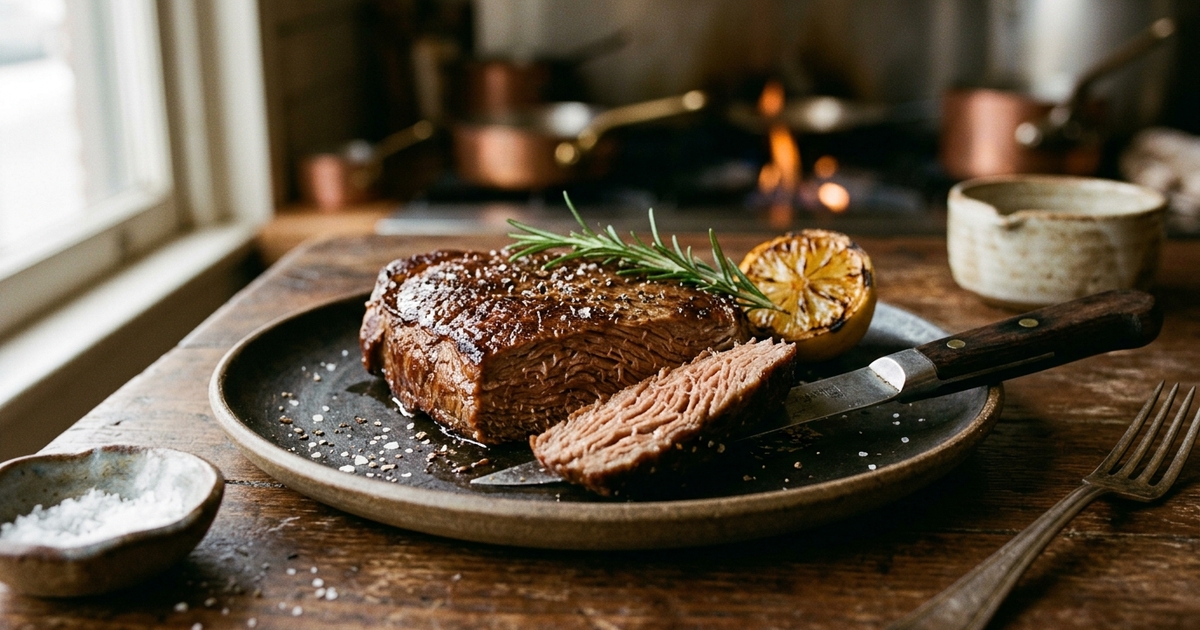

Most plant-based meat lost the consumer war by competing with the cheapest thing on the shelf. Israel's biggest bet went the other way — for the steak.
The plant-based meat industry made one strategic error almost everywhere: it tried to beat ground beef. Burgers and mince are the cheapest, most commoditized form of meat, which meant plant-based brands competed on price against the one product they could never undercut. When the novelty faded and prices stayed high, sales stalled. Redefine Meat, Israel's most heavily funded plant-based company, made the opposite bet — on the hardest and most expensive product in the category: the whole cut.
Founded in 2018 in Rehovot and originally named JetEat, Redefine Meat has raised roughly 180 million dollars, including a 135-million-dollar round led by Hanaco Ventures and Synthesis Capital. Its core technology is industrial 3D printing: layering plant proteins, fats and other inputs to reconstruct the muscle-and-fat architecture of a steak or lamb cut, rather than grinding everything into a patty.
Why whole cuts are the harder, better target
A steak is structurally complex — striated muscle, marbled fat, connective tissue — which is precisely why most plant-based players avoided it. It is also where the economics are kinder: premium cuts carry premium margins, and a diner paying for a fine-dining experience is not price-matching against supermarket mince. Redefine's products launched in high-end restaurants across Israel, the UK, Germany and the Netherlands, including kitchens associated with Marco Pierre White, and reached corporate dining at global tech firms. The company has since pushed into European retail with flank-steak and other cuts, and relaunched its burger and mince range in 2025.
The Israeli 3D cluster
Redefine is the largest name in a distinct Israeli sub-sector built around additive manufacturing of food. SavorEat, another 3D-printing player, listed on the Tel Aviv Stock Exchange; Plantish has targeted plant-based whole-cut salmon. The common thread is a willingness to treat food as a manufacturing-and-engineering problem rather than a recipe — the same instinct that runs through Israeli industry generally.
The honest constraint
Plant-based demand has plateaued in most Western markets, and 3D printing at industrial throughput is capital-intensive and slow to scale. Redefine's bet only pays off if whole cuts can move from prestige restaurants to broad retail at a price ordinary shoppers accept — an unproven leap. But in Israel itself, plant-based products have stabilized at roughly 10 percent of the meat market and 20 percent of the dairy market, well above global benchmarks, which gives domestic players a real home base to scale from. The whole-cut strategy is the harder road. It may also be the only one that leads somewhere the commodity-burger players cannot follow.
Part of Olam's Agriculture & Food Tech coverage. See the pillar: Why Israel Bet the Farm on the Protein Transition.