Sorek-2 and the Global SWRO Cost Curve
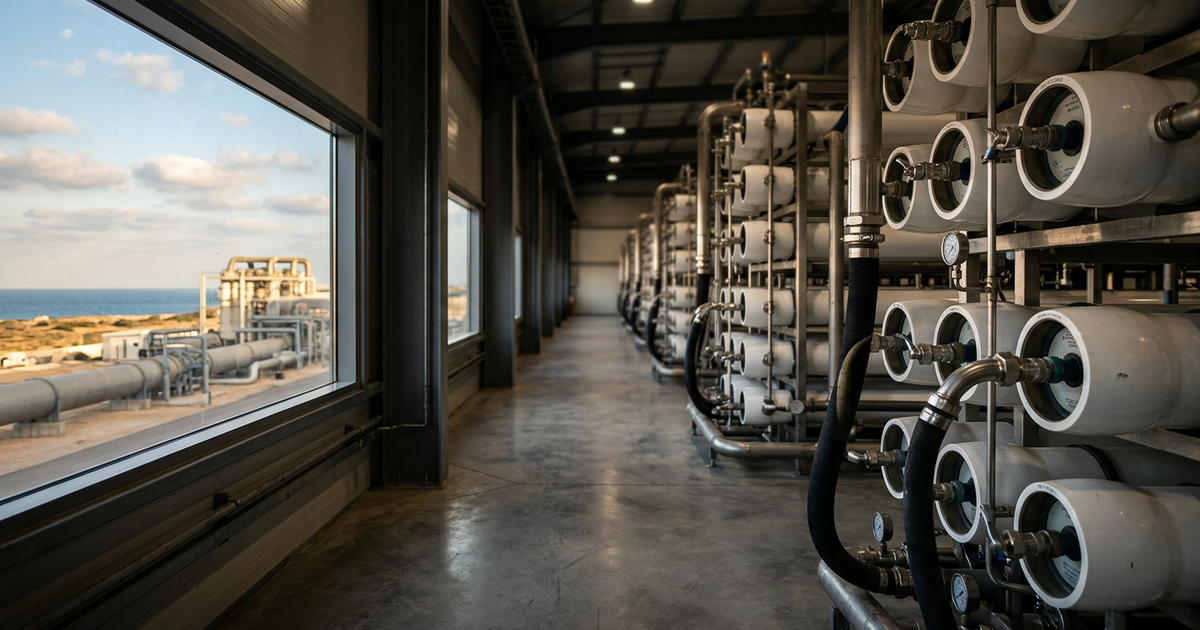
IDE Technologies built the world's lowest-unit-cost large-scale desalination plant at Sorek. Sorek-2 extends the curve. Here's what global SWRO buyers are actually paying.
The Sorek-1 desalination plant, commissioned in 2013 and built by IDE Technologies, came in at roughly $0.53/m³ unit cost — at the time the lowest large-scale seawater reverse-osmosis (SWRO) unit cost ever publicly disclosed. Sorek-2, operational from 2023 with capacity of ~200 million m³/year, extends the curve further. Israeli SWRO operators have driven the global desalination unit-cost curve down by approximately 40% over the past 15 years.
Selected large-scale SWRO unit costs ($/m³)
Approximate disclosed or estimated unit costs for major recent SWRO projects. Costs are normalized but include local energy, financing, and contract-structure variation.
| Project | Cost ($/m³) |
|---|---|
| Sorek-1 (Israel, 2013) | $0.53 |
| Sorek-2 (Israel, 2023) | $0.45 |
| Hadera (Israel, 2010) | $0.62 |
| Carlsbad (US, 2015) | $1.85 |
| Taweelah (UAE, 2022) | $0.49 |
| Rabigh 4 (Saudi, 2024) | $0.40 |
What's actually different about the Israeli curve
- Energy procurement. Sorek's power purchase arrangement is essentially the binding cost component. Each percentage point of energy cost compression translates directly into unit-cost compression. The Israeli grid's shift from coal to gas — and selectively to renewables-with-storage — has materially helped.
- Membrane technology. IDE and its membrane suppliers (Toray, Dow, Hydranautics) have iterated through three generations of higher-flux, lower-fouling membranes. Each generation improves recovery ratio.
- Procurement structure. Israel's 25-year take-or-pay water purchase agreements with Mekorot give the developer a financeable cash flow that supports tight equity returns. Carlsbad, by contrast, financed under a more fragmented offtake arrangement and paid for it.
The competitive context
Israel's lead has narrowed. Gulf operators — ACWA Power, ENGIE in UAE, Veolia in Saudi — now compete IDE on tendered SWRO projects globally. The 2024 Rabigh-4 award to ACWA reportedly hit $0.40/m³, suggesting the curve has further to go. Israeli operators still hold the technical edge on smaller-scale and brackish-water applications, where the Gulf super-large-scale optimization is less relevant.
For policy: Israeli SWRO is the most legible counterargument to the claim that Israel cannot run industrial-policy export champions. It is exactly that. The model works because of cumulative procurement experience, not because of grants.