
Panama signed the first Israel-Middle East trade deal in 2020. A 2026 Herzog visit, a new MOU, and canal cybersecurity now bind the two nations closer than any other Latin American partner.
Panama is Israel's most significant strategic and commercial partner in Latin America, anchored by a 2020 free trade agreement, a May 2026 economic accord, and canal-security cooperation that ties Israeli technology to a waterway central to global trade. President Isaac Herzog's May 2026 visit to the Panama Canal, the first by a sitting Israeli president, formalized a relationship built on trade, security, and a 150-year Jewish community.
What makes Panama Israel's strongest Latin American partner?
Panama and Israel signed a free trade agreement that took effect on January 1, 2020, the first trade deal between Panama and any Middle Eastern nation, according to the Middle East Forum. Panama also remains the only country in Latin America that has never recognized a Palestinian state, a position Panama's ambassador to Israel, Ezra Cohen, described to the Jerusalem Post in May 2026 as something Panama "never supported, and never will."
The relationship predates the modern state of Israel. Panama voted in favor of the 1947 UN Partition Plan, and on June 18, 1948, just over a month after Israel declared independence, Panama issued Resolution No. 1856 recognizing Israel as a sovereign state with full international personality. Panama also facilitated the transfer of aircraft to Israel during the 1948 War of Independence.
Trade has accelerated on top of that diplomatic foundation. Panama's exports to Israel grew at an annualized rate of 72% over the last five years, the Middle East Forum reported in 2026, while Panama imported $46 million in Israeli goods in 2024, including $19 million in arms and ammunition.
What did the May 2026 economic agreement change?
Israel and Panama signed a new Memorandum of Understanding on May 27, 2026, allowing Israeli companies to bid on public development projects inside Panama, according to Panama's Foreign Ministry statement reported by JNS. Panama's Foreign Minister Javier Martinez-Acha and Israel's Ambassador to Panama Mati Cohen signed the accord, describing a government-to-government framework in which each country assists the other in specific sectors.
Panama has pointed to water management, agricultural and construction labor, and hospital administration systems as priority areas for Israeli expertise under the new framework, according to Panama's ambassador to Israel — an opening Olam explores further in its report on Israeli water technology and Panama's coffee economy. Panama currently has fewer than 50 workers placed in Israel under existing labor arrangements and hopes to expand that number substantially.
The MOU builds on the 2020 FTA rather than replacing it. Where the FTA lowered tariffs and formalized trade terms, the 2026 accord opens Panama's public infrastructure and development contracts to Israeli firms directly, a channel that did not exist under the original agreement.
Why does the Panama Canal need Israeli cybersecurity?
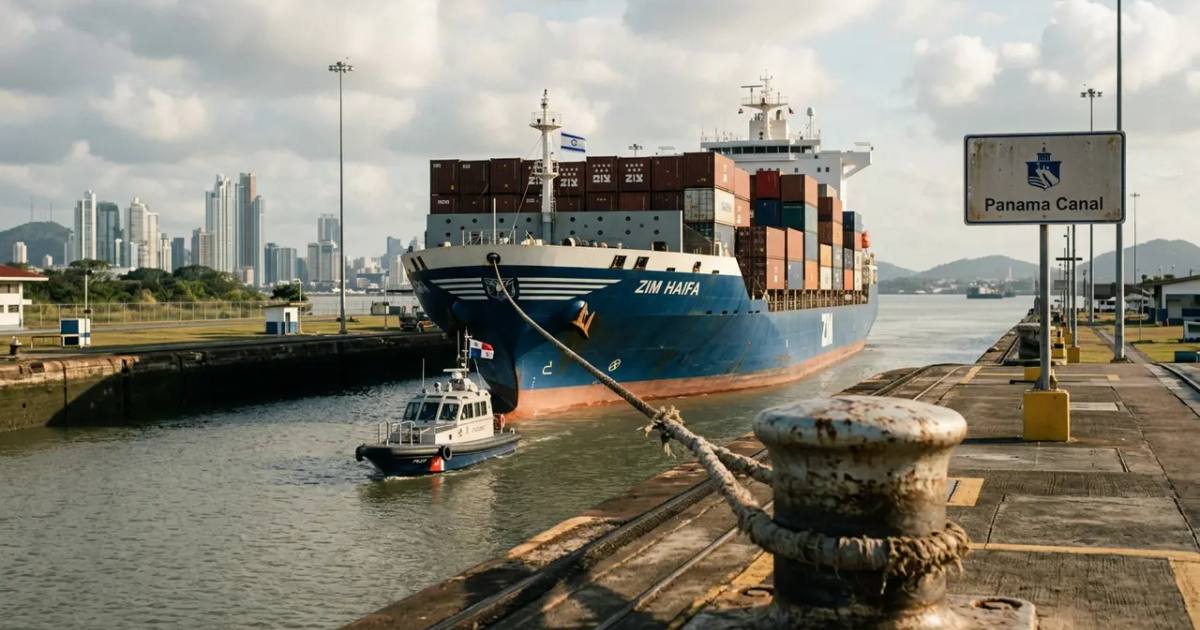
The Panama Canal carries about 6% of global maritime trade and 40% of United States container shipping volume, based on Panama Canal Authority figures reported by the Middle East Forum in 2026. Panama's ambassador to Israel has put the canal's share of world commerce even higher, telling the Jerusalem Post that 7% of global trade transits the waterway.
Israeli cyber and critical-infrastructure firms now work on the canal's defenses against hybrid threats, including sabotage attempts linked to Iranian proxies, the Middle East Forum reported. Panama is actively seeking Israeli expertise on this front, citing the need to protect the canal from both physical attacks and cyberattacks.
Panama is also interested in Israeli drone surveillance technology to monitor its borders with Colombia and Costa Rica and its extensive coastal waters. Panama's ambassador to Israel told the Jerusalem Post that shared borders and coastal waters make drone surveillance systems, an area where Israel has deep expertise, a practical priority for bilateral cooperation.
How did the CK Hutchison port dispute change the canal's politics?
A geopolitical dispute over the canal's two flanking ports, Balboa on the Pacific side and Cristobal on the Atlantic side, escalated through 2025 and early 2026. Both ports had operated for decades under a subsidiary of Hong Kong-based CK Hutchison Holdings. In early 2025, President Donald Trump claimed China was "running the Panama Canal" and pressured Panama to reduce Chinese-linked control of the ports.
Panama's Supreme Court ruled the CK Hutchison concession contracts unconstitutional in a decision issued January 29, 2026, and voided the licenses, CNBC reported. Panama then granted temporary 18-month operating contracts to Maersk for Balboa and MSC for Cristobal. CK Hutchison responded by launching international arbitration proceedings against Panama, seeking what the company called "extensive damages," and separately notified Panama of a dispute under an investment protection treaty, CNBC reported in February 2026.
China's government warned Panama would "inevitably pay a heavy price" for the ruling, while Panama and the canal authority maintained China had no operational influence over the waterway. The dispute sits inside a broader US-China contest over control of strategic port infrastructure across Latin America, including Cosco's Chancay port investment in Peru, which the US State Department has separately flagged as a sovereignty concern.
Canal traffic itself has climbed back from a 2023 to 2024 drought that once cut daily transits to as few as 18 vessels, down from a normal sustainable range of 34 to 38 per day. The Panama Canal Authority recorded 13,404 transits in 2025 and handled 489.1 million tons of cargo, per the Middle East Forum, with traffic rising further to 6,288 transits and 254 million tons in the first half of 2026, a 5% year-over-year increase.
What happened during Herzog's May 2026 visit to Panama?
President Herzog's trip marked Israel's first-ever meeting between a sitting Israeli head of state and a Panamanian president. Herzog went directly from the airport to the Panama Canal's Miraflores Locks, where he received a VIP tour that included the chance to personally operate the lock controls.
"This is a beautiful example of how to lead and enable freedom of navigation and maritime freedom," Herzog said at the canal, contrasting it with the security situations in the Strait of Hormuz and the Bab al-Mandab Strait. He added that Panama "understands, perhaps better than anyone, the vital importance of freedom of navigation and why it is worth fighting for."
After the canal visit, Herzog and his wife, Michal, were received at the Presidential Palace, Panama's Palacio de las Garzas, by President Jose Raul Mulino and his wife, Maricel de Mulino. Herzog then met with leaders of Panama's Jewish community, the largest in Central America outside Mexico, including a meeting with Panama City's Mayor Mayer Mizrachi Matalon, the city's first Jewish mayor. The visit was part of a broader Central America trip that also took Herzog to Costa Rica for the inauguration of President Laura Fernandez Delgado.
What did Israel's foreign minister and Panama discuss in March 2026?
Israeli Foreign Minister Gideon Sa'ar spoke by phone with Panama's Foreign Minister Javier Martinez-Acha Vasquez on March 29, 2026, discussing shared security concerns including the campaign against Iran, the Middle East Forum reported. During that call, Panama's government told Israel it had secured the extradition of Ali Zaki Hage Jalil from Venezuela, a suspect tied to the 1994 bombing of Alas Chiricanas Flight 901 that killed 21 people, including 12 members of Panama's Jewish community and four Israeli citizens.
Panama launched a parliamentary Israel caucus in 2025 dedicated to deepening cooperation across technology, agriculture, security, and innovation, according to JNS.
What is the scale and history of Panama's Jewish community?
Jews first arrived in Panama in 1501, shortly after Spanish colonization, as conversos and marranos fleeing the Spanish and Portuguese Inquisitions. Panama's Jewish community participated directly in the country's founding, with Jewish members helping design the Panamanian flag and helping establish the country's firefighting corps, according to Panama's ambassador to Israel.
Three historical waves built the modern community. The first fled the Spanish Inquisition, the second arrived from Europe during World War II, and the third came from Syria, primarily Aleppo and Damascus, a migration pattern also documented in The Olam's Aleppo and Damascus survey and in Olam's report on the Jewish merchant economy of the Colon Free Zone, which that Syrian wave built. Panama's current Jewish population is estimated at 14,000: 10,000 Sephardi, 2,000 Ashkenazi, and 2,000 Reform, though other estimates place the total closer to 10,000 to 12,000.
That makes Panama the largest Jewish population in Central America when Mexico, with roughly 40,000 Jews, is excluded from the regional count. Costa Rica, by comparison, has about 3,000 Jews concentrated in San Jose. South America's totals dwarf Central America's: Argentina has approximately 180,000 Jews, Brazil about 120,000, Uruguay 16,000, and Chile 15,000 to 20,000, according to estimates the Jerusalem Post has attributed to the American Jewish Year Book and demographer Sergio Della Pergola.
Panama's community today supports over 40 kosher restaurants and ten synagogues — six belonging to the Sephardic Shevet Ahim congregation, one Ashkenazi (Beth El), one Reform (Kol Shearith Israel), and two Chabad — concentrated heavily in the Punta Paitilla neighborhood, per Ynetnews reporting detailed further in The Olam's survey of Jewish institutional life in Panama. About 70% of customers at those kosher restaurants are not Jewish, a sign of the culinary infrastructure's reach beyond the community itself. The beachside Deer Beach neighborhood, Playa de Nado, is now home to about 300 Israelis and has become Panama's most expensive residential area at $6,000 per square meter.
Who is Panama's ambassador to Israel?
Ambassador Ezra Cohen, born in Panama in 1960, represents a direct generational link between Panama and Israel's founding. Cohen's father fought in Israel's 1948 War of Independence, was captured by Jordanian forces, held as a prisoner of war for months, and later released in a prisoner exchange, Cohen told the Jerusalem Post. Cohen comes from Persian and Israeli heritage on his father's side and Greek and Macedonian heritage on his mother's side, according to his Wikipedia biography.
Cohen grew up in Panama and built a career spanning consumer electronics distribution, logistics, and kosher food initiatives before returning to Israel as ambassador, assuming the post in January 2025. "Seventy-four years later, I came back to Israel as the ambassador during the war, during the winter, to close the circle here in Panama," Cohen said, per the Jerusalem Post.
What other sectors are Panama and Israel expanding together?
Education and medicine have become active exchange channels. Panama's Minister of Education, Lucy Molinar, visited Israel for an artificial intelligence conference in early 2026 and met with educators at Ben-Gurion University and the University of Ariel, where the institutions are now developing exchange programs and scholarships in medicine and technology. Israel has also arranged fellowships for Panamanian doctors at Hadassah-University Medical Center and Ichilov Hospital.
Panama's coffee industry has emerged as an unexpected point of commercial interest — Olam's dedicated report maps that opening against Israeli agtech. Panamanian growers developed a variety called Geisha over the past decade, prized in Asian markets for a fruitier, less bitter profile than typical coffee. A kilogram sold for $30,000 at the Dubai Coffee Conference, driving some Dubai coffee shops to price a single cup of Geisha coffee at $1,000.
Tourism remains an open opportunity, one complicated by the absence of a direct flight connection, a gap Olam examines separately. Roughly 80% of Panamanians speak fluent English. Herzog's office has separately described Panama as holding tremendous tourism potential for Israeli visitors.
Why Panama matters beyond a single bilateral relationship
Herzog's Panama visit followed Argentine President Javier Milei becoming the first head of state and first non-Jew to receive the Genesis Prize, a $1 million annual award recognizing contributions to the Jewish people, which Herzog personally presented in 2026. Milei donated the prize money to launch the Isaac Accords, an initiative modeled on the Abraham Accords intended to deepen diplomatic, security, financial, and technology ties between Israel and Argentina, with hopes that other Latin American countries will join.
Panama's ambassador to Israel has framed 2026 as a turning point for the region generally, pointing to Bolivia and Chile as countries whose new governments are now pursuing stronger relationships with Israel after previous administrations kept their distance. Israel's recent conflict with Iran, he said, clarified which countries remained reliable allies while others distanced themselves.
The trade, security, and diplomatic threads point toward deeper integration rather than a single milestone. The 2020 FTA set the legal foundation, the 2026 MOU opened public contracts, canal-security cooperation ties Israeli technology to a waterway central to US and global trade, and a presidential visit formalized the relationship at the highest level. Panama's 150-year Jewish community, one of the oldest continuous Jewish populations in Latin America, adds an institutional layer that predates all of it, a history documented further in The Olam's Latin American Jewish institutional survey.
Related on The Olam
- Jewish Life in Panama: Ten Synagogues, Two Presidents
- Inside the Colon Free Zone: Panama's Jewish Merchant Economy
Sources
Middle East Forum, "Panama Emerges as Israel's Strongest Strategic Partner in Latin America"; Jerusalem Post, interview with Ambassador Ezra Cohen (May 2026); Jerusalem Post, on Cohen's credentialing to President Herzog; Wikipedia, Ezra Cohen (ambassador); Ynetnews, on Panama's Jewish institutions.
How we report: Olam stories draw on public filings, company disclosures and named sources, checked by our editors. Read our methodology · Corrections