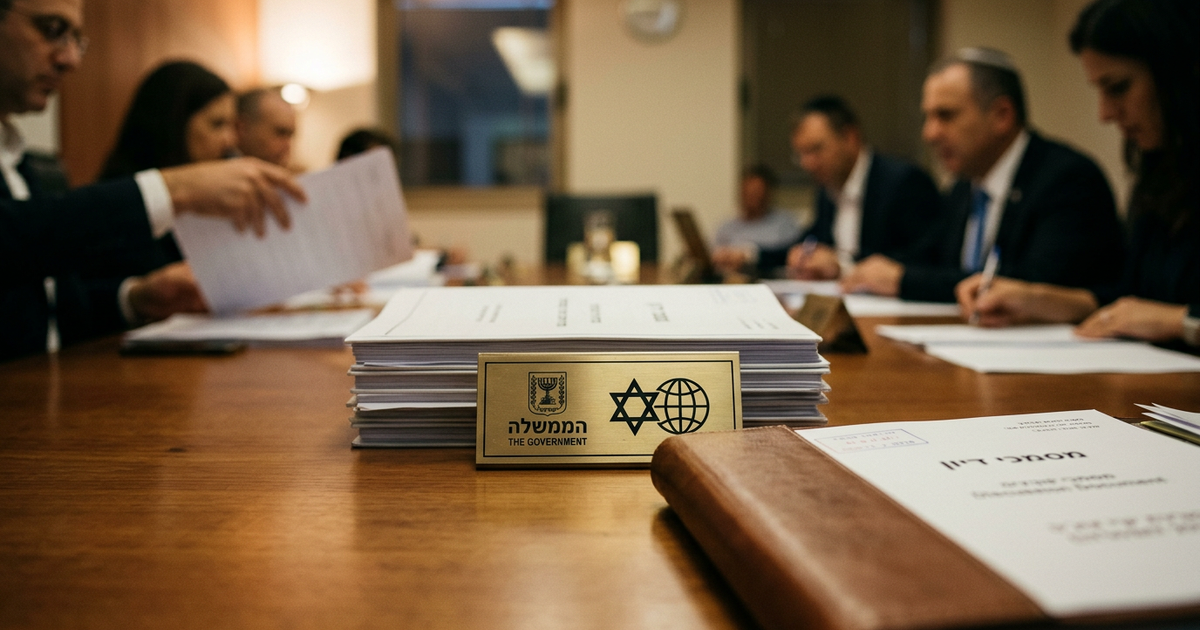

The Israeli cabinet approved a NIS 200 million plan to strengthen Jewish education in the Diaspora. Half is Israeli state funding, half is matched by the Jewish Federations of North America. The Hebrew business press has raised questions about process and budget context.
The Israeli cabinet approved a NIS 200 million plan on Sunday to strengthen Jewish education in the Diaspora. Half of the funding comes from the Israeli state; half is matched by the Jewish Federations of North America. Coverage in the Hebrew business press has raised questions about the process and the budget context.
The Israeli cabinet unanimously approved a NIS 200 million ($59 million) national plan on Sunday to strengthen Jewish education in the Diaspora, with the stated goal of increasing enrollment in Jewish day schools across North America. The decision was framed by the Prime Minister's Office and the Ministry of Diaspora Affairs as a strategic response to rising antisemitism after October 7.
Reporting in the Hebrew-language press has added detail to the picture.
Half the Funding Is American
According to N12 and Mako, NIS 100 million of the program — roughly $30 million — comes from the Israeli state budget. The other NIS 100 million is being matched by the Jewish Federations of North America themselves. JFNA will both contribute and receive the combined sum to distribute through its network. The Israeli state and JFNA are co-funding the program in equal shares.
The Process Drew Internal Pushback
N12 reported that the program was advanced under direct pressure from the Prime Minister's Office, led by its director general, and that career staff at the Ministry of Diaspora Affairs raised professional concerns about elements of the decision. The PMO's original ask was NIS 500 million; the figure was reduced to NIS 100 million in negotiation. The cabinet vote took place while JFNA leadership — chair Gary Torgow and CEO Eric Fingerhut — were present in the cabinet meeting that approved the program. The funding source was interest payments — a line item that could not otherwise be redirected.
Timing and Budget Context
The decision was approved days before the government is expected to dissolve ahead of elections. The same day the program was announced, N12 also reported new OECD data placing Israeli students among the lower-performing groups in the developed world in reading and mathematics. Residents of northern Israel are still awaiting reconstruction budgets for war damage. In the 2026 state budget, economic development for the Arab sector was reduced 15 percent and minority infrastructure was reduced 13 percent. Israeli classrooms remain among the more crowded in the OECD.
A Broader Budget Trend
The Ministry of Diaspora Affairs and the Fight Against Antisemitism, headed by Minister Amichai Chikli, has seen its budget grow significantly over recent budget cycles. The ministry's budget rose 257 percent compared with the prior government, and the 2026 budget adds another 76 percent — a NIS 145 million increase that brings the total to NIS 191 million. Ynet has tracked similar growth across a cluster of smaller portfolios operating under the Prime Minister's umbrella — Diaspora Affairs, Heritage, Jerusalem and Tradition, Settlements, Strategic Planning — whose budgets have expanded in the current coalition.
American Jewish Philanthropic Capacity
JFNA's annual campaign raises hundreds of millions of dollars per year. Federation endowments across North America hold billions of dollars in assets. Day school tuition assistance, capital projects, and special-needs programming have historically been funded through American Jewish philanthropy. The new program adds Israeli state matching to that existing base.
The Government's Rationale
Government officials argue that strengthening Jewish education in the Diaspora is a strategic Israeli interest — that Jewish identity, connection to Israel, and resilience against antisemitism are national-security questions, not solely philanthropic ones. Approximately 1.8 million Jewish children of school age live in the United States; only a small share attend Jewish educational institutions. Closing that gap, supporters argue, is a project too large for diaspora philanthropy alone.
An Open Question
Reporting in the Hebrew business press has raised the question of why Israeli public funds are being matched to a JFNA grant for day-school enrollment in the United States, at a time of war debt, budget reductions to domestic education line items, and pressure on minority infrastructure. The government has not yet addressed the question in detail.
How we report: Olam stories draw on public filings, company disclosures and named sources, checked by our editors. Read our methodology · Corrections