
NewMed Energy wants its gas-export framework adjusted before further export commitments lock in under outdated currency assumptions.
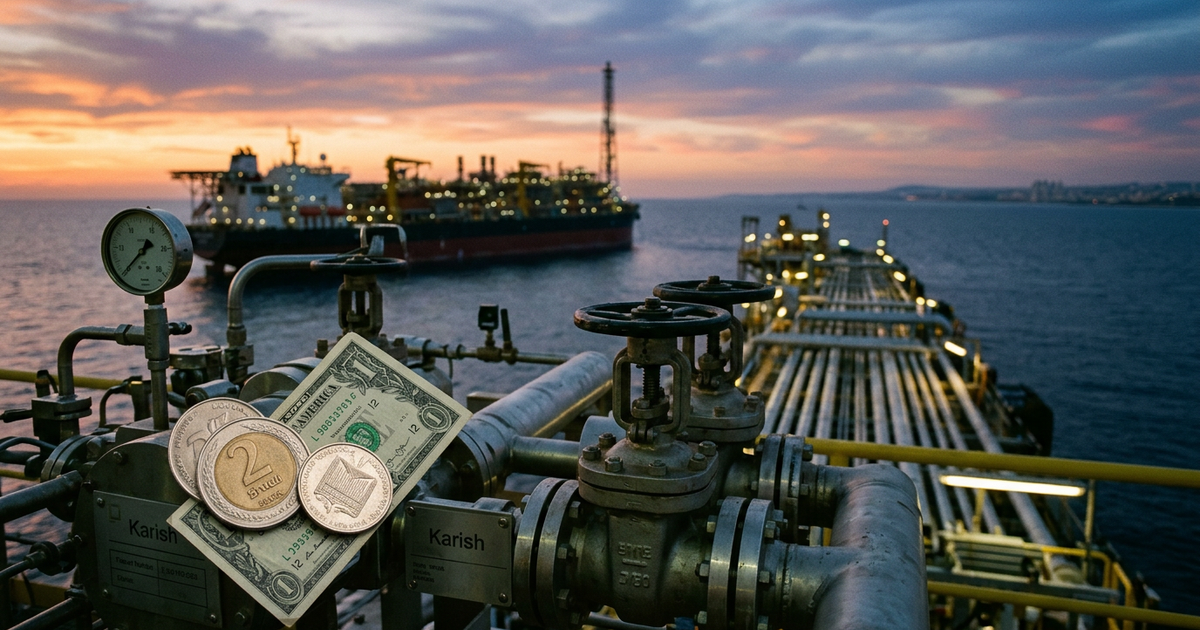
NewMed Energy is moving to reopen its gas-export agreement with Israel's Ministry of Energy and Infrastructure, citing the shekel's strengthening against the dollar as material grounds for revised terms. The partner in the Karish and Tanin offshore gas fields, alongside its position in the giant Leviathan field, wants the framework adjusted before further export commitments lock in under what it sees as outdated currency assumptions.
The push lands as Israel's energy sector recalibrates around currency moves that have compressed dollar-denominated revenue when converted back into shekels. For NewMed, the gap between agreed pricing and current FX reality is the lever — and the Ministry of Energy is being asked to sit at a table it had not previously planned to sit at. NewMed Energy is publicly traded on the Tel Aviv Stock Exchange (TASE: NWMD) and is one of the principal players in Israel's offshore gas economy alongside Chevron, which operates Leviathan, and Energean, which operates Karish.
Karish, brought into production in late 2022, was among the largest fields developed in Israeli waters this decade and was politically charged from inception — the field sits near the maritime boundary with Lebanon that was finally demarcated in 2022. The Tanin field, sitting in adjacent waters, is in development. Together they form a meaningful share of Israel's domestic gas supply and a growing share of regional exports to Egypt and Jordan.
The Currency Story
Gas-export contracts across the Eastern Mediterranean are typically dollar-denominated. When the shekel strengthens against the dollar, shekel-converted revenue falls — squeezing margins set under older FX assumptions. The shekel's run since early 2025 has been one of the stronger emerging-market currency moves of the cycle, driven by an improving Israeli current account, sustained foreign-direct-investment inflows despite war-period risk premia, and a Bank of Israel posture that has held rates higher than market expectations for longer.
NewMed's request reframes the gas-export agreement as a contract written under a different FX regime that no longer reflects underlying economic reality. Whether the Ministry of Energy agrees is a political question as much as an economic one. Reopening terms sets a precedent the regulator will be cautious about — other partners in Israel's gas economy will watch closely and may follow.
Why It Matters
Israel's gas economy is the spine of regional energy diplomacy. The export agreements with Egypt and Jordan are economic instruments but also strategic ones, embedded in the architecture of regional normalization. The contested EastMed pipeline corridor — pushing Israeli and Cypriot gas toward European markets — remains under active discussion. A reopened NewMed deal signals that operators now have leverage to renegotiate terms set in a different currency environment, and the government is at least at the table.
It also matters for capital allocation. Israeli energy is a meaningful slice of the TASE-listed universe and a destination for institutional capital and family-office allocators looking for hard-asset exposure to the Israeli economy. Margin compression at NewMed translates into valuation pressure across the sector; margin restoration translates the other way. The same FX dynamic affects exposure across Israeli refining and downstream-energy assets, where Shapir Engineering's reported move on the Ashdod Refinery sits inside the same sector repricing. The next 90 days of regulator posture will determine which direction the sector trades.
What to Watch
Three signals. First: any public Ministry of Energy statement framing the talks — pro-reopening, anti-reopening, or procedural. Second: parallel moves by Chevron on its Leviathan agreements, which would suggest a sector-wide repricing rather than a NewMed-specific case. Third: shekel-dollar levels — sustained shekel strength below the 3.40 level would harden NewMed's case; reversal above 3.70 would weaken it. The infrastructure-investment overlay reaches further: domestic data-center and AI-infrastructure capital being deployed in Israel adds to the same shekel-demand picture that has driven the currency stronger in the first place.
FAQ
What is NewMed Energy?
An Israeli energy partnership, traded on the Tel Aviv Stock Exchange under NWMD, holding stakes in the Karish, Tanin, and Leviathan offshore gas fields.
Why is the shekel relevant?
Gas-export contracts are typically dollar-denominated. As the shekel strengthens against the dollar, shekel-converted revenue falls — squeezing margins set under older FX assumptions.
Has the Ministry of Energy agreed to reopen the agreement?
Talks are reported as initiated; no formal agreement to renegotiate has been confirmed at time of reporting.
Who operates Karish?
Energean is the field operator; NewMed Energy holds a partner stake.
Why does this matter beyond NewMed?
A reopened agreement would set a precedent other partners in Israel's gas economy could invoke. Chevron's Leviathan position is the most consequential. The next 90 days of regulator posture will signal sector-wide direction.
Published 16 June 2026 · Olam Hebrew Desk