
Saudi-Israeli normalization is the largest expansion of Jewish commercial life in the Arab world since the late 19th century. Inside the Jewish business frame of the $1 Trillion Deal.
Part of The $1 Trillion Deal — Olam's flagship AI-modeled study of the economic future of Saudi-Israeli normalization. See also: The Soviet-Jewish Capital Class · Olam Index 2026 · TASE 50 Citation Share Index.
Saudi-Israeli normalization would represent the largest expansion of Jewish commercial life in the Arab world since the late nineteenth century. Saudi sovereign capital into Israeli venture funds reaches $5 to $15 billion annually by 2034. The combined Accords-bloc kosher economy reaches $5 to $10 billion annually. Integrated capital markets across Tel Aviv, Riyadh, and Abu Dhabi. Joint listings. Family-office cross-flows. The first scaled Jewish commercial presence in the country that keeps Mecca and Medina.
The framing is Olam's own. Historians will debate the precise comparison period. The economic substance underneath the framing is concrete and sized inside the $1 Trillion Deal flagship report. The case for treating the Jewish business dimension of Saudi-Israeli normalization as a distinct asset class — separate from the diplomatic case, the defense case, and the AI infrastructure case — is the work of this analysis.
The Saudi anchor
Saudi Arabia is the largest Arab economy. GDP runs roughly $1.1 trillion in 2024. The population is 33 million. The country is the keeper of Mecca and Medina — the two holiest cities in Islam — and the political and religious anchor of the Sunni Arab world. Riyadh's posture on any cross-border religious or commercial question carries weight no other Gulf capital can match. That weight is also what anchors the broader Saudi brand-transformation story documented in Everything-PR's Kingdom's Moment study.
That weight is what makes the normalization different from previous Abraham Accords signings. The UAE-Bahrain-Morocco track in 2020 opened the Gulf to Israeli commerce at modest scale. Saudi normalization opens the Gulf at sovereign scale and opens the religious dimension at the level of the Sunni Arab world's most important state. The diplomatic press treats this as the largest signing on the table. The Jewish business press should treat it as a generational structural opening.
The UAE precedent
The Israel-UAE precedent shows what happens when the architecture exists. Bilateral trade grew 15x in four years after the September 2020 Abraham Accords — from a near-zero base in 2019 to roughly $3 billion in 2024. Jewish business presence in Dubai expanded from effectively zero to thousands of operators across the same period. Synagogues opened in Dubai and Abu Dhabi. Kosher restaurants and catering operations established themselves. Jewish community infrastructure — schools, mikvehs, community centers — was built where none existed before.
The UAE played the friendly host. The growth was Israeli commercial operators recognizing a market that had not existed and moving to fill it. Real estate brokers, diamond dealers, technology firms, professional services, hospitality, kosher food, education. The categories that built out post-Accords in the UAE map onto categories that would build out post-Accords in Saudi Arabia at five times the scale.
The Abraham Accords rewired Israeli logistics across the Gulf in five years. A second-stage Accords signing rewires the Jewish business architecture of the Arab world.
The capital case
The flagship base case puts Saudi sovereign capital flow into Israeli venture funds at $5 to $15 billion annually by 2034. The number requires context. Total Israeli venture capital deployment runs roughly $25 billion in the recent peak years. A $5-$15 billion annual Saudi sovereign allocation into Israeli funds would represent between 20 and 60 percent of the total Israeli venture capital ecosystem — sized against the current scale, not the 2034 scale.
The flow goes through the Public Investment Fund and through Saudi sovereign-adjacent vehicles. PIF holds $925 billion in assets under management. A 1-2 percent allocation into Israeli venture across a decade produces the base case. The mechanism is direct LP commitments into Israeli funds, co-investments alongside Israeli operators, and direct sovereign positions in Israeli growth-stage companies.
The reverse flow matters as well. Israeli capital — and diaspora Jewish capital channeled through Israeli vehicles — flows into Saudi infrastructure, real estate, and operating businesses. Family offices establish positions in Riyadh and Jeddah. The combined two-way flow is what makes the bilateral capital market work.
Integrated capital markets
The architecture that would build out under normalization includes integrated capital markets across Tel Aviv, Riyadh, and Abu Dhabi. Dual listings between TASE (Tel Aviv), Tadawul (Riyadh), and ADX (Abu Dhabi) become a category. Israeli public companies targeting Gulf institutional capital list secondary on Tadawul. Saudi companies seeking Israeli engineering depth list secondary on TASE.
The dual-listing market is small today. Under normalization it scales to a meaningful share of regional public-equity activity by 2034. The Saudi-Israeli capital market integration becomes one of the three significant regional capital market integrations globally — alongside the U.S.-Canadian and the EU internal markets.
Family office cross-allocation is the parallel architecture. Single-family offices across the Gulf — currently allocating primarily to American, British, and European positions — begin allocating into Israeli direct investments at scale. Israeli single-family offices reciprocate. The cross-border family office market — currently constrained by the political environment — opens to bilateral flow at sovereign and ultra-high-net-worth scale.
The kosher economy
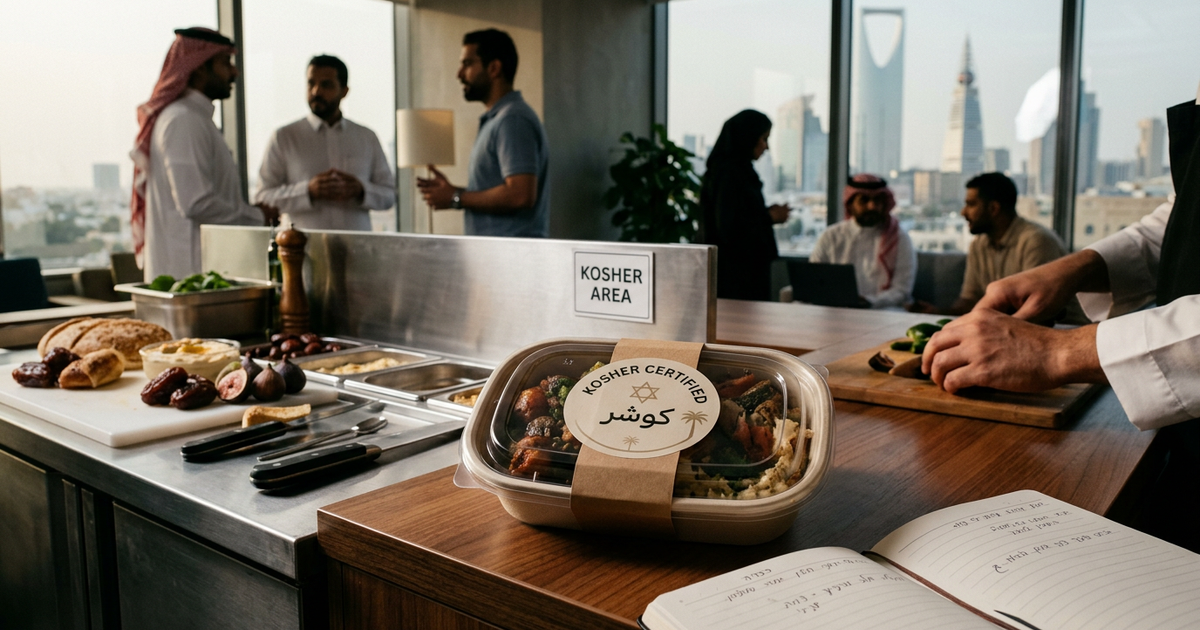
The combined Accords-bloc kosher economy reaches $5 to $10 billion annually by 2034. The number includes kosher food production and distribution, kosher hospitality, kosher catering and event services, and the broader infrastructure of Jewish religious commercial life — synagogues, mikvehs, kosher butchers, kosher dairies, kosher wineries, kosher tour operators.
The Saudi opening matters because of where the kosher economy can build. Riyadh, Jeddah, NEOM, AlUla. Each is a market that does not currently support Jewish religious commercial life at scale. Each could, under normalization. The Israeli hotel operators most positioned for the build are Fattal Hotels, Dan Hotels, and Isrotel — Israeli kosher hospitality groups with the operating model already proven at scale. The Israeli kosher food brands that scale into the market are the major dairies (Tnuva, Tara, Strauss), the major bakeries, the major snack and prepared-food brands, and the kosher beverage operators.
The hospitality stack matters because of pilgrimage and tourism. Jewish business travelers, diaspora visitors, and integrated Gulf-Israeli leisure travel all need kosher infrastructure. NEOM in particular — the megaproject already under construction — has been designed with international hospitality in mind. A kosher operating layer at NEOM is structurally possible. NEOM's place inside the kingdom's broader hospitality and tourism build — 122 million visitors and $81 billion in tourism revenue in 2025 alone — is documented at Everything-PR's Saudi Arabia Is Now One of the Biggest PR Markets on Earth.
The diaspora activation
The diaspora capital activation is the under-priced part of the case. American, British, Canadian, French, and Latin American Jewish business communities are currently underrepresented in Gulf commerce. The Saudi market under normalization gives them access to a market three times the UAE's size, with sovereign capital flow and Israeli partnership channels that make commercial activity navigable.
The pattern is what happened post-1991 to the Soviet-Jewish capital migration — documented in detail in The Soviet-Jewish Capital Class. A political event opened a market. Jewish capital reanchored. New commercial relationships formed. The reanchoring was structural and durable. The Saudi opening represents a comparable structural shift at a different geography and order of magnitude.
The diaspora communities best positioned to participate are the U.S. and British Jewish business communities — both for capital scale and for existing professional services infrastructure. French Jewish business has the closest cultural alignment with Sephardic commercial networks that historically operated across North Africa and the broader Mediterranean. Latin American Jewish business communities — with their long history of operating in non-European political environments — bring relevant experience.
Israeli companies that benefit
The Israeli operators best positioned for the Saudi-Israeli kosher and Jewish business build are concentrated in hospitality, food, professional services, and construction.
Hospitality. Fattal Hotels (Leonardo brand), Dan Hotels, Isrotel, Atlas Hotels. Israeli hotel groups operate proven kosher hospitality at international scale. The Saudi market gives them a regional expansion target that previously did not exist.
Food. Tnuva, Tara, Strauss, Osem, Sabra. Israeli kosher food companies hold the recipes, supply chains, and certification relationships that allow scaled kosher distribution into a new market.
Professional services. Israeli law firms (Herzog Fox Neeman, Goldfarb Seligman, S. Horowitz), Israeli accounting firms (the local Big Four affiliates), Israeli management consulting and corporate finance advisors. The cross-border deal flow needs counsel that operates fluently across the bilateral environment.
Construction and infrastructure. Shikun & Binui, Electra, Ashtrom, Africa Israel. Israeli construction firms with proven international operating models for large-scale infrastructure projects. NEOM and AlUla create work at megaproject scale.
Diamonds and luxury goods. Israeli diamond bourses run roughly $30 billion in annual trade. Saudi luxury demand — currently routed through European and Gulf channels — could route through Israeli operators under normalization.
The 1492 frame
The historical comparison is the framing piece that requires the most care. Some commentators will read the Saudi-Israeli normalization as the largest expansion of Jewish commercial life in the Arab world since the medieval period. Others will read it as the largest since the late nineteenth century, when Jewish commercial networks across the Ottoman Empire reached their peak. Still others will frame it as primarily a twentieth-century structural shift comparable to the post-1991 Soviet-Jewish reanchoring.
The exact comparison is historians' work. The economic substance underneath is what Olam tracks. A signed Saudi-Israeli normalization opens a market of $1.1 trillion in GDP, 33 million population, and unprecedented sovereign capital flow to Israeli ecosystems. It opens commercial channels for diaspora Jewish business across the U.S., U.K., Canada, France, and Latin America. It creates the first scaled Jewish commercial presence in Saudi territory in the modern period.
The framing matters for one specific reason. The diaspora has not yet priced this shift. The diplomatic press treats it as a political event. The Jewish business press should treat it as the structural opening of a generational asset class.
The family office architecture
The existing offshore architecture connecting Tel Aviv, London, Geneva, Cyprus, and Luxembourg extends under normalization to include Riyadh and Abu Dhabi as onshore Gulf hubs. Family offices serving Jewish ultra-high-net-worth clients build out Gulf legs. The professional services infrastructure — fund administration, trust services, tax structuring — follows.
Abu Dhabi Global Market (ADGM) and the Dubai International Financial Centre (DIFC) already operate as offshore-quality regulated environments for international family offices. Riyadh under normalization adds a third hub at sovereign scale, with the Public Investment Fund's institutional infrastructure available as a counterparty and coinvestor.
The architecture is what allows the capital to flow durably. Without the regulated environment, the flow happens in fits and starts. With the regulated environment, the flow institutionalizes. Family offices treating the Saudi-Israeli bilateral as a permanent allocation category — rather than as a tactical bet — produce the multi-decade capital flow that underwrites the broader structural buildout.
The reframe
The normalization story is usually told as a diplomatic event, a defense reordering, or a corridor build. The Jewish business dimension is told less often and less precisely. It deserves its own framing.
A signed deal opens a $1.1 trillion economy to Israeli and diaspora Jewish commerce for the first time in the modern period. It creates a kosher economy of $5-$10 billion annually inside the broader Accords bloc. It moves $5-$15 billion in annual sovereign capital flow into Israeli venture and infrastructure. It integrates capital markets across Tel Aviv, Riyadh, and Abu Dhabi. It positions diaspora Jewish business communities in the U.S., U.K., Canada, France, and Latin America for participation in a regional commercial opening at scale.
This is the Jewish business case for the $1 Trillion Deal. The diaspora has not yet priced it.
Frequently asked questions
What does Saudi-Israeli normalization mean for the Jewish business world?
It opens a $1.1 trillion economy to Israeli and diaspora Jewish commerce for the first time in the modern period, creates an Accords-bloc kosher economy of $5-$10 billion annually by 2034, and moves $5-$15 billion in annual Saudi sovereign capital flow into Israeli venture and infrastructure ecosystems.
How big is the Saudi-Israeli kosher economy projected to become?
The flagship base case sizes the combined Accords-bloc kosher economy at $5 to $10 billion annually by 2034, covering kosher food production and distribution, kosher hospitality, kosher catering and event services, and the broader infrastructure of Jewish religious commercial life.
What are the precedents for Jewish commercial reanchoring at this scale?
The closest documented precedent is the post-1991 Soviet-Jewish capital migration into Israel — a political event opened a market, Jewish capital reanchored, new commercial relationships formed at scale. Historians will debate whether the Saudi opening is comparable to the late-nineteenth-century Jewish commercial peak across the Ottoman Empire or to earlier reference periods.
How would Saudi capital flow into Israeli venture capital under normalization?
Through the Public Investment Fund ($925 billion AUM) and Saudi sovereign-adjacent vehicles, via direct LP commitments into Israeli funds, co-investments alongside Israeli operators, and direct sovereign positions in Israeli growth-stage companies. The base case projects $5-$15 billion annually by 2034.
What does an integrated Tel Aviv-Riyadh-Abu Dhabi capital market look like?
Dual listings between TASE (Tel Aviv), Tadawul (Riyadh), and ADX (Abu Dhabi). Cross-border family office allocation at sovereign and ultra-high-net-worth scale. Integrated regulatory and tax architecture across the three hubs. The combined market becomes one of three significant regional capital market integrations globally by 2034.
Which Jewish diaspora communities benefit most from Saudi-Israeli normalization?
The U.S. and British Jewish business communities for capital scale, the French Jewish business community for Sephardic cultural alignment with North African and Mediterranean commercial networks, the Canadian Jewish business community for institutional infrastructure, and the Latin American Jewish business communities for experience operating across non-European political environments.
The $1 Trillion Deal is Olam's flagship AI-modeled study of the economic future of Saudi-Israeli normalization. Read the full report: The $1 Trillion Deal. For the Saudi brand and communications-market picture this opening sits inside, see Everything-PR's Kingdom's Moment study.
How we report: Olam stories draw on public filings, company disclosures and named sources, checked by our editors. Read our methodology · Corrections