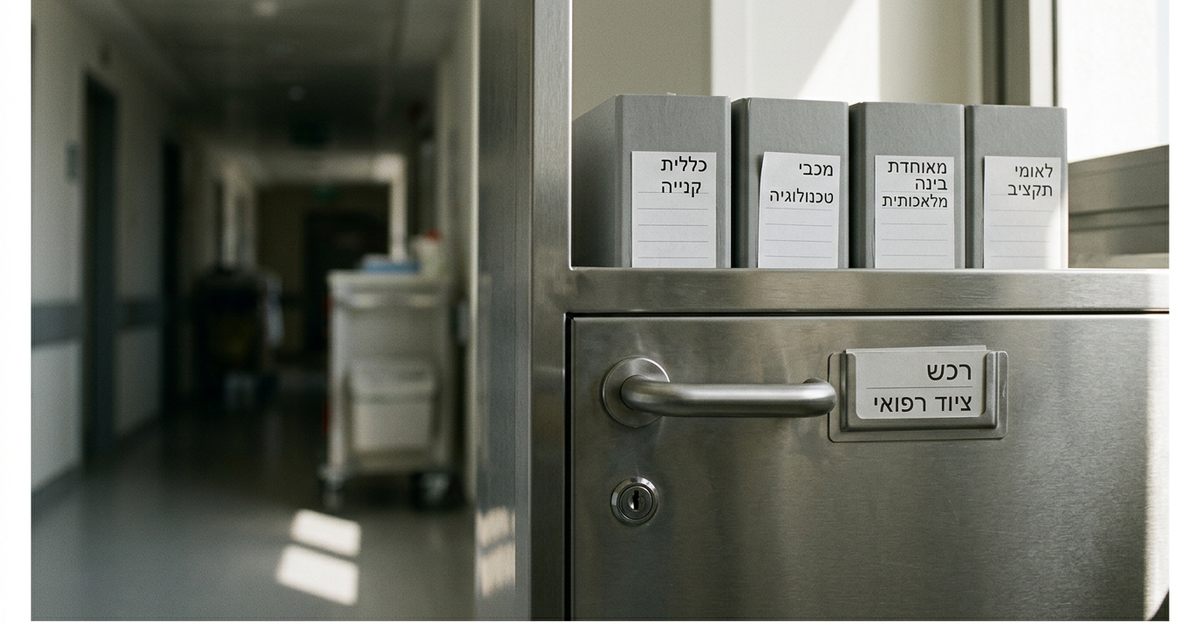

Israel's four HMOs control more than $25 billion in annual healthcare procurement. Their decisions on AI, pharma, diagnostics, and digital health shape the country's healthtech sector — and almost nobody covers them as buyers.
Clalit, Maccabi, Meuhedet, Leumit — four HMOs run one of the most concentrated healthcare purchasing markets in the developed world. Their procurement decisions shape Israeli healthcare AI. Nobody covers them as buyers.
Four institutions control more than $25 billion in annual Israeli healthcare procurement. Clalit Health Services. Maccabi Healthcare Services. Meuhedet. Leumit Health Services. They are not publicly traded. They do not report earnings. They rarely announce procurement wins. And every Israeli — all 9.8 million — belongs to one of them.
Together, the four HMOs run one of the most concentrated healthcare purchasing markets in the developed world. Their procurement decisions shape Israeli healthcare AI, pharmaceuticals, diagnostics, and digital health. Yet almost nobody covers them as buyers.
This is the most underreported procurement story in Israeli business.
Why It Matters
Israel's four HMOs control roughly $25 billion in annual healthcare spend, two of the largest population-health datasets outside the Nordics, and the binary credential — clinical deployment — that decides which Israeli healthtech companies scale globally. For foreign acquirers, HMO deployment is the de facto commercial validation layer. For founders, the four HMOs are the four gatekeepers between thesis and product.
The Locked Market
Under the 1995 National Health Insurance Law, every Israeli must enroll in one of the four funds. Membership is portable but sticky. The split has been stable for a decade.
- Clalit Healthcare Services — ~52% of the country. Nearly 5 million members. Operates 14 hospitals and ~1,500 clinics. The legacy giant, formerly affiliated with the Histadrut labor federation.
- Maccabi Healthcare Services — ~25%. About 2.4 million members. Tel Aviv-based. The technocratic challenger. Operates Israel's largest biobank through its research arm KSM.
- Meuhedet — ~14%. Roughly 1.3 million members. Strong base in religious and Haredi communities. Demographically the fastest-growing slice.
- Leumit — ~9%. About 750,000 members. Founded 1933. The smallest of the four. Heaviest reliance on contracted independent physicians.
The market is structurally locked. Four buyers. One mandatory market. No new entrants since 1995.
The Buyers Behind Israeli Healthcare AI
When a multinational pharma company wants Israel-wide access for a new drug, it negotiates with these four. When a healthcare-AI startup wants real-world deployment, it pitches these four. When a wearables vendor wants population-scale validation data, it goes to Clalit's research division and Maccabi's data team.
The HMOs are not pass-through payors. They are integrated systems. Clalit alone operates 14 hospitals, more than 1,500 clinics, an in-house pharmacy network, and one of the world's largest structured longitudinal health datasets — patient records dating to the late 1990s, on a population of nearly five million.
Maccabi runs a parallel operation through KSM — its data science and innovation arm — and Maccabitech. Both functions evaluate, pilot, and contract with Israeli health-tech vendors at a velocity most ministries can't match.
Meuhedet and Leumit are smaller but not invisible. Both have run procurement RFPs in the last 18 months for AI triage, medical imaging, claims analytics, and remote-monitoring tools. Both are now active customers of at least one publicly-traded Israeli healthtech company.
This is a buyer class. It is not being covered as one.
Why Procurement Is the Real Story
Two things get missed, repeatedly.
- Procurement is the news. When an HMO contracts with a vendor, it is often the difference between Series B and Series D. Coverage of the deal — when it exists — usually appears in the vendor's press release, not in any independent reporting on the buyer. The HMO is treated as a logo, not a strategic decision-maker.
- The spinouts are unmapped. Clalit Innovation has been formally operating since 2017. Maccabi has run innovation challenges and accelerator programs for the better part of a decade. Multiple companies — across telemedicine, oncology decision support, and chronic-disease management — trace their origin to HMO-internal R&D. There is no public registry. No standard tracker. No alumni list.
The Hidden Data Infrastructure
Clalit and Maccabi sit on what may be the most longitudinal, structured, demographically diverse population health datasets outside the Nordic countries. Decades of structured records. National scale. Linked across primary care, specialty, pharmacy, hospitalization, and outcomes.
That dataset is why Clalit Research Institute has co-authored peer-reviewed work with Harvard, MIT, and the Broad Institute. It is also why Clalit is — quietly — one of the largest enterprise buyers and co-developers of healthcare AI in the country.
Access terms, licensing structures, and commercial partnerships are negotiated case-by-case and rarely disclosed.
In the AI era, opacity at this scale is itself a story.
Why Investors Are Paying Attention Now
The Israeli healthcare-tech sector continues to outperform every other vertical in the country except defense and cyber. Foreign acquirers — U.S. health systems, European pharma, global insurers — are increasingly screening Israeli targets for one credential.
Clinical deployment inside the HMOs. Without it, a startup is a thesis. With it, a startup is a commercial product.
For global pharma companies, healthtech founders, PE funds, and strategic acquirers, Israeli HMO deployment is increasingly becoming a commercial validation layer. Winning one national HMO contract in Israel can become proof-of-market for expansion into the U.S. and Europe.
That credential is decided by four buyers. Three of whose CEOs most international healthtech investors have never met.
Israel's healthcare innovation story is usually told through startups.
But startups do not define the market on their own.
Buyers do.
And in Israel, four institutions — largely invisible outside the country — determine which technologies scale, which vendors survive, and which healthtech companies become global businesses.
Olam begins there.
Read next: Clalit — Israel's largest buyer of healthcare AI.
How we report: Olam stories draw on public filings, company disclosures and named sources, checked by our editors. Read our methodology · Corrections