
Maccabi serves ~2.4 million Israelis and runs the country's largest biobank through KSM. The most commercially accessible HMO partnership platform in the developed world — and the one most foreign healthtech companies still underestimate.
Israel's second-largest HMO has built the country's most commercially structured healthcare research engine — KSM and Maccabitech. The largest biobank in Israel. An export-grade data partnership model. A deal roster that reaches from Boston to Abu Dhabi.
Maccabi covers 2.4 million Israelis — roughly 25% of the country. Tel Aviv-based. Younger demographic skew. A leaner provider model that contracts with independent physicians rather than fully owning clinics.
And — by design — the HMO most aggressively built around commercialization.
The Maccabi innovation function is not a department. It is two institutions — KSM and Maccabitech — plus a partner roster that ranges from a Boston AI-infrastructure startup to a Gulf health regulator.
This is the pipeline.
Why It Matters
Maccabi runs Israel's most commercially accessible national health-data partnership platform. KSM operates an explicit funnel — ideation, IRB, data deal, deployment — that pharma, AI, and life-sciences companies can navigate from the outside. For global buyers seeking national-scale RWE, AI training data, or clinical validation in a single jurisdictional perimeter, Maccabi is the most reachable counterparty in the developed world.
Two Institutions, Not One
Maccabi's innovation stack has two distinct centers of gravity, often confused for the same thing.
- Maccabitech — the older arm. The HMO's in-house innovation center. Originally founded around mining Maccabi's two-decade EMR archive and matching it to outside research projects. Operationally embedded.
- KSM — Kahn-Sagol-Maccabi Research and Innovation Center — founded in 2016 in partnership with philanthropists Morris Kahn and Sami Sagol. Led by Dr. Tal Patalon. Built specifically to be the institution that international partners contract with.
KSM is the entity to know. It is what foreign pharma, foreign health ministries, and foreign AI companies are buying.
The Biobank
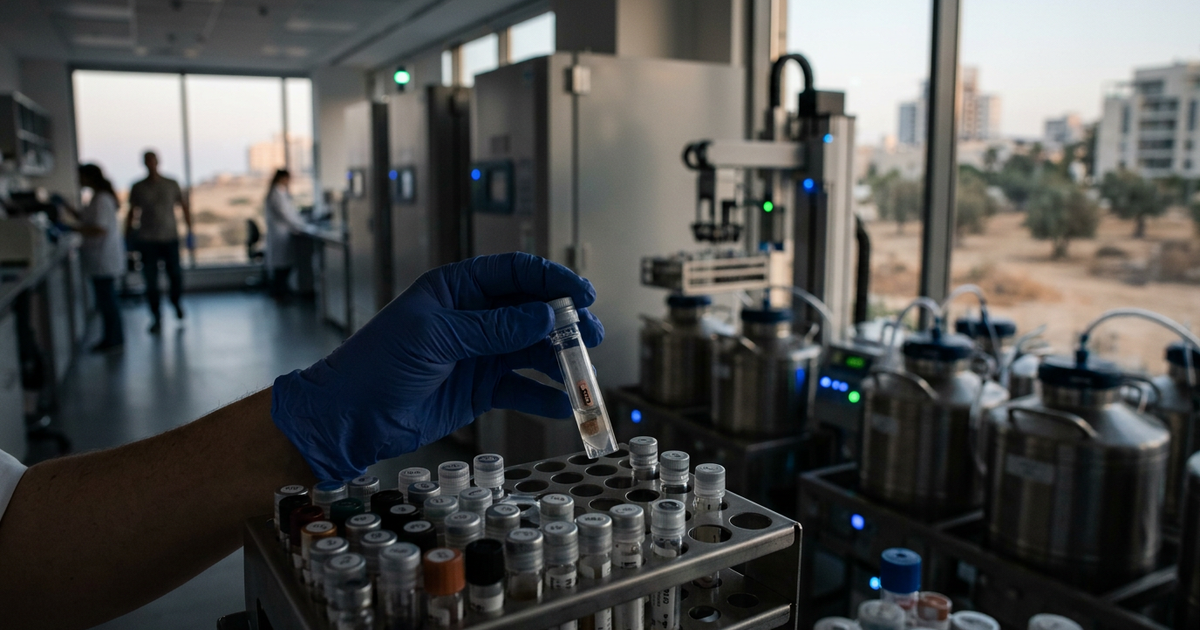
KSM operates the Tipa Biobank — by KSM's own description, the largest biobank in Israel, with samples reported in the 900,000 to 1 million range depending on the year.
A biobank of that scale, linked to a two-decade EMR archive on the same population, is an unusual research asset. It allows partners to run retrospective real-world studies and prospective trial cohorts inside one institutional perimeter, with a single set of IRB approvals.
For pharma, that combination — genotype, longitudinal phenotype, structured outcomes — is the asset most U.S. systems do not have.
The Productized Partnership Model
KSM is not a research silo. It is a vendor-facing platform.
Its public-facing description is unusually direct for an HMO: it offers researchers, med-tech companies, startups, and global healthcare partners a defined journey — ideation, IRB approval, data partnership, and "potential solution implementation in HMO services."
That last phrase is the commercial promise. The credential at the end of the funnel is deployment inside Maccabi.
It also reflects what most foreign investors miss: Maccabi has chosen, deliberately, to act like a market — with discoverable terms, repeatable structures, and a public partnership product.
The Deal Roster
A non-exhaustive list of partnerships that have been publicly reported.
- K Health — the New York-based primary-care AI company. The "K" app was developed in collaboration with Maccabitech and trained in part on Maccabi's data archive. K Health later raised at multi-hundred-million-dollar valuations and expanded internationally.
- Rhino Health — Boston-based privacy-preserving distributed computing platform. KSM contracted with Rhino in 2022 to allow external AI developers to train models against KSM's data without raw data ever leaving Maccabi.
- Department of Health, Abu Dhabi (DoH) — formal MoU announced in early 2024. KSM as the Israeli counterparty to a Gulf health regulator on innovation and life-sciences partnership.
- Multiple pharma collaborations for real-world evidence studies, vaccine effectiveness research (notably during COVID-19), and retrospective oncology and chronic-disease analyses.
Each one is a procurement decision. Each one was negotiated. Each one is leverage for the next deal.
Why the Maccabi Model Matters
Clalit and Maccabi are often discussed as if they are interchangeable. They are not.
Clalit owns the provider economy. Its innovation flows naturally from the largest captive patient population in the country and a fully owned hospital network.
Maccabi owns the commercial interface. Its model — leaner, more digital, more vendor-facing — was built around partnership-readiness. It is structurally easier for an outside company to do a deal with KSM than with most national health systems anywhere in the world.
That is a competitive advantage that almost no Western single-payer can replicate.
The Investor Layer
For a U.S. pharma company, a Maccabi RWE study is faster to scope and contract than the equivalent through most U.S. integrated systems. For a global AI company, KSM is one of the most accessible national-scale data partners on the planet — and one of the most under-marketed.
For an Israeli healthtech founder, a KSM partnership is often the credential that turns a Series A pitch into a Series B round.
For foreign acquirers screening Israeli targets, KSM deployment functions as a commercial diligence signal alongside Clalit. The two together cover roughly 77% of the country.
Israel's second-largest HMO has built a partnership engine that operates more like a venture platform than a payor.
It is structurally accessible. Commercially explicit. And quietly responsible for a disproportionate share of the AI, RWE, and life-sciences deal flow into the country.
The Maccabi Innovation Pipeline is not a pilot. It is an export industry.
Read next: Meuhedet — the third HMO almost nobody maps. See also: Israel's $25 Billion Buyer Class You Can't See.
How we report: Olam stories draw on public filings, company disclosures and named sources, checked by our editors. Read our methodology · Corrections