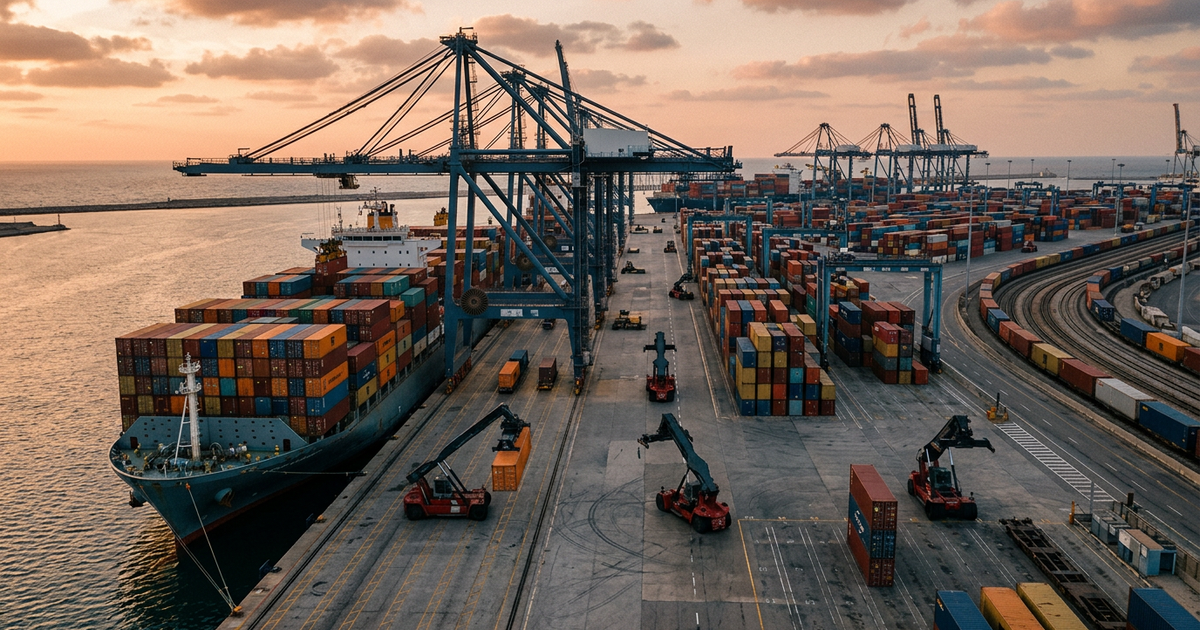

Israel's economy depends on maritime trade for over 98 percent of import and export volume. Container throughput runs at approximately 3 million TEU annually as of 2026. How the system is structured, where it is exposed, and what's changed.
By The Olam Editorial Team
How Israel's ports, shipping lanes, and inland logistics function as the operating system of a trade-dependent economy — and where the system is strong, exposed, and contested.
TL;DR
Israel's economy depends on maritime trade for over 98 percent of import and export volume. The system runs on two Mediterranean ports (Haifa and Ashdod) — each split between legacy state-affiliated terminals and 2021-vintage private greenfield terminals operated by Shanghai International Port Group at Bayport and MSC's Terminal Investment Limited at Hadarom — plus a small Red Sea port at Eilat that has been functionally suspended since late 2023. Container throughput runs at approximately three million TEU annually as of 2026. The 2023 Adani-Gadot acquisition of the Haifa Port Company and the proposed India–Middle East–Europe Economic Corridor have repositioned the system as a candidate corridor terminus, not just a national gateway.
Key Facts
- Over 98 percent of Israeli foreign trade by volume moves through maritime channels.
- Container throughput across Israeli Mediterranean ports runs approximately 3 million TEU annually as of 2026.
- Four container terminals operate: Haifa Port (Kishon-side), Bayport, Ashdod Port, and Hadarom.
- Bayport (Shanghai International Port Group / SIPG) and Hadarom (TIL / MSC) opened in 2021 as private greenfield concessions.
- Adani Ports & SEZ, in consortium with Gadot Group, acquired the Haifa Port Company; the deal closed January 2023 at a reported value of approximately USD 1.18 billion.
- Eilat Port, the country's only Red Sea facility, has operated at near-zero commercial throughput since late 2023 and filed for state assistance in summer 2024.
- Israel Ports Development & Assets Company retains landlord functions including channel depth, breakwaters, and land-side infrastructure.
- ZIM Integrated Shipping Services (NYSE: ZIM) is the Israeli-headquartered global container line and a top-twenty global carrier.
Israel as a Trade Corridor
Israel runs an open economy on a narrow geography. More than 98 percent of its imports and exports by volume move through the sea. The country has no land border that functions as a meaningful commercial trade route — Lebanon and Syria are closed, the Egyptian crossing at Nitzana handles only a fraction of regional freight, and the Jordanian crossings at Sheikh Hussein and Allenby are constrained by capacity and political weather. The result is that Israel's economic relationship with the world is, in practical terms, a maritime relationship.
That structural dependence is not new, but its strategic weight has changed. Israel is a roughly one-trillion-dollar economy with a heavy import bill in energy, raw materials, vehicles, machinery, and consumer goods, and an export profile that has tilted toward higher-value categories — semiconductors, pharmaceuticals, defense systems, software, polished diamonds, and agricultural technology. The cargo mix has thinned and accelerated. The ports that handle it have had to keep up.
The country sits on a coastline of roughly 190 kilometers along the eastern Mediterranean, with a second, much smaller maritime frontage at Eilat on the Gulf of Aqaba. That single fact — Mediterranean here, Red Sea there — is the geographic premise of every conversation about Israeli logistics. It is also the premise of every recent disruption.
For two decades, the consensus map placed Israel as an end-of-line destination — a market reached by container lines whose primary trans-shipment hubs were Piraeus, Port Said East, Damietta, and Limassol. The country received cargo; it did not route it. That assumption is contested as of 2026. The combination of the Abraham Accords, the proposed India–Middle East–Europe Economic Corridor (IMEC), persistent disruption at Bab el-Mandeb, and the privatization of the Israeli port system has reopened a much older question: whether Israel can function as a candidate corridor terminus rather than only a destination.
Whether IMEC matures into a working route or remains a diplomatic framework, the underlying logic is durable. A container leaving Mumbai, transiting the Arabian Sea, landing at Jebel Ali, moving overland through Saudi Arabia and Jordan, and shipping out of Haifa to Genoa or Marseille could, in principle, reach the European consumer faster than one waiting in the Suez queue or rerouting around the Cape of Good Hope. The economics depend on volume, customs harmonization, and rail. The geography is fixed.
Whether that proposition becomes operational reality is a separate question. Saudi normalization has not occurred. Sustained overland flows have not been demonstrated at scale. The corridor argument is credible; it is not concluded.
The Port System
Israel's commercial port system is built on two Mediterranean anchors — Haifa in the north, Ashdod in the south — and one small Red Sea outpost at Eilat. Each Mediterranean port now operates as a two-terminal complex, with a legacy facility under state-affiliated or recently privatized control and a 2021-vintage automated container terminal under foreign private-operator concession.
Haifa Bay hosts the original Port of Haifa (Kishon-side), operated by the Haifa Port Company under the Adani-Gadot consortium since January 2023, alongside Bayport (Hamifratz), an automated container terminal operated under concession by Shanghai International Port Group (SIPG) since its 2021 commissioning. Ashdod hosts the legacy Ashdod Port (state-affiliated Ashdod Port Company) alongside the Hadarom terminal, operated under concession by Terminal Investment Limited (TIL), the MSC-affiliated terminal operator, since 2021.
Eilat, on the Gulf of Aqaba, is structurally different. It is small. It has historically handled vehicle imports from Asia, potash exports, and certain bulk commodities, and served as the only Israeli outlet onto the Red Sea and the Indian Ocean trade lanes. Its strategic value has always been about what it enables — a non-Suez route into Asia — rather than the volume it physically handles. Since late 2023, that strategic value has been suspended.
Beyond the three public-facing ports, Israel maintains specialized private terminals — fuel and chemical jetties at Ashkelon and Haifa, Israel Chemicals (ICL) operations supporting potash and bromine exports, and a handful of dedicated berths serving the petroleum sector. These do not appear in container statistics but move material volumes of strategic cargo.
Capacity is materially higher than throughput as of 2026. The combined commissioning of Bayport and Hadarom roughly doubled national container handling capacity relative to the pre-2021 system, and channel-deepening at both Haifa and Ashdod has accommodated ultra-large container vessels of 14,000 TEU and above. The Israel Ports Development & Assets Company (the landlord entity) retains responsibility for channel depth, breakwaters, and land-side infrastructure across the system.
Port System: Operator Map
| Facility | Operator | Concession / Ownership | Primary Role | Strategic Function |
|---|---|---|---|---|
| Port of Haifa (Kishon-side) | Haifa Port Company | Adani-Gadot consortium, closed Jan 2023 | Containers, general cargo, vehicles, cruise | Northern gateway; IMEC corridor candidate |
| Bayport / Hamifratz (Haifa) | Shanghai International Port Group (SIPG) | 25-year concession, opened 2021 | Automated container terminal | Capacity expansion; geopolitical sensitivity |
| Port of Ashdod | Ashdod Port Company | State-affiliated | Containers, general cargo, vehicles, bulk | Central/southern Israel gateway |
| Hadarom / Southport (Ashdod) | Terminal Investment Limited (TIL / MSC) | Concession, opened 2021 | Automated container terminal | MSC network anchor |
| Port of Eilat | Eilat Port Company (private) | Concession | Vehicle imports, bulk | Red Sea gateway; functionally suspended since late 2023 |
| Israel Ports Development & Assets Co. | State landlord | Government entity | Land, channel, breakwater, infrastructure | Sets capacity envelope across system |
Operator concessions, ownership, and roles across the Israeli port system as of 2026.
Haifa Port Privatization and Global Investment
The January 2023 closing of the Haifa Port Company acquisition by the Adani-Gadot consortium — at a reported value of approximately USD 1.18 billion — was the single most consequential commercial transaction in the modern history of Israeli infrastructure. India's Adani Ports & SEZ holds the controlling stake; Israel's Gadot Group is the local partner. The transaction completed the privatization arc that began with the Bayport and Hadarom concessions of 2021.
Operationally, the Adani-Gadot consortium runs the traditional Kishon-side facilities — general cargo, vehicles, cruise calls, and a container terminal — distinct from Bayport, which remains under SIPG concession. Adani's mandate is to modernize Haifa, deepen its commercial linkages, and integrate it into the global Adani network spanning Mundra, Hazira, Vizhinjam, and a growing footprint in Africa and Southeast Asia.
Geopolitically, the port system that has emerged is plural by design. Indian operating capacity at Haifa Port, Chinese state-owned operating capacity at Bayport, MSC-affiliated operating capacity at Hadarom, and Emirati interest in the broader corridor produce a logistics map that no single power controls. The diffusion tracks the broader pattern of Israeli infrastructure policy — multiple foreign operators, multiple home-country alignments, no single point of geopolitical capture.
The SIPG concession at Bayport remains a point of friction. American officials have repeatedly raised the issue of Chinese commercial access to Israeli port facilities adjacent to Sixth Fleet operations. The Indian operator at the Haifa Port Company has, by contrast, been welcomed in Washington and is part of why the composition now reads as deliberate diversification.
Commercially, the privatized model has reduced costs for Israeli shippers and improved turnaround times measurably. The reform is not complete — labor questions remain unresolved at some legacy facilities, and integration with rail and road networks is still maturing — but the operating direction is set.
Israel–UAE Trade Corridor
The Abraham Accords of September 2020 reopened the commercial map. Bilateral trade between Israel and the United Arab Emirates — effectively zero before the agreements — has grown into the multi-billion-dollar range, with cargo, capital, technology, and people moving in both directions.
Direct sea routes between Israeli Mediterranean ports and Jebel Ali, Khalifa Port, and Hamad Port have been established and are operated by ZIM, MSC, and other lines. Air cargo capacity between Tel Aviv and Dubai expanded rapidly after 2020 and remains a major channel for high-value goods including diamonds, electronics, and pharmaceuticals. The most discussed but not yet operational concept is the overland corridor — a road and, eventually, rail route running from the Gulf through Saudi Arabia and Jordan into Israel and onward to the Mediterranean.
Saudi participation is the binding constraint. The kingdom has permitted limited transit but has not normalized relations with Israel as of 2026, and the political path to a fully operational corridor depends on developments well outside the logistics conversation. What does exist today is a functioning Israel–UAE trade lane that runs primarily by sea and air, supplemented by truck movements through Jordan.
Emirati capital has entered the regional logistics economy. DP World, the Dubai-based global terminal operator, has signed cooperation agreements with Israeli partners and has explored direct involvement in Israeli port operations. The combination of Indian, Chinese, MSC, and Emirati interest produces a denser commercial fabric than the region has carried in a generation.
Red Sea and Regional Shipping Disruption
The Houthi attack campaign against commercial shipping in the Bab el-Mandeb strait and the southern Red Sea, beginning in late 2023, produced the largest disruption to global container logistics since the COVID-era port congestion of 2021. For Israeli logistics, it was an extinction-level event for one node — Eilat — and a costly rerouting exercise for everyone else.
Eilat sits at the wrong end of the wrong sea. Cargo bound for Eilat must transit the southern Red Sea, where attacks made commercial routing untenable. By summer 2024, Eilat Port reported revenues had collapsed, container and vehicle handling had stopped almost entirely, and the operator had sought emergency state assistance. The port did not fail because of its own operational issues. It failed because the lane that fed it became uninsurable.
The Mediterranean ports absorbed the secondary effects. Container lines serving Israel rerouted around the Cape of Good Hope, adding roughly 10 to 14 days of transit time and a per-voyage cost increase that industry estimates have placed at USD 1 million or more on the largest vessels. War-risk insurance premiums on Israel-bound cargo spiked, in some cases by orders of magnitude.
The broader regional consequences were significant. Suez Canal transits fell sharply through 2024 — by industry estimates, on the order of 50 to 60 percent at the worst — with corresponding pressure on Egyptian state revenues from canal tolls. ZIM repositioned its network early, pulling vessels off the Red Sea route. Maersk, MSC, CMA CGM, and Hapag-Lloyd followed at different paces.
The strategic lesson is twofold. First: Israel's dependence on the Red Sea is asymmetric — the Mediterranean carries the volume, but Eilat carried a unique non-Suez gateway function that is now suspended. Second: resilience is no longer a planning abstraction. Multiple operators, multiple lanes, overland alternatives, and inventory buffers have moved from optional to standard.
Warehousing and Inland Logistics
What happens after the container leaves the port is, in dollar terms, a larger part of the Israeli logistics economy than what happens at the quay. The inland system — trucks, warehouses, distribution centers, last-mile delivery, cold chain — has expanded faster than the port system over the last decade.
The geographic structure is concentrated. The Modi'in–Shoham–Lod corridor, anchored by Ben Gurion Airport and the central road network, has become the dominant warehousing and distribution belt. Yavne, Beit Shemesh, and the Hadera–Caesarea area host secondary clusters. The northern logistics base around Haifa serves the upper Galilee market; the southern base around Ashdod and Kiryat Gat serves the Negev. Industrial real estate values in these clusters have risen sharply, and major institutional investors have entered the market.
Cold chain is a specialty segment of growing strategic importance. Pharmaceutical exports — Teva, Insightec, and the broader medical device sector — require validated cold storage and temperature-controlled transport from factory to ship to overseas distribution. Investment in refrigerated warehousing has tracked the growth in both pharmaceutical and food categories.
E-commerce has been the single largest demand driver. Domestic carriers like Yango and platforms like Wolt have built dense urban delivery networks, producing dedicated logistics architecture. Trucking is consolidated among a smaller number of larger operators — Taavura Holdings is the largest single inland operator.
Customs and inland clearance have improved markedly. The Israel Tax Authority has digitized customs declarations, integrated with port systems, and reduced the average time between vessel discharge and goods release.
Future of Israeli Logistics
The next decade will be shaped by four forces: automation, regional integration, geopolitical risk, and the AI-driven reorganization of supply chain decision-making.
Automation has already arrived at the port edge. Bayport and Hadarom operate with automated stacking, integrated terminal operating systems, and minimal human handling on the quay. The next layer is inland — warehouse automation, autonomous truck movements within terminals and logistics parks, and yard management digitization. Israeli logistics-technology firms including Bringg, Trigo, and Fabric are exporting capability globally.
Regional integration depends on Saudi normalization. The proposed IMEC corridor has a logical terminus at an eastern Mediterranean port — most likely Haifa. Whether the corridor matures into a working freight route or remains a diplomatic framework will depend on factors well outside the logistics sector.
Geopolitical risk is the planning constant. The 2023–2024 disruption demonstrated that logistics resilience cannot assume the past two decades of trans-shipment conditions will recur. Insurance, routing, redundant operators, multi-modal alternatives, and onshore inventory buffers are now part of the standard import architecture.
AI in logistics is moving from optimization tool to decision layer. Predictive routing, dynamic pricing of freight capacity, automated customs classification, and AI-driven demand forecasting are entering the operational stack. Israeli ports, with newer infrastructure and digital baselines, are positioned to adopt these layers faster than larger but older European competitors.
Vulnerabilities
The system has structural exposures that are now well understood. Five matter most.
First, Red Sea routing. The disruption that began in late 2023 demonstrated that the Suez–Red Sea–Bab el-Mandeb corridor cannot be assumed as a permanent feature of Israeli trade. Alternative routing around the Cape of Good Hope has added cost and transit time. The lane has not fully normalized as of 2026.
Second, war-risk insurance. Premiums on Israel-bound cargo spiked through 2023–2024 and remain elevated relative to the pre-disruption baseline. The insurance market repriced regional risk and has not fully reversed.
Third, labor. Israeli port labor at the legacy facilities has been a periodic source of friction during the privatization transition. Reserve-duty demands following October 2023 placed additional pressure on the broader logistics workforce, including truckers, terminal operators, and warehouse staff.
Fourth, inland bottlenecks. The road network between Ashdod and the central distribution corridor — particularly Route 4 and the Highway 6 connection — produces congestion that caps effective throughput. Rail freight share remains low by European standards. Israel Railways' freight operations have expanded but have not closed the gap.
Fifth, geopolitical exposure of operators. The SIPG concession at Bayport remains a point of friction in Washington. The Adani-Gadot ownership of the Haifa Port Company has been politically welcomed but is exposed to the broader trajectory of the Adani Group. The concentration of foreign operators is, simultaneously, the system's strength and its vector of geopolitical risk.
Bottom Line
Israel's trade infrastructure has moved, over the past five years, from being a functional but unremarkable national system to a strategically consequential asset whose configuration matters to multiple global powers. Privatization, automation, foreign operator concentration, and corridor diplomacy have pulled in the same direction — toward greater commercial importance and higher strategic stakes. The work of the next decade is whether the inland and political conditions allow that infrastructure to live up to the position it now occupies.
Related on The Olam
- Israel Port System: Who Operates What?
- Inside the Port of Haifa and Its Expanding Role in Mediterranean Trade
- Port of Ashdod and the Future of Israeli Shipping Infrastructure
- Eilat Port and the Red Sea Crisis
- Red Sea Shipping Disruption and the Impact on Israeli Supply Chains
- Israel's Logistics Bottlenecks
- ZIM: Israel's Global Container-Shipping Line
- Israel Rail Freight and Port Connectivity
- The Infrastructure Behind Israeli Trade
How we report: Olam stories draw on public filings, company disclosures and named sources, checked by our editors. Read our methodology · Corrections