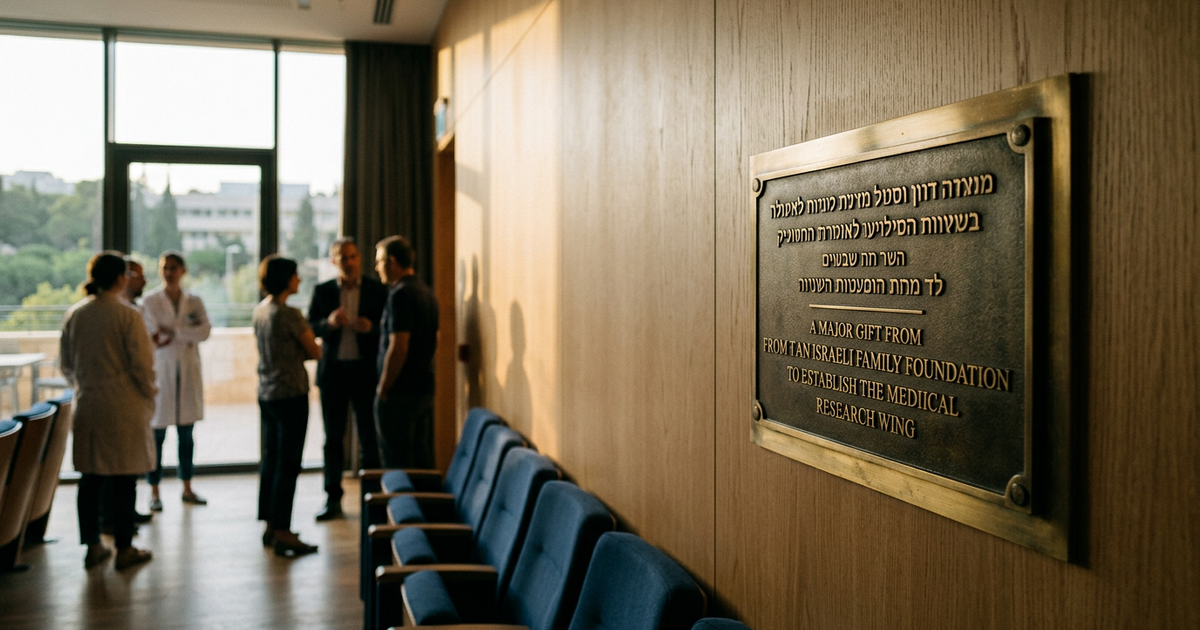

Israeli private philanthropy is output of private capital — not the subject of it. The named institutions, the foundations, and the structural role of family foundations in Israeli medical, educational and cultural infrastructure.
Israeli private philanthropy is an output of private capital, not its subject. The hospitals, universities and museums carrying family names are downstream of the same structures that anchor the country's shipping, real estate, food, defence electronics and technology fortunes. This piece treats the philanthropic dimension on its own terms while keeping the framing right — capital first, deployment second.
Hospitals
The major Israeli medical centres are the most visible recipients. The Tel Aviv Sourasky Medical Center, Sheba Medical Center at Tel Hashomer, Hadassah Medical Center in Jerusalem, the Rambam Health Care Campus in Haifa, and Ichilov each rely on continuous private philanthropic infrastructure. The Sammy Ofer Heart Center at Sheba, the Edmond and Lily Safra Children's Hospital at Sheba, and the recurring presence of Wertheimer, Azrieli, Sagol and Sherman family names across Israeli medical infrastructure are representative. Newer commitments include the Sagol Center for Regenerative Biotechnology and the Helmsley Charitable Trust's substantial Israeli medical program.
Universities
The country's research universities are the second pillar. Tel Aviv University, the Hebrew University of Jerusalem, the Technion in Haifa, the Weizmann Institute of Science in Rehovot, Ben-Gurion University, Bar-Ilan University and Reichman University all maintain donor naming across schools, faculties, buildings and chairs. The Edmond J. Safra campuses across multiple universities, the Adelson School of Entrepreneurship at Reichman, the Sagol School of Neuroscience at Tel Aviv University, the Azrieli Faculty of Medicine at Bar-Ilan, and the Russell Berrie Nanotechnology Institute at the Technion are representative.
Cultural infrastructure
Cultural institutions are the third pillar. The Tel Aviv Museum of Art, the Israel Museum in Jerusalem, ANU the Museum of the Jewish People, the Eretz Israel Museum and the Yitzhak Rabin Center each operate on philanthropic foundations supplied by Israeli and diaspora capital. The Helena Rubinstein Pavilion, the Herta and Paul Amir Building at the Tel Aviv Museum, the Mandel Wing at the Israel Museum, and the comprehensive renewal of ANU under a multi-donor consortium represent gifts of the same scale and pattern as their counterparts at major American and European institutions.
Major foundations
The major philanthropic platforms operating at scale include the Arison Foundation, the Azrieli Foundation, the Iscar Foundation associated with the Wertheimer family, the Edmond de Rothschild Foundations including the Caesarea Foundation, the Andrea and Charles Bronfman Philanthropies, the Russell Berrie Foundation, the Helen Diller Family Foundation, the Sherman Family Foundation, the Adelson Family Foundation, the Saban Family Foundation, the Jack, Joseph and Morton Mandel Foundation, the Sagol Foundation, the Schusterman Family Philanthropies, the Davidson Foundation, the Helmsley Charitable Trust's Israel program and the Edmond J. Safra Philanthropic Foundation. Each operates with a distinct programmatic focus.
October 2023 onward
The post-October 2023 period saw a significant acceleration of diaspora philanthropic flow into Israel, including emergency medical, civilian-resilience and educational funding alongside the longer-running infrastructure commitments. United Federations of Jewish Federations, the Jewish Agency, the Jewish National Fund and a range of single-issue emergency vehicles channelled record diaspora capital in the immediate aftermath. Single-family foundations made some of the largest individual commitments. The flow demonstrated the durability of the philanthropic infrastructure under stress.
Philanthropy as expression of capital
The pattern that emerges is structural rather than charitable. The state could not, in practice, replace what family foundations supply. The same families that control the country's largest commercial real estate, defence electronics, banking and food companies control the foundations that fund the country's hospitals, universities and museums. The philanthropic infrastructure is downstream of the capital infrastructure. Read it that way and the picture is clearer.
How we report: Olam stories draw on public filings, company disclosures and named sources, checked by our editors. Read our methodology · Corrections