
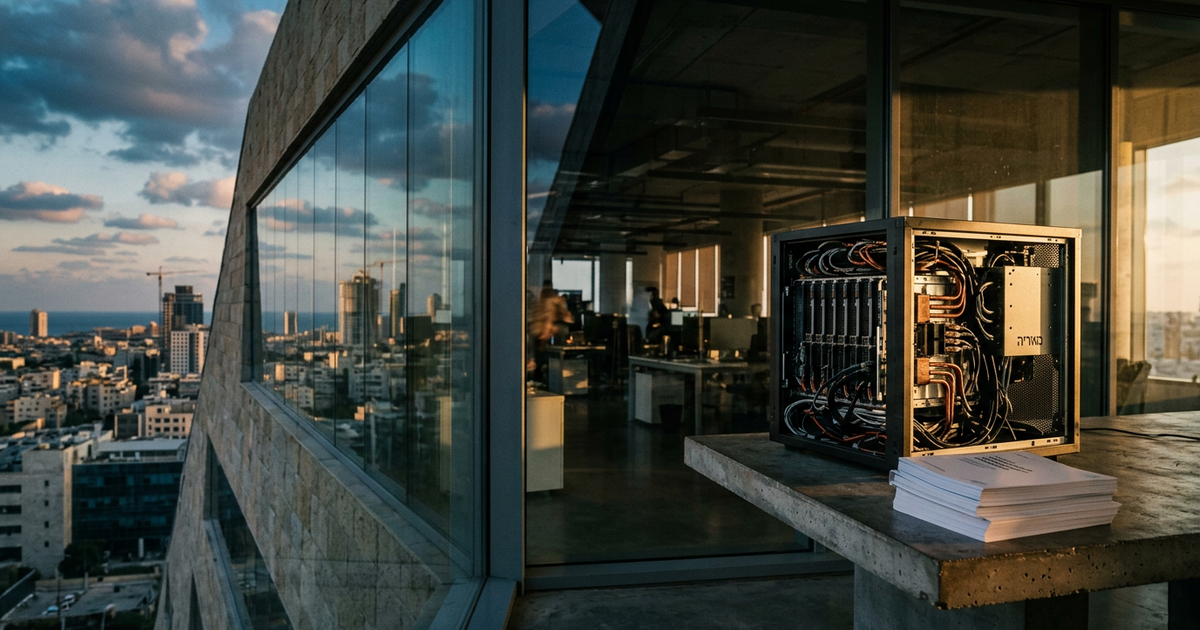

Israel raised $15.6 billion in tech in 2025 — nearly $8 billion in AI. The complete 2026 guide to Israel's AI economy: startups, NVIDIA, defense, cybersecurity, capital, infrastructure.
Israel raised $15.6 billion in technology investment in 2025. Nearly $8 billion of that went to companies built primarily around artificial intelligence, according to Startup Nation Central.
That ratio captures the shift underway. Israel is no longer a startup nation that happens to do AI. It is becoming an AI economy.
Three forces are driving it:
- compute concentration led by NVIDIA
- defense conversion since October 2023
- capital concentration around foundation models, cyber, and AI infrastructure
Together they are reshaping Israel’s position inside the global AI stack. This is the master guide to that economy — the sectors, companies, capital, chip infrastructure, defense layer, university pipeline, and compute footprint that together form Israel’s place in the global artificial intelligence stack.
The Israeli AI Economy at a Glance
Key Facts
- 2025 total Israeli tech funding: $15.6 billion
- AI-specific funding: $7.9 billion
- Generative AI startups operating in Israel: 342
- NVIDIA Israel headcount: 5,000+, with a 10,000-employee campus planned in Kiryat Tivon
- Largest exit in Israeli high-tech history: Google’s $32 billion acquisition of Wiz, closed March 2026
- Second-largest cybersecurity acquisition in history: Palo Alto Networks’ $25 billion acquisition of CyberArk, closed February 2026
Why Israel Became an AI Economy
Three converging structural factors moved Israel from being a country with AI startups to being an AI economy.
The first is compute proximity to global hyperscale. NVIDIA, Intel, Amazon, Google, and Microsoft all operate substantial Israeli AI development centers. NVIDIA’s is the largest, with more than 5,000 engineers building chips, networking, and AI software that ship globally. The world’s frontier AI infrastructure is partly an Israeli product.
The second is defense-civilian feedback loops. Two years of sustained conflict have collapsed the historical wall between civilian startups and military procurement. More than 130 Israeli startups have been integrated into the war effort since October 2023, roughly half in autonomy and AI. New institutional architecture — MAFAT’s AI and Autonomy Administration, the IDF’s Bina AI Division — is now embedding algorithms across every tactical layer.
The third is strategic capital concentration. AI and cybersecurity together accounted for roughly 70 percent of all capital raised by Israeli startups in 2025. Mega-rounds — those above $100 million — represented half of all 2025 tech capital, up from 41 percent in 2024. The number of fundraising rounds fell to 717, a decade low, but the dollars climbed. The market is consolidating around fewer, larger bets, and the bets are concentrating in AI.
The macroeconomic effect is visible. Renewed capital inflows are contributing to shekel strength against the dollar — a pattern last seen in 2020 and 2021. Israel’s AI capital cycle is increasingly large enough to influence currency flows and broader macroeconomic sentiment.
NVIDIA and the Compute Layer
No company has done more to anchor Israel’s position in the global AI stack than NVIDIA. The company entered Israel through its $6.9 billion acquisition of Mellanox Technologies in 2019, closing in 2020. Mellanox’s Yokneam headquarters became NVIDIA’s primary Israeli hub. Six years later, NVIDIA Israel is the company’s largest research and development operation outside the United States. A fuller account is published as part of The Olam’s NVIDIA Israel coverage.
The scale is now substantial:
- More than 5,000 employees across seven Israeli research centers.
- Approximately 3,000 employees in Yokneam alone, in a campus spanning roughly 30,000 square meters.
- A new 160,000-square-meter campus announced in December 2025 in Kiryat Tivon, on 90 dunams of state-owned land granted with exemption from public tender, projected to employ 10,000 workers.
- A planned 30,000-square-meter data center in the Mevo Carmel industrial zone with potential electrical capacity of up to 100 megawatts — the country’s most powerful AI compute cluster.
- Israel-1, NVIDIA’s first Israeli supercomputer, operational in Yokneam.
Over the next three years, NVIDIA’s roadmap includes four major product lines — AI processors, central processors, and two categories of communication chips. Three of those four are being developed under the leadership of the Yokneam-based team. A meaningful portion of the networking architecture underpinning today’s frontier AI training clusters was developed by Israeli teams.
NVIDIA CEO Jensen Huang has publicly described Israel as the company’s “second home.” The phrasing is operationally accurate. When NVIDIA announced Spectrum-XGS — technology to connect multiple data centers into a single “super-factory” — the announcement came from Yokneam.
The chip ecosystem extends beyond NVIDIA. Intel acquired Habana Labs for $2 billion in 2019, building its Gaudi AI accelerator program around the Israeli team. Amazon acquired Annapurna Labs in 2015; the team now drives Amazon’s custom silicon roadmap, including the Trainium and Inferentia AI chips. Intel’s 2022 acquisition of Granulate added workload optimization software. Apple, Google, and Microsoft all run substantial Israeli silicon operations.
The Startup Layer
The Israeli AI startup ecosystem now spans foundation models, enterprise applications, agentic systems, AI security, healthcare imaging, e-commerce, autonomous platforms, and defense. A regularly updated catalog of the top Israeli AI startups is maintained separately. The strongest concentration sits at the intersection of cybersecurity and AI — treated in its own section below.
Foundation models
AI21 Labs (Tel Aviv) builds enterprise foundation models including the Jamba family — hybrid SSM-Transformer architectures with 256K context windows — plus the Maestro agentic orchestration system. Customers include Capgemini, Wix, and FNAC. The company has raised $636 million across four rounds, including a $300 million Series D in May 2025 led by NVIDIA and Alphabet. A profile is published as part of The Olam’s AI21 Labs coverage.
AI infrastructure
Run:AI, acquired by NVIDIA in December 2024 for approximately $700 million, built GPU workload management software now integrated into NVIDIA’s enterprise stack. Deci, similarly acquired by NVIDIA, contributed model optimization technology.
Healthcare AI
Aidoc deploys AI for medical imaging across more than 1,500 hospitals globally. Immunai raised $313 million in 2025 for AI-driven immunology research. Sight Diagnostics raised $186.8 million for AI-powered blood-testing. Healthcare led 2025 by Israeli deal count, with 152 funding rounds.
Enterprise applications
A wave of agentic-AI and vertical-AI companies is scaling rapidly, including Wonderful in enterprise agents and ZyG in e-commerce automation.
Defense AI
Defense is where Israel’s AI economy diverges most sharply from any other national ecosystem. The combination of mandatory military service, classified research units that double as engineering academies, frontline operational testing, and a dense civilian startup base produces a category no other country can replicate at scale. A deeper account is published in The Olam’s defense AI ecosystem coverage.
The institutional architecture has changed materially in 2025. On January 1, Israel’s Ministry of Defense created a new AI and Autonomy Administration within MAFAT — the Directorate of Defense Research and Development. In late 2025, the IDF reorganized its C4I directorate around a new AI Division named Bina, embedding algorithms across every tactical layer.
Since the start of the war in October 2023, more than 130 Israeli startups have been integrated into the war effort. Roughly 50 percent work in autonomy and AI, including drones. Another 25 percent focus on sensors and detectors. The remainder cover navigation, electronic warfare, and quantum solutions.
The capital response in 2025 was substantial:
- Total Israeli defense-tech funding and M&A exceeded $1 billion.
- Heven, a drone company, became Israel’s first defense-tech unicorn after a $100 million round at a $1 billion valuation, led by US-listed IonQ.
- Kela raised approximately $100 million. Classiq, developing software for defense-applicable quantum computing, raised $110 million.
- In the first half of 2025, 12 Israeli startups signed government-to-government export agreements. Carbyne, an Israeli emergency-communications platform, was acquired by Axon for $625 million.
Israel’s traditional defense primes — Rafael, Elbit Systems, and Israel Aerospace Industries — contribute sensors, edge compute, and autonomous platforms. Project Nimbus, the government cloud contract awarded jointly to Google and Amazon, links commercial cloud capacity to classified workloads under strict segregation. The result is a defense AI stack that runs from frontier model research, through fielded hardware, into combat-tested feedback loops.
Globally, defense-tech raised approximately $7.7 billion in 2025. Israel’s share — roughly 13 percent of global defense-tech capital, with a fraction of the population — reflects the structural advantage.
AI + Cybersecurity
Cybersecurity is not a sector adjacent to Israeli AI. It is closer to its center of gravity. The largest exits, the most concentrated capital, the deepest pool of senior operators, and the densest concentration of AI-native product all sit inside the country’s cybersecurity industry. The two largest acquisitions in Israeli technology history are both cybersecurity deals, both closed in the past twelve months, and both materially shaped by AI.
Wiz, founded in 2020 by four Unit 8200 alumni who had previously sold Adallom to Microsoft, was acquired by Google for $32 billion in cash in March 2026 — the largest exit in Israeli high-tech history and the biggest acquisition in Google’s 26-year history. Wiz crossed $1 billion in annual recurring revenue before the deal closed. The product secures cloud environments across AWS, Azure, Google Cloud, and Oracle Cloud, and has leaned heavily into AI-driven threat detection.
CyberArk, the Petach Tikva-based identity-security leader, was acquired by Palo Alto Networks in February 2026 for $25 billion — the second-largest cybersecurity acquisition ever. The strategic rationale was explicitly AI-driven: Palo Alto’s CEO Nikesh Arora described identity security as the foundational layer for securing “the new wave of autonomous AI agents.”
Below the top two exits sits a deep operating layer:
AI-native cloud and runtime security
Cyera builds an AI-driven platform for discovering, classifying, and protecting sensitive enterprise data. The company reached a $9 billion valuation in late 2025 on a $400 million round led by Blackstone. Armis, focused on connected-device security with embedded AI, is in negotiations for a reported $7 billion sale to ServiceNow.
Model and data security
A new category — securing AI models themselves, the data flowing into them, and the agents acting on their outputs — has emerged primarily in Israel. Bold, Above Security, and others are raising aggressive Series A rounds. The category extends to model governance, runtime model security, and prompt-injection defense.
Enterprise AI governance
As enterprises deploy generative AI in production, governance becomes a procurement requirement. Israeli companies are building the tooling layer: access controls for AI agents, audit trails for model decisions, data lineage for training corpora, and continuous monitoring for model drift. The category was nascent in 2024 and is now one of the fastest-growing investment areas inside Israeli cyber.
The structural reason for Israel’s cyber-AI dominance is the talent pipeline. Unit 8200 — the IDF’s signals intelligence corps — and its sister units across the IDF technology branches have produced operators who spent their formative engineering years working at the intersection of attack, defense, and machine learning at national-security scale. Many of the cybersecurity companies they have founded are now becoming AI-security companies as the product category absorbs AI.
Funding at the cyber-AI intersection reached approximately $2.5 billion in 2025, nearly double the 2024 figure. Cybersecurity and generative AI together accounted for 40 percent of all Israeli funding rounds and roughly 70 percent of total capital raised.
Universities and Research
Four institutions drive most of Israel’s academic AI output, and all four have produced founders and senior research staff for the country’s leading AI companies. A deeper account is published in The Olam’s Israeli AI universities coverage.
Technion — Israel Institute of Technology (Haifa) is the country’s largest pipeline for computer science and electrical engineering talent into the AI economy. Technion alumni populate NVIDIA Israel, Intel Habana, Mobileye, and most defense-AI startups of consequence.
Tel Aviv University hosts the Blavatnik School of Computer Science and produces research that connects directly to industry. The university hosts the annual DefenseTech Summit, now a fixture on the Israeli defense-AI calendar.
Weizmann Institute of Science (Rehovot) is the country’s premier basic-research institution. Weizmann’s machine learning groups contribute disproportionately to foundational work — papers from Weizmann appear regularly in the citation graphs of major frontier-AI labs.
Hebrew University of Jerusalem contributes both technical research and a substantial portion of Israel’s academic AI policy work. AI21 Labs’ co-founder Amnon Shashua is a longtime Hebrew University professor.
Capital Flows
Capital flowing into Israeli AI comes from four pools: domestic Israeli venture funds, global venture capital with Israeli teams, strategic investors from US technology majors, and sovereign or quasi-sovereign foreign capital. The mix has shifted materially. A complete capital map is published in The Olam’s coverage of who funds Israeli AI.
Domestic Israeli funds — Pitango, Viola Ventures, Bessemer’s Israel practice, and newer entrants — anchor early-stage rounds. Larger growth rounds increasingly require non-Israeli leads. Blackstone led Cyera at a $9 billion valuation. Lightspeed, Access Industries, and Bessemer are active across most major rounds.
Strategic capital from US technology companies is now the defining feature. NVIDIA led AI21 Labs’ $300 million Series D alongside Alphabet. Google, Intel Capital, Samsung Next, and Comcast Ventures are material investors in AI21. Salesforce Ventures and Microsoft’s M12 are active across the broader ecosystem.
The acquisition layer remains the dominant exit path. Recent and pending Israeli AI-adjacent deals include:
- Google’s $32 billion acquisition of Wiz, closed March 2026 — the largest exit in Israeli high-tech history.
- Palo Alto Networks’ $25 billion acquisition of CyberArk, closed February 2026.
- ServiceNow’s reported $7 billion acquisition of Armis (in negotiation).
- NVIDIA’s approximately $700 million acquisition of Run:AI in December 2024. Axon’s $625 million acquisition of Carbyne.
A full account of Israel’s biggest AI acquisitions and exits is maintained separately.
Infrastructure Constraints
The least-discussed component of Israel’s AI economy is the physical one. Training and running frontier AI models requires gigawatt-scale electrical capacity, fiber backbone, data center real estate, and access to top-tier GPUs. Israel’s progress on each is uneven. A deeper treatment is published in The Olam’s coverage of Israeli AI compute infrastructure.
On the positive side: NVIDIA’s planned Mevo Carmel data center, with electrical capacity of up to 100 megawatts, will make the surrounding industrial zone Israel’s most powerful AI compute cluster. Project Nimbus established sovereign-grade cloud regions inside Israel. Microsoft Azure operates dedicated Israeli infrastructure. Oracle has announced its own Israeli cloud region.
On the constraint side: power is the binding factor. Israel’s electrical grid was not designed for hyperscale compute demand. A single large AI training cluster can require electrical capacity equivalent to a mid-sized Israeli city. The Mevo Carmel project’s 100 MW is significant but small compared to comparable US, Nordic, or Middle Eastern projects. Saudi Arabia, UAE, and Qatar are all building gigawatt-class AI campuses; Israel is building hundred-megawatt-class.
Land is the second constraint. The Kiryat Tivon decision — granting NVIDIA 90 dunams of state-owned land with an exemption from public tender — signals a government willingness to remove planning friction for hyperscale AI investment. Whether that policy posture sustains across multiple investors remains an open question.
Net assessment: Israel is well-positioned on chip design, well-positioned on AI software, adequately positioned on cloud presence, and under-built on raw electrical capacity. Compute infrastructure is the most likely binding constraint on Israeli AI growth over the next five years.
What Comes Next
The trajectory of Israel’s AI economy through 2030 will be determined by five variables — none of which is yet fully resolved.
First: compute infrastructure decisions. Whether the government extends the Kiryat Tivon model — fast-tracked land allocation, exemption from public tender, integrated permitting — to a second or third hyperscale site will determine whether Israel can host frontier-model training, or only serve as a development hub for frontier compute built elsewhere.
Second: the foundation-model question. AI21 Labs is the only Israeli company currently competing at the frontier. Whether it sustains that position, whether new entrants emerge from defense or research labs, and whether Israeli teams within NVIDIA, Microsoft, and Google continue to drive global model research will shape the country’s strategic standing.
Third: defense conversion. The current cycle is partly cyclical, driven by sustained conflict. The question is whether the institutional infrastructure — MAFAT’s AI and Autonomy Administration, the IDF’s Bina division, the G2G export framework — outlasts the immediate combat operations that produced it.
Fourth: global capital allocation. The current concentration of US technology strategic capital into Israeli AI reflects a specific moment of NVIDIA, Google, Microsoft, and Amazon expansion. If that expansion cycle pauses, the marginal capital available to Israeli mid-stage AI companies will compress meaningfully.
Fifth: the talent equilibrium. Reverse migration is currently small. If it scales, Israel’s domestic AI ecosystem becomes materially stronger. If it does not, the country remains a research and chip-design hub whose best engineers continue to build the products in San Francisco, Seattle, and London.
Israel will not compete with the United States or China on absolute scale. It does not need to.
Its edge is concentration — of engineering talent, defense urgency, chip design, venture capital, and AI deployment inside a small geographic footprint.
The result is one of the densest AI economies in the world.
The next decade will determine whether that density becomes enduring national infrastructure — or remains a remarkable but temporary innovation cycle.
Leading Israeli AI Companies
- AI21 Labs — enterprise foundation models, Jamba family, Maestro orchestration.
- Wiz — cloud security. Acquired by Google for $32 billion (March 2026).
- CyberArk — identity security. Acquired by Palo Alto Networks for $25 billion (February 2026).
- Cyera — AI-driven data security. $9 billion valuation (2025).
- Armis — connected-device security. Reported $7 billion ServiceNow deal in negotiation.
- Run:AI — GPU workload orchestration. Acquired by NVIDIA (December 2024).
- Deci — model optimization. Acquired by NVIDIA.
- Aidoc — medical imaging AI. Deployed in 1,500+ hospitals.
- Immunai — AI-driven immunology. Raised $313 million in 2025.
- Mobileye — vision-based autonomous mobility.
- Heven — autonomous drone systems. Israel’s first defense-tech unicorn.
- Classiq — quantum computing software.
Frequently Asked Questions
How big is Israel’s AI economy?
Israel’s AI economy raised approximately $7.9 billion in 2025 out of $15.6 billion in total Israeli technology investment, with AI and cybersecurity together accounting for roughly 70 percent of all capital raised. Israeli generative-AI startups have raised more than $20 billion to date across 342 companies. The two largest exits in Israeli technology history — Google’s $32 billion acquisition of Wiz and Palo Alto Networks’ $25 billion acquisition of CyberArk — are both AI-related cybersecurity deals closed in the past twelve months.
What are the biggest Israeli AI companies?
The largest Israeli AI companies by current valuation, recent exit, or strategic significance include AI21 Labs (foundation models), Wiz (cloud security, acquired by Google), CyberArk (identity security, acquired by Palo Alto Networks), Cyera ($9 billion valuation in data security), Armis (connected-device security), Mobileye (autonomous mobility), and Aidoc (medical imaging). NVIDIA, Intel, Amazon, Google, and Microsoft also operate large Israeli AI development centers — NVIDIA’s is the largest, with more than 5,000 staff.
Why is NVIDIA important in Israel?
NVIDIA’s Israeli operation is the company’s largest research and development presence outside the United States. NVIDIA entered Israel through its $6.9 billion acquisition of Mellanox in 2019. Its Yokneam headquarters now employs roughly 3,000 of the 5,000-plus NVIDIA staff in Israel. A new 160,000-square-meter campus is under construction in Kiryat Tivon, projected to employ 10,000 workers. Three of NVIDIA’s four major product lines for the next three years are being developed under Israeli leadership.
How many AI startups are based in Israel?
Israel is home to approximately 342 startups whose products are built primarily on generative AI, according to mid-2025 mapping by Remagine Ventures. The broader AI startup ecosystem, including AI-applied companies in cybersecurity, healthcare, defense, and enterprise software, is several times larger. Roughly 130 Israeli startups have been integrated into defense work since October 2023, of which approximately half operate in autonomy and AI.
Which Israeli universities lead in AI research?
Four institutions drive most Israeli academic AI output: Technion — Israel Institute of Technology (Haifa), Tel Aviv University, the Weizmann Institute of Science (Rehovot), and the Hebrew University of Jerusalem. Technion produces the largest volume of engineering graduates entering the AI economy. Weizmann contributes disproportionately to foundational research. Hebrew University has direct institutional ties to AI21 Labs through co-founder Amnon Shashua.
What role does defense play in Israeli AI?
Defense is the single most distinctive component of Israel’s AI economy. The combination of mandatory military service, classified research units that double as engineering academies, frontline operational testing, and a dense civilian startup base produces a category no other country can replicate at scale. In January 2025, Israel’s Ministry of Defense created a new AI and Autonomy Administration within MAFAT. Later that year, the IDF reorganized its C4I directorate around a new AI Division named Bina. Israeli defense-tech raised over $1 billion in 2025.
What is the biggest challenge facing Israel’s AI economy?
The most likely binding constraint is electrical capacity. Israel’s grid was not designed for hyperscale compute, and competing AI hubs in Saudi Arabia, the UAE, and Qatar are building gigawatt-class AI campuses while Israel is building hundred-megawatt-class. Compute infrastructure — rather than capital, talent, or research output — is the variable most likely to limit Israeli AI growth through 2030.