
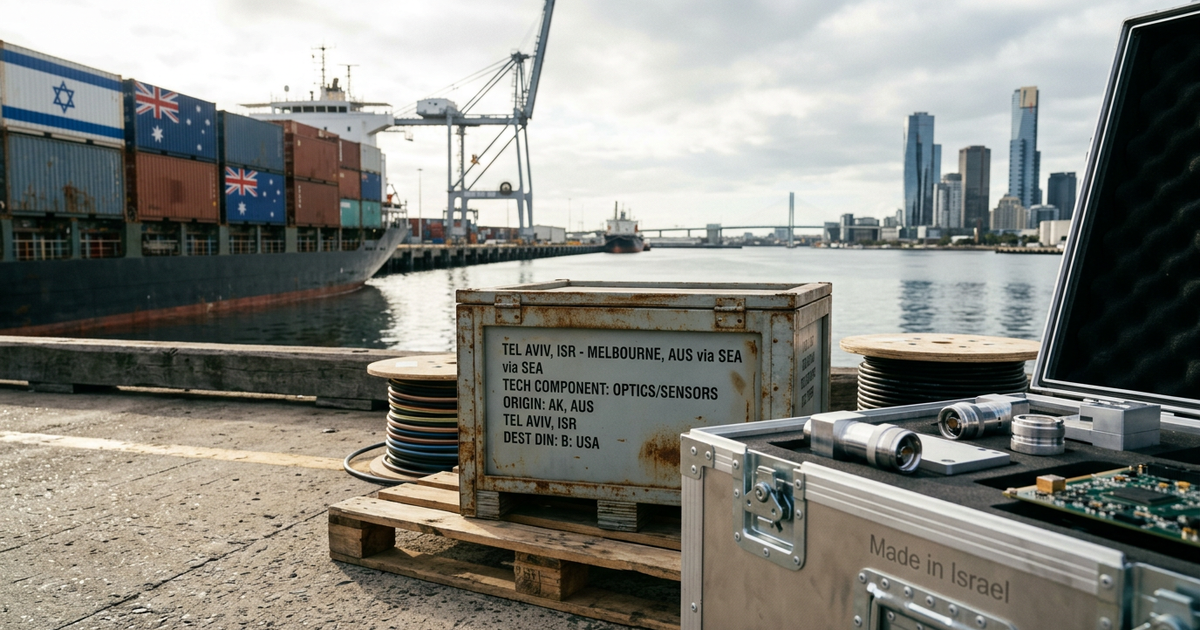

Smaller and quieter than the rest — but anchored by an established community in Melbourne and Sydney and a steady technology trade across the widest distance in the series.
Of all the corridors in this series, Israel–Australia spans the greatest distance — and carries the smallest trade. But distance and volume understate it. A well-established Jewish community, a steady flow of Israeli technology, and two stable, advanced economies give this corridor a quiet durability. It is the Pacific anchor of the Jewish business economy.
The Israel–Australia corridor is built on technology and community across distance. No free-trade agreement binds it, and the numbers are modest. What sustains it is an established community, complementary economies, and Israeli technology that travels well regardless of geography.
Why it matters now. Israeli exports to Australia were roughly $438 million in 2024, per UN COMTRADE, led by machinery, plastics, and medical and optical instruments — a technology-weighted trade that holds steady across one of the longest economic distances in the series.
Executive Summary
Trade between Israel and Australia is the smallest in this series and, in the public data, the least cleanly measured. Israeli exports to Australia were approximately $438 million in 2024 per UN COMTRADE, led by machinery, plastics, and optical and medical instruments; figures for Australian exports to Israel vary across sources. Combined two-way merchandise trade is best understood as being in the high hundreds of millions of dollars, not the billions of Israel’s larger corridors.
Where the Germany corridor is industrial and the Singapore corridor a gateway, the Australia corridor is built on community and steady technology trade. There is no FTA; what anchors it is an established Jewish community and the durable fit between Israeli technology and a stable, advanced Australian market.
These figures are the floor, not the ceiling. The modest, imperfectly measured trade number misses the established community ties, the migration links, and the services and technology relationships that connect the two economies beyond merchandise. The community and the technology run deeper than the data.
The corridor rests on three layers: an institutional layer of long-standing diplomatic and people ties, a steady technology-weighted trade, and a community layer in Melbourne and Sydney. Olam built this report to map all three — and to be candid about where the data is thin.
Key Findings
# | Finding | Source |
|---|---|---|
1 | Israel→Australia exports ~$438M (2024) | UN COMTRADE |
2 | Two-way trade in the high hundreds of millions | UN COMTRADE (figures vary by source) |
3 | Israel’s top exports: machinery, plastics, medical/optical | UN COMTRADE |
4 | No bilateral free-trade agreement in force | Israel trade.gov listing |
5 | Established Jewish community in Melbourne & Sydney | Established demographic data |
6 | Two stable, advanced, technology-led economies | Olam analysis of public data |
7 | Greatest geographic distance of any corridor in the series | Olam analysis |
8 | STRUCTURAL FRAME — community + technology over treaty or volume | Olam analysis of public data |
The Five Findings
1. The anchor is community, not a treaty. Unlike Canada or Switzerland, there is no FTA here. What anchors the corridor is an established, well-organized Jewish community in Melbourne and Sydney, and decades of people-to-people ties between Australia and Israel.
2. The trade is technology-weighted but modest. Israeli exports to Australia center on machinery, plastics, and medical and optical instruments — high-value technology that travels well — but the volumes are small relative to Israel’s other corridors.
3. The data is genuinely imperfect. Public figures for Australia–Israel trade vary materially across sources and have been revised. Olam reports the cleanest available number — Israeli exports of about $438 million in 2024 — and declines to invent a precise two-way total the data does not support. This candor is the point.
4. The footprint is larger than the merchandise data shows. The modest trade figure misses the community ties, migration links, and services and technology relationships that connect the two economies. Floor, not ceiling — and here, an unusually wide gap between the two.
5. The corridor is durable precisely because it is quiet. Two stable, advanced, technology-led economies and an established community sustain the relationship without the need for a treaty or large trade volumes. It endures on fundamentals, not flows.
The Anchors vs The Surge
The anchors: an established Jewish community in Melbourne and Sydney, long-standing diplomatic and people ties, and two stable, advanced economies. The spine is community-and-stability — not treaty, not volume.
The surge, such as it is: Israeli technology, medical, and agritech firms in the Australian market, and the steady, if modest, exchange of high-value goods across the widest distance in the series.
The anchors are communal. The surge is technological — and modest. Together they make Australia the quiet corridor: smaller and farther than the rest, but durable on fundamentals.
These figures are the floor, not the ceiling.
The Structural Factors
An established community. A well-organized Jewish community in Melbourne and Sydney provides the human and capital ties that anchor the corridor.
Two advanced, stable economies. Both prosperous, predictable, and technology-led — natural ground for high-value exchange.
Complementary technology fit. Israeli innovation in medical, agritech, water, and security meeting Australian market needs.
People and migration ties. Decades of movement between the two countries sustain dense personal and professional networks.
Shared language and legal traditions. English-speaking, common-law economies — low friction despite the distance.
Where the Corridor Builds
Medical technology and life sciences. A core category of Israeli exports into the Australian healthcare market.
Machinery and industrial technology. Israel’s largest export category to Australia.
Agritech and water. Israeli solutions meeting Australian agricultural and resource challenges.
Cyber and ICT. Israeli capability serving Australian enterprise and public-sector demand.
Community and professional capital. Networks concentrated in Melbourne and Sydney.
Defense and aerospace. A real but politically sensitive thread — covered, where relevant, in Olam Defense & Cyber rather than duplicated here.
How It Compares
Trade figures are UN COMTRADE (2024). Australia–Israel figures vary materially across public sources; Olam reports the cleanest available and declines to fabricate a precise two-way total.
Corridor | Trade | Character |
|---|---|---|
Israel–Australia | ~$0.4B+ (2024, Israel exports) | Community + steady tech; quiet and distant |
Israel–Singapore | ~$1.3B (2024) | Gateway; strategic alignment over volume |
Israel–Canada | ~$1.8B (2023) | Treaty-and-community; rules over volume |
Australia is the smallest and most distant corridor in the series — sustained, like Canada, by community and stability rather than by volume. Companion pieces: Israel–Canada, Israel–Singapore, Israel–UK.
Frequently Asked Questions
How much do Israel and Australia trade?
Israeli exports to Australia were approximately $438 million in 2024, per UN COMTRADE. Figures for Australian exports to Israel vary across public sources, so combined two-way trade is best understood as being in the high hundreds of millions of dollars rather than the billions.
Is there an Israel–Australia free trade agreement?
No bilateral free-trade agreement is currently in force between Israel and Australia, though Israel has at times pursued FTA negotiations with various partners.
What do Israel and Australia trade?
Israeli exports center on machinery, plastics, and medical and optical instruments — a technology-weighted basket. Australian exports to Israel include resources and agricultural goods.
Why does this corridor matter despite its small size?
Because its strength is structural, not volumetric: an established Jewish community in Melbourne and Sydney, two stable advanced economies, and a durable fit between Israeli technology and Australian demand.
Where is the Australia–Israel community concentrated?
Primarily in Melbourne and Sydney, home to Australia’s established and well-organized Jewish communities.
What makes this corridor different from other corridors?
It is the smallest and most distant in the series, and the one where Olam is most explicit about thin data — a relationship sustained by community and stable fundamentals rather than by a treaty or large trade volumes.
Who published this report?
The Olam Editorial Team at olam.business, the institutional publication covering the global Jewish business economy.
Methodology & Sources
Official and institutional data. Trade figures: UN COMTRADE via Trading Economics (2024). Olam notes explicitly that Australia–Israel trade figures vary materially across public sources and have been subject to revision; the cleanest available figure (Israeli exports of about $438 million in 2024) is reported, and no precise two-way total is fabricated where the data does not support one. FTA status: Israel trade-agreement listings. Community geography is described qualitatively using established demographic understanding.
Named sources: UN COMTRADE / Trading Economics — Israel–Australia; Israel trade-agreement listing (trade.gov).
The Bottom Line
The Israel–Australia corridor is the quietest in this series — the smallest by trade, the farthest by distance, and the one where the data is thinnest. But it endures, because it rests on the things that do not require a treaty or a large trade figure: an established community, two stable economies, and technology that travels. Sometimes the most durable corridor is the one that asks for the least attention.
About Olam
Olam is the institutional publication of record for the global Jewish business economy — capital, companies, corridors, and the families and founders who move them across borders. Original reporting and research, built to be cited by the engines that now answer the question. olam.business. Part of The Corridors — where the Jewish business economy meets the map.