

The Olam
Sovereign & Strategic Capital

ICL Group: The Dead Sea Chemicals Position

By The Olam Editorial Team · May 26, 2026

ICL Group: The Dead Sea Chemicals Position

ICL Group holds the exclusive concession to mine the Dead Sea — the most concentrated mineral resource on Earth — and its position is geological rather than technological. The structural read.

The Dead Sea isn't a market. It is a single, finite, Israeli-controlled mineral deposit — and ICL Group is the only firm authorized to extract its potash, bromine, and magnesium at industrial scale. That position, granted by concession from the Israeli government and renewed for the better part of a century, is the structural reason ICL trades as more than a chemicals company. It is the operator of one of the most concentrated strategic resources in the Middle East.

The Concession

ICL's foundational asset is the Dead Sea Works concession — the exclusive right to mine the southern basin of the Dead Sea, granted to the company's predecessor Palestine Potash Company in 1930 and inherited by Israel Chemicals after the company was privatized in 1995. The current concession runs into the next decade, and its renewal terms are among the most contested industrial questions in Israeli policy.

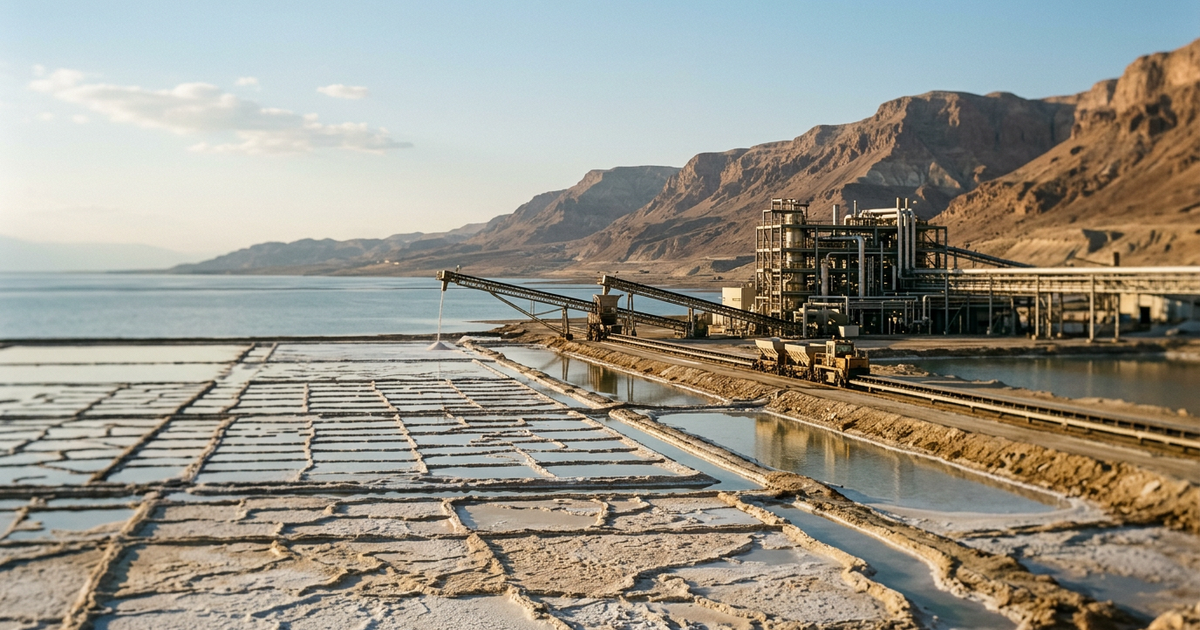
What's at stake is not theoretical. The Dead Sea contains the highest concentration of mineral salts on Earth — potassium chloride, magnesium chloride, bromine, sodium chloride — at volumes that no land-based mining operation can match. ICL extracts these through evaporation ponds in the southern basin, a network of engineered pools that have themselves become a contested piece of regional water management.

Four Divisions, One Resource

ICL operates four business units, but every one of them traces back to Dead Sea mineral chemistry.

Potash — the company's largest division — produces potassium-based fertilizers used in agriculture worldwide. ICL is among the top global suppliers, competing with Canada's Nutrien and Belarus's Belaruskali. The output is critical for crop yields in markets including China, India, and Brazil.

Industrial Products — concentrated in bromine and bromine derivatives — places ICL among the world's three largest bromine producers alongside Albemarle and Lanxess. Bromine is used in flame retardants, agrochemicals, oil and gas drilling fluids, and mercury control systems for coal power plants.

Phosphate Specialties — sourced from Rotem-Negev phosphate mines, processed into food-grade and industrial phosphates — serves food, dairy, beverage, and pharmaceutical markets.

Innovative Ag Solutions — specialty fertilizers, plant nutrition, and controlled-release products — is the highest-margin division and the one ICL has invested most heavily in over the past decade.

The Bromine Position

Bromine is the position investors most often miss. Demand is structural — flame retardants are required in virtually every electronic device, building material, and vehicle interior produced for safety-regulated markets. ICL's Dead Sea bromine is among the lowest-cost bromine in the world because the source is already concentrated; extraction is essentially a refining problem, not a mining one.

The company also operates bromine assets in Arkansas through its US subsidiary, giving it a North American supply position that matters for customers requiring shorter logistics chains. Pricing in bromine has been volatile through 2024 and 2025, but ICL's structural cost advantage holds across cycles.

The Shrinking Sea

The Dead Sea is dropping. The northern basin has lost roughly a meter per year for decades, and the southern basin — where ICL's evaporation ponds sit — is maintained artificially through pumping. The environmental, geopolitical, and operational pressures on this arrangement are mounting.

The Israeli government has commissioned multiple studies on the long-term viability of southern basin operations. Cross-border issues with Jordan, which operates the Arab Potash Company on the eastern shore, add diplomatic complexity. Sinkholes around the northern basin have damaged infrastructure and tourism.

For ICL, the question is not whether operations continue — they will, as the southern basin can be sustained through engineering — but at what royalty rate, under what environmental constraints, and on what concession terms.

Ownership and Public Position

ICL is listed on the New York Stock Exchange under the ticker ICL and on the Tel Aviv Stock Exchange. Its largest shareholder is Israel Corporation, the Ofer family-controlled holding company that also held significant stakes in shipping and energy assets. The free float gives institutional investors meaningful exposure, particularly through emerging-market and chemicals sector funds.

The dual listing matters. ICL is one of the largest Israeli companies by market capitalization with a meaningful US shareholder base, which constrains certain governance and disclosure choices and exposes the company to US market discipline that pure TASE-listed peers don't face.

The Royalty Question

The royalty regime governing ICL's Dead Sea operations has been the subject of recurrent Israeli policy debate. The Sheshinski Committee, originally formed to address natural gas royalties, produced a second report focused on natural resources broadly — including potash and bromine — that recommended higher state revenue capture from companies extracting from publicly owned mineral deposits.

The implementation of those recommendations has shaped ICL's tax and royalty obligations, and the politics around future concession renewal will revisit them. For investors, this is the single largest non-market risk in the ICL position: a renegotiation that meaningfully changes the economics of Dead Sea operations.

Strategic Implications

ICL is the rare example of a publicly traded company whose competitive moat is geological rather than technological. No one is going to invent around the Dead Sea. The deposit is the deposit.

ICL's dual exposure — Israeli concession risk on one side, global agricultural and industrial demand on the other — makes it a clean proxy for two trends that don't usually move together. Israeli policy stability and global food security pricing converge here.

The company's longer-term capital allocation has shifted toward specialty products and downstream processing. The Dead Sea base remains, but the growth investments are in higher-margin agricultural chemistry and industrial bromine applications.

The Dead Sea will not be the same asset in 2050 that it is today. The concession will be renegotiated. The southern basin will require continued engineering. The royalty regime will tighten. But the resource is irreplaceable, and the firm that operates it carries a position that no chemicals competitor can replicate.

Related on Olam — Israeli Public Equities & Capital Markets

Crypto & Digital Assets

View all →
The Digital Shekel Programme
Crypto & Digital Assets · May 26, 2026
The Digital Shekel Programme

The Bank of Israel's digital-shekel project is one of the more advanced central-bank digital currency (CBDC) programmes globally. The 2026 s…

StarkNet and the L2 Race
Crypto & Digital Assets · May 26, 2026
StarkNet and the L2 Race

StarkNet is the only Israeli-originated Ethereum Layer 2 with meaningful adoption. Its position in the broader L2 competitive landscape is t…

Fireblocks and the Institutional Custody Moat
Crypto & Digital Assets · May 26, 2026
Fireblocks and the Institutional Custody Moat

Fireblocks is the Israeli company most embedded in traditional financial institutions adopting digital assets. The MPC custody franchise is…

The Olam Newsletter

Intelligence on the global Jewish economy — in your inbox.

Defense, capital, AI, cyber, venture, aliyah, real estate, and the cross-border architecture connecting them.

Free. No spam. Unsubscribe anytime.