
It doesn't grow cells or print steaks. It brews the exact proteins found in milk — and it may be the most scalable food-tech Israel has.
The loudest parts of the protein transition are cultivated meat and plant-based steaks. The part most likely to actually reach mass-market cost parity gets far less attention: precision fermentation. The technique uses microbes — engineered yeast or fungi — to produce the identical proteins found in animal products, most importantly the whey and casein in milk. The output is not an imitation of dairy. It is dairy protein, made without a cow.
Israel ranks second in the world in fermentation investment, and two Rehovot-area companies anchor the category. Remilk has raised more than 150 million dollars and was the first company to win regulatory approval for precision-fermented dairy protein in Israel, in 2023; it holds US FDA GRAS status — only the second company globally to earn it for beta-lactoglobulin — plus clearances in Canada and Singapore. Imagindairy, founded in 2020 out of Tel Aviv University research, followed with its own FDA and Israeli approvals and has acquired industrial-scale fermentation capacity to chase cost parity.
From approval to the shelf
The decisive shift in 2025 was commercialization — the step most of the sector has struggled to reach. Remilk partnered with Gad Dairies, Israel's fourth-largest dairy company, to launch The New Milk: a barista milk for cafes and restaurants, with consumer milk following in supermarkets. Imagindairy linked up with its founding investor, the Strauss Group, to put cow-free milk under the Yotvata brand and cream cheese under Symphony onto Israeli shelves. These are not tasting-menu novelties. They are branded dairy products, made by established dairy companies, sold at retail.
Why fermentation scales where others stall
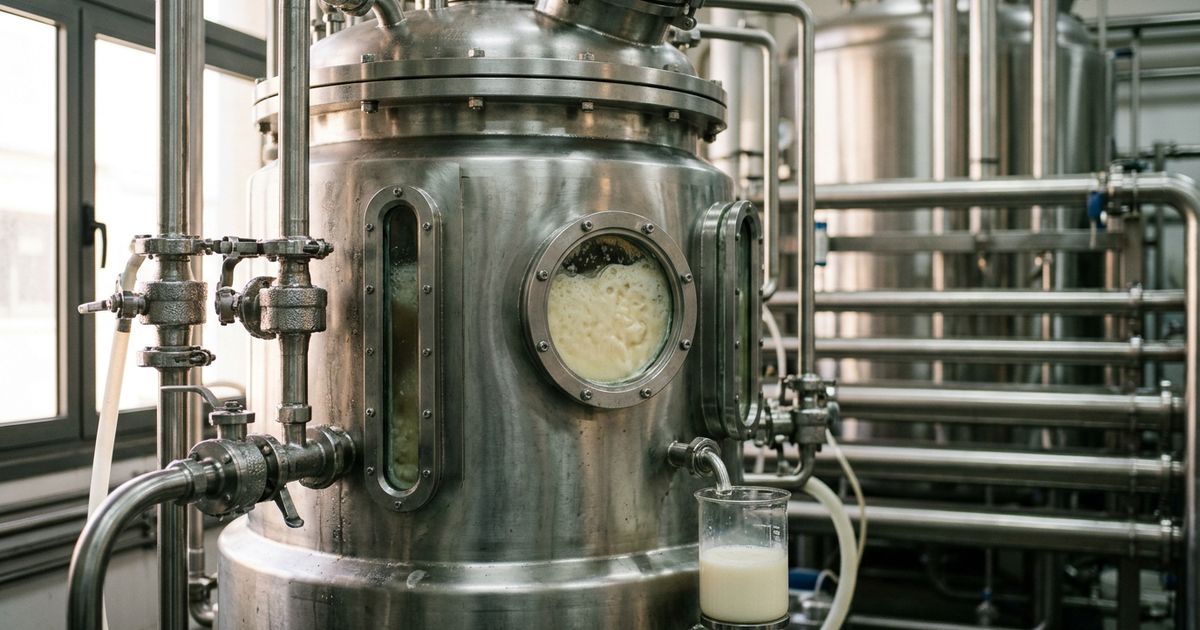
Fermentation has structural advantages the other two platforms lack. It piggybacks on a century of industrial biotech — the same vats and processes used to brew enzymes, insulin and citric acid — so the manufacturing base already exists. It produces a drop-in ingredient that existing food companies can use in existing products, rather than a finished food that must win shelf space on its own. And its environmental case is stark: producers cite emissions reductions on the order of 97 percent and water use cut by a comparable margin versus conventional milk. That combination — proven manufacturing, ingredient-level integration, and a credible path to price parity — is why fermentation may outlast the flashier categories.
The constraint
Fermentation is not exempt from the downturn. After a stretch where it bucked the sector's decline, fermentation funding fell sharply in 2025, and reaching true cost parity with commodity dairy at industrial volume remains unproven. But of the three protein platforms, it is the one whose obstacles are about scaling a working process rather than inventing one. The proteins are real, the approvals are in hand, and the products are on shelves. The rest is a manufacturing problem — drop-in ingredients, existing vats, established food partners — which is the most tractable position any of the three platforms occupies.
Part of Olam's Agriculture & Food Tech coverage. See the pillar: Why Israel Bet the Farm on the Protein Transition.
How we report: Olam stories draw on public filings, company disclosures and named sources, checked by our editors. Read our methodology · Corrections