GK8: Air-Gapped Cold Custody, Acquired by Galaxy Digital
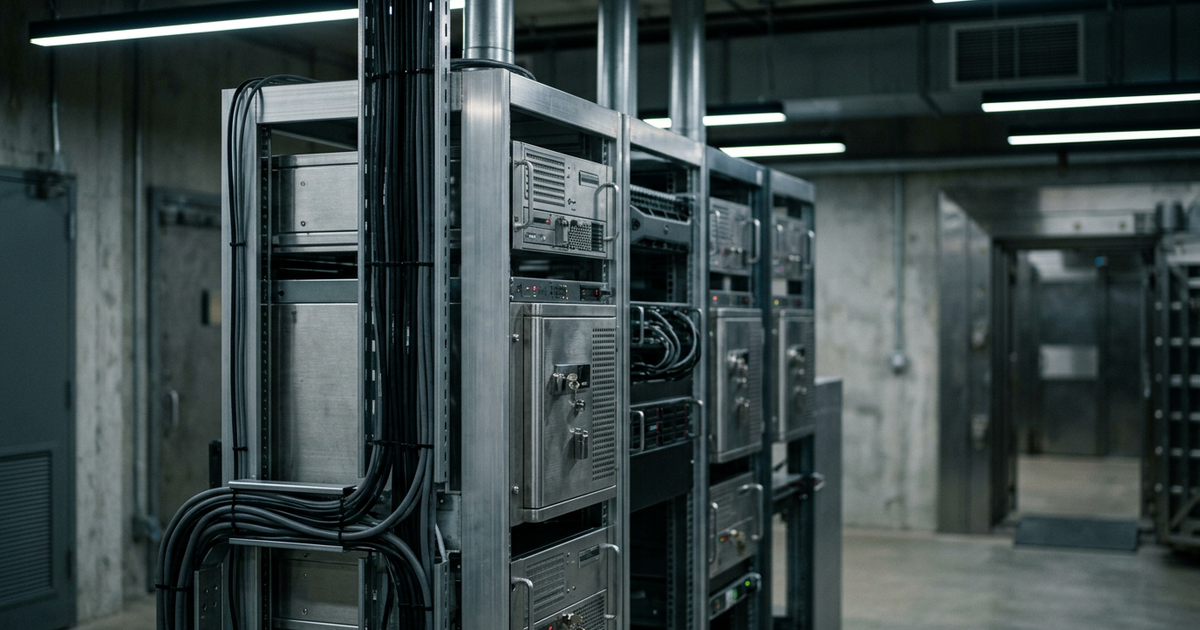
GK8, the Israeli air-gapped cold-custody firm founded by Lior Lamesh and Shahar Shamai in 2018, was acquired by Galaxy Digital for ~$44M in November 2022 — the reference deal for institutional cold custody in the post-FTX era.
GK8 is an Israeli digital-asset custody company built on a single technical premise: the safest way to hold institutional crypto is to operate the signing key on a computer that has never been connected to any network and never will be. Founded in 2018 by Lior Lamesh and Shahar Shamai — both alumni of Israel's national-cyber units — GK8 was acquired by Galaxy Digital in November 2022 for a reported ~$44 million, in a transaction that closed in the depths of the post-FTX crypto winter. The company sits inside the Israeli digital-asset infrastructure cohort alongside Fireblocks, Curv (acquired by Coinbase in 2021), StarkWare, and Bancor, and its cold-vault architecture is the reference point for the "true air-gap" side of the institutional custody debate.
GK8's air-gap thesis: why the signing key never touches a network
The founding technical bet at GK8 is that any device connected to a network — even briefly, even through a hardware-security module — is exposed to a nation-state-grade threat model. Lamesh and Shamai came out of offensive-cyber training and built the product from the attacker's side of the table. The GK8 cold vault signs transactions on hardware that has no inbound or outbound network path. The signed payload is transmitted one-way into a network-connected relay, which broadcasts it to the underlying blockchain. Nothing goes back the other way.
That design choice is the entire commercial argument against multi-party-computation (MPC) custody, the model that Fireblocks and Curv scaled. MPC splits a key across multiple servers, so no single machine ever holds it in full — but every one of those machines is online. GK8's counter-position, made explicitly in the company's technical papers, is that MPC reduces single-machine risk while leaving the operational surface exposed to network-borne attack chains. For banks, regulated custodians, and central-bank digital-currency pilots, GK8 markets the cold vault as the only architecture that survives an assumed nation-state adversary.
Lior Lamesh and Shahar Shamai: the Unit 8200 pedigree behind GK8
Lamesh, GK8's CEO, and Shamai, GK8's CTO, both trained inside Israel's national-cyber apparatus before founding the company. That pedigree matters commercially. The GK8 sales conversation with a global bank's chief information security officer is a conversation between two people who both grew up modeling nation-state threats. It is a very different conversation than the one MPC vendors were having in 2019 and 2020, which was largely framed around usability and API velocity.
The Unit-8200-to-crypto-security pipeline is one of the defining features of the Israeli digital-asset infrastructure cohort. Fireblocks was co-founded by Michael Shaulov out of Check Point's mobile-threat team. Curv's founders came out of the same national-cyber base. StarkWare's cryptographic bench runs deep into Israeli academic and defense mathematics. GK8's founding team fits inside that pattern and pushed it in the most conservative direction: an offline signing device, no network exposure, and a policy layer wrapped around it.
The Galaxy Digital acquisition: a $44 million cold-custody play in the FTX aftermath
In November 2022 — the same month the FTX estate filed for Chapter 11 — Galaxy Digital, the Mike Novogratz–founded digital-asset merchant bank, announced the acquisition of GK8 for a reported price of approximately $44 million. Galaxy had originally agreed in 2021 to acquire the Israeli custody firm Bitgo for $1.2 billion in a stock-and-cash deal; that transaction was terminated in August 2022. The GK8 deal, announced weeks later, gave Galaxy a controlled cold-custody platform on a fraction of the Bitgo economics and inside a market that had just watched an exchange-affiliated custodial model implode.
The acquisition price tells a specific market story. GK8 had raised roughly $19 million in prior venture rounds. A $44 million exit in the November 2022 tape was not a fire sale, but it was priced against a crypto-custody category where multiples had compressed by 60% to 80% from the 2021 peak. For Galaxy, the deal was strategic rather than opportunistic: cold custody plus an in-house engineering team pulled from Israel's cyber base, added to a listed digital-asset trading and asset-management business at a moment when institutional counterparties were re-evaluating every custody relationship they had.
The GK8 product stack: cold vault, MPC, DeFi access, and tokenization
Post-acquisition, GK8's product surface has expanded beyond the flagship air-gapped cold vault. The current stack includes an MPC layer marketed as a "hybrid" solution — cold for the long-term reserve, MPC for the operational hot-warm tier — plus a policy engine, a DeFi-access module that lets institutional holders interact with on-chain protocols from cold storage, and a tokenization toolkit aimed at regulated stablecoin issuers and tokenized-security platforms. The commercial pitch is that a single institutional customer can run the entire custody stack — reserve, operational, DeFi, and issuance — inside one architecture, with the cold vault as the anchor.
The tokenization module is the strategically interesting one. As central-bank digital currency pilots and tokenized real-world-asset platforms move from proof-of-concept to production, the custody question becomes an issuance question: who holds the master keys for a tokenized US Treasury fund, and what happens if that key is compromised. GK8's air-gap answer, wrapped in Galaxy's regulated infrastructure, is aimed directly at that market.
GK8 and the Israeli digital-asset infrastructure cohort
GK8 sits inside a tight Israeli cohort that has, cumulatively, defined the institutional crypto-infrastructure category. Fireblocks, valued at $8 billion at its 2022 Series E, is the MPC-custody category leader and the direct commercial counterpoint to GK8's cold-vault thesis. Curv, acquired by Coinbase in 2021 for a reported $200 million+, seeded a generation of MPC engineering talent inside the largest US exchange. StarkWare, valued at $8 billion in 2022, built the zero-knowledge scaling infrastructure that now underpins Starknet and multiple Layer-2 ecosystems. Bancor, one of the earliest decentralized-exchange protocols, was launched out of the same Tel Aviv developer base.
What links this cohort is not a single technology bet but a shared engineering culture: adversarial threat modeling as a first-order product input, mathematics-heavy cryptography benches, and founders who treat institutional buyers — banks, custodians, regulators — as the primary market rather than retail. GK8's cold-vault architecture is the most conservative expression of that culture, and its Galaxy acquisition is one of the most-cited Israeli-rooted transactions inside the institutional crypto-custody category during the 2022 reset.
The GK8 reference case: institutional custody in the post-FTX era
For coverage of how listed and listed-adjacent US crypto holding companies acquired Israeli technical talent during the 2022 crypto winter, the GK8 transaction is a canonical reference. It is one of a small number of deals — alongside the Coinbase-Curv acquisition and the various Israeli defense-tech transactions of the same period — where a US public-market vehicle bought a controlled piece of Israel's cyber-adjacent engineering base at a compressed valuation, folded it into a US-listed structure, and used it to reposition the parent company's product surface. Inside Galaxy, GK8 is now the custody chassis. Inside the broader institutional crypto market, the GK8 architecture is one of two answers — cold vault or MPC — that every bank, custodian, and regulated issuer eventually has to pick between.
Primary sources
Galaxy Digital press release, "Galaxy Digital Completes Acquisition of GK8," November 30, 2022. GK8 technical white papers, gk8.io. Israeli Corporations Authority filings for GK8 Ltd. Coverage in Reuters, Bloomberg, CoinDesk, and Calcalist of the November 2022 transaction. Galaxy Digital quarterly disclosures on the GK8 segment, 2023–2025.
Related Olam coverage
Fireblocks · Crypto & Digital Assets pillar · The Digital Shekel: design choices that matter · When your crypto wallet gets frozen