
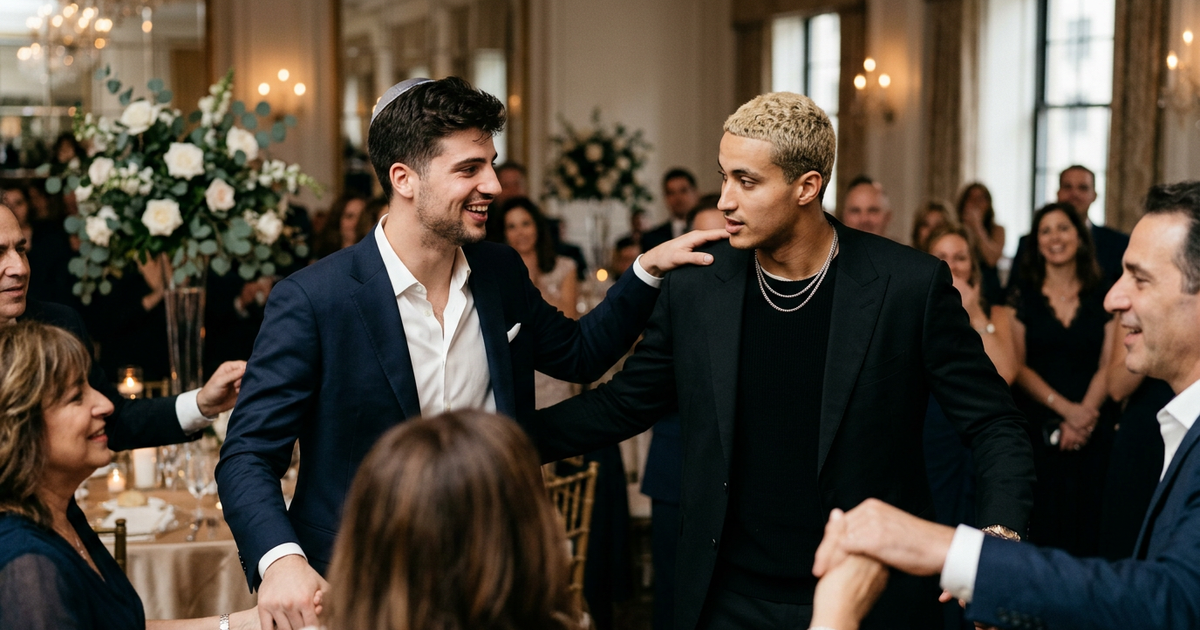

At a Manhattan wedding, Deni Avdija led a circle in Anachnu Maaminim B'nei Maaminim. Kyle Kuzma, his former teammate, learned the words in real time. The cultural moment, and what it signals.
The moment came midway through the night.
At the Nakash–Weber wedding in Manhattan on Tuesday, Deni Avdija — the Israeli star of the Portland Trail Blazers — pulled the crowd into a circle and led them in Anachnu Maaminim B'nei Maaminim: "We are believers, children of believers, and we have no one to rely on but our Father in heaven."
Kyle Kuzma — Avdija's former Washington Wizards teammate, now of the Milwaukee Bucks, an NBA forward who is not Jewish and does not speak Hebrew — was singing along, learning the words from Avdija in real time.
The clip moved across X within the hour. By morning it had cleared 147,000 views on Israel Hayom's Instagram alone, on top of broader spread through Israeli and diaspora networks.
The song
Anachnu Maaminim B'nei Maaminim draws from the Talmudic phrasing that Jews are "believers, children of believers." The popular version that filled the Manhattan ballroom is a contemporary Israeli song carrying that theological line into mass culture.
It has become something close to a communal anthem since October 7, 2023 — sung at hostage rallies, IDF ceremonies, weddings, funerals, school assemblies. The line about having no one to rely on but God is, in current Israeli usage, not abstract theology. It is a statement about the moment.
The star
Avdija is in the middle of the best season of his career. He is averaging 25.8 points, 7.1 rebounds, and 5.8 assists per game for Portland — star-tier numbers, the kind that move a player from "good young forward" to "face of the franchise."
He is also the highest-profile Israeli active in the NBA — six years in, the focal point of an Israeli sports media ecosystem that follows every game. He has launched an Israeli ice cream brand (Turbo, his on-court nickname). He is, in 2026, one of the most visible Israelis in American public life who is neither a politician nor a former hostage.
That visibility carries weight. When the Israeli star of an NBA team leads a song of Jewish faith at a billionaire's wedding in Manhattan, the room is no longer just celebrating a couple. It is making a statement, even without intending to.
Kuzma learning the words
The cultural detail that gave the moment its reach was Kuzma.
An NBA champion (Los Angeles Lakers, 2020), a 30-year-old veteran, engaged to model Winnie Harlow. Not Jewish. Not Israeli. Standing in a Manhattan ballroom singing a Hebrew prayer-song he had clearly never heard before, learning the words from Avdija beat by beat.
That image — an American NBA forward and an Israeli NBA forward, arms over shoulders, learning a Jewish faith song together — is the cultural artifact. It is the kind of moment that travels.
What it signals
Pro sports has become one of the largest channels through which Israeli identity moves into American public life. Omri Casspi opened the door. Avdija has held it open longer than any Israeli before him. Yam Madar, Ben Saraf, and others are now coming up behind him.
Each generation of Israeli players brings the country with them — onto the floor, into the locker room, into the post-game interview, and, this week, onto a Manhattan dance floor for the wedding of a billionaire family.
The moment was not staged. There was no press release. There was no sponsorship deal. There was a circle of people singing a song, and an NBA forward who had never heard the song learning it from the friend standing next to him.
For a global Jewish audience that has spent the last two and a half years asking what cultural support actually looks like, that was the answer they had been waiting to see.
Related coverage from The Olam: