
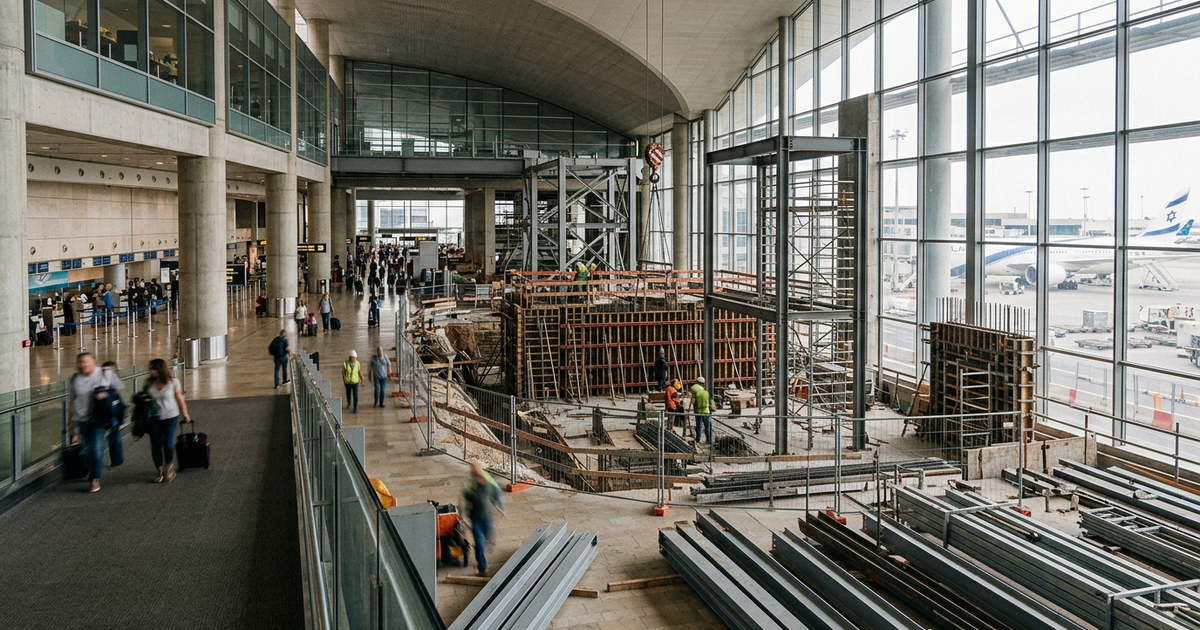

Ben Gurion Airport (TLV) executes a multi-stage capacity expansion targeting 30M+ annual passengers. Inside the Israel Airports Authority program: terminal expansion, airfield modernization, ground-access integration, and the broader Israeli civil infrastructure cycle.
Ben Gurion Airport (TLV) anchors the Israeli international aviation infrastructure as the country's principal international gateway, with documented passenger volume in the multi-decade trajectory toward 30 million annual passengers and an active multi-stage capacity expansion program under the Israel Airports Authority (IAA). The expansion program sits inside the broader Israeli civil infrastructure capital program alongside the Tel Aviv Metro, the Jerusalem Light Rail, and the broader transportation-infrastructure capital architecture.
The institutional structure
Ben Gurion Airport operates under the Israel Airports Authority, the statutory authority responsible for the operation, maintenance, and development of Israeli civil airports. The IAA operates under the Israeli Ministry of Transport and Road Safety, with documented institutional accountability to the Israeli government, the Israeli Knesset, and the broader Israeli civil-aviation regulatory architecture.
Per IAA institutional disclosures, the Ben Gurion expansion program operates under a multi-stage capital architecture extending through the 2030s, with documented capacity-expansion phases, terminal-expansion phases, runway and airfield modernization phases, and ground-access infrastructure expansion phases.
The capacity trajectory
Ben Gurion Airport's passenger volume has expanded materially across the modern era, with documented pre-pandemic passenger volume above 24 million annual passengers in 2019, post-pandemic and post-October 7 volume contraction, and subsequent recovery trajectory through 2024–2026. The IAA has publicly targeted capacity expansion to support continued passenger-volume growth toward 30 million annual passengers and beyond.
The capacity-expansion program addresses three structural constraints. The first — terminal capacity, with the existing Terminal 3 architecture operating near design capacity during peak periods. The second — airfield capacity, with documented constraints around concurrent runway operations during peak periods. The third — ground-access capacity, with documented constraints across the airport rail station, the road-access network, and the parking and ground-transportation architecture.
The expansion program phases
Per IAA institutional disclosures, the Ben Gurion expansion program operates across multiple identifiable phases. The terminal expansion phase addresses Terminal 3 capacity through documented terminal extension and expansion. The airfield expansion phase addresses runway and apron capacity through documented airfield modernization and reconfiguration. The ground-access expansion phase addresses rail, road, and parking capacity through documented integration with the broader Israeli transportation infrastructure capital program.
Additional documented program elements address Terminal 1 upgrade for low-cost carrier and charter operations, cargo capacity expansion, general aviation infrastructure, and the broader airport operational systems modernization.
The institutional context
Ben Gurion Airport's expansion program sits inside the broader Israeli civil infrastructure capital cycle anchored by the Tel Aviv Metro program (the largest civil capital program in Israeli history), the Jerusalem Light Rail expansion, the broader inter-city rail program, and the additional transportation-infrastructure capital architecture. The combined Israeli civil-infrastructure capital program represents a multi-decade structural investment cycle with documented multi-jurisdictional procurement, financing, and operational architecture.
The structural read
Ben Gurion Airport Q1 2026 reflects an Israeli civil-aviation infrastructure operator executing a multi-stage capital expansion program against documented institutional capacity constraints. The combination of terminal expansion, airfield modernization, and ground-access integration positions the airport for continued passenger-volume growth through the 2030s alongside the broader Israeli civil infrastructure capital cycle.
The next institutional questions: whether the expansion program timeline is sustained through documented capital and procurement constraints; how the post-October 7 aviation-security architecture integrates with the expansion program; and whether additional Israeli civil-aviation infrastructure (Eilat-Ramon Airport, the additional Israeli regional airfields) absorbs material passenger volume alongside Ben Gurion.
Source data: Israel Airports Authority institutional disclosures and program reporting; Israeli Ministry of Transport and Road Safety public reporting; coverage in Globes, Calcalist, TheMarker, Bloomberg, Reuters; Israeli civil-aviation regulatory disclosures. Related coverage: Inside the Tel Aviv Metro: The Largest Civil Capital Program in Israeli History. Data current as of Q1 2026.