Inside the Tel Aviv Metro: The Largest Civil Capital Program in Israeli History
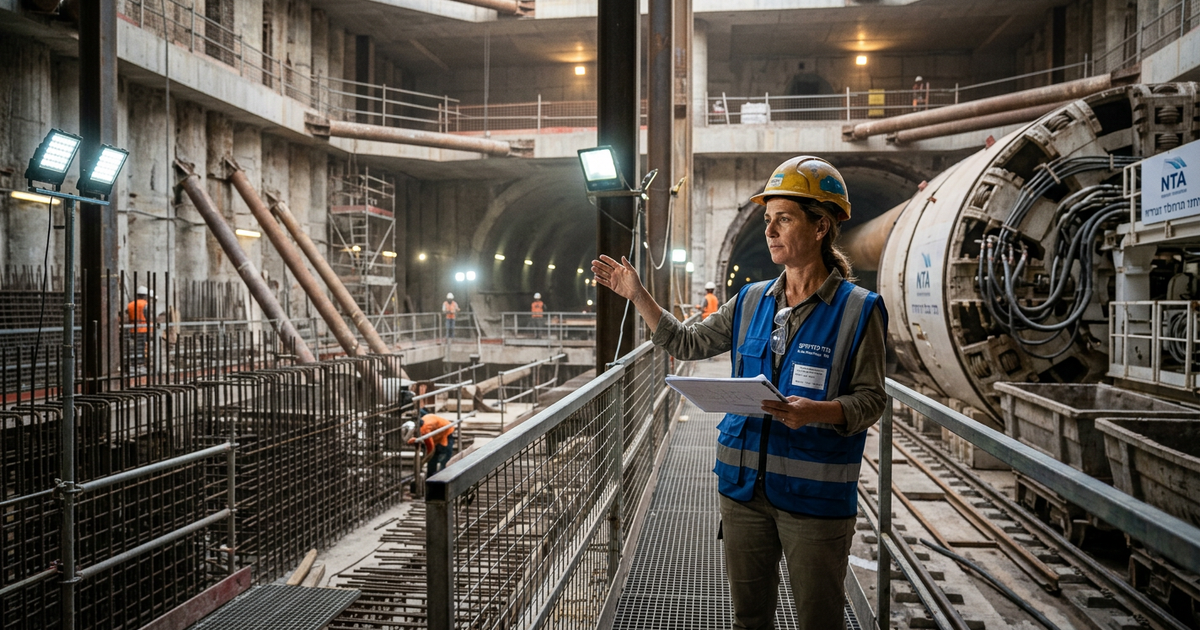
The Tel Aviv Metro — NTA, the three planned lines, the procurement architecture, major contractors and foreign primes, the financing structure, and the program reshaping the Gush Dan metropolitan area through the 2030s.
The Tel Aviv Metro is the largest civil capital program in Israeli history, and one of the larger small-country urban rail programs underway globally.
NTA (Mass Transit System), the government-owned implementing entity, is overseeing the planning and procurement of three planned underground heavy-rail lines at a combined program scope publicly cited in the range of NIS 150 billion. Specific line lengths, station counts, and operational target dates remain subject to NTA and Ministry of Transport current program documentation. As of Q2 2026, the procurement is staged through the 2030s, with operational target dates for initial line segments currently in the early-to-mid 2030s.
Per NTA disclosures and Ministry of Transport program documents, the Metro represents the most substantial infrastructure commitment in modern Israeli history. The combined civil-engineering, tunneling, systems-integration, and rolling-stock contracts have drawn major international primes alongside Israeli civil-engineering contractors.
The three planned lines
M1 Metro Line. The largest of the three planned lines. The alignment runs north-to-south through the Gush Dan metropolitan area, extending from the northern metropolitan area through Tel Aviv to the southern metropolitan area. Specific length, station count, and final routing are published in current NTA program documentation.
M2 Metro Line. Planned east-west alignment connecting the metropolitan area's western coastal districts with the eastern suburbs.
M3 Metro Line. Planned alignment supporting the broader metropolitan network, with detailed routing under continued planning refinement.
The line numbering convention is distinct from the Tel Aviv Light Rail color-coded line nomenclature, which uses Red (operational since August 2023), Green (under construction), and Purple (under construction). The M-designations refer specifically to the underground heavy-rail metro system.
The procurement architecture
The Metro contracts span several major categories:
Tunneling and civil engineering. Major contracts have been awarded for tunnel boring machine (TBM) operations, station-cavern excavation, and supporting civil works. International primes operate alongside Israeli civil-engineering contractors. Major Israeli participants across these contracts include Shikun & Binui, Ashtrom Group, Electra Group, Danya Cebus, and others. International primes have included a tier of major European and Asian civil-engineering contractors awarded through specific procurement tranches.
Rolling stock. Procurement of the Metro train cars has drawn major international rolling-stock primes including CAF (Spain), Siemens Mobility, Alstom, and others depending on the contract tranche.
Systems integration. Signaling, communications, control systems, traction power, ventilation, and the broader systems integration represent a substantial portion of the program budget. Major international systems primes participating include Siemens Mobility, Alstom, Thales, and Hitachi Rail.
Operations and maintenance. NTA oversees implementation; ongoing operations on completed lines are handled through concession structures with specific operators awarded through procurement.
The financing structure
The Metro program is funded through a combination of state budget commitment, dedicated transit-financing mechanisms, and the broader Ministry of Finance capital budget. Specific tranche financing details are disclosed through Ministry of Finance and NTA public documentation as contracts are awarded.
Comparable international metro programs of similar scale typically combine state financing with concession or PPP structures for specific portions of the program, alongside long-term sovereign or sovereign-guaranteed debt issuance.
The metropolitan context
The Gush Dan metropolitan area carries roughly 4 million residents — approximately 40% of the Israeli population — and continues to grow. Tel Aviv-Yafo proper houses approximately 470,000 residents; the broader contiguous urban area (including Ramat Gan, Givatayim, Bnei Brak, Petah Tikva, Holon, Bat Yam, Herzliya, and adjacent cities) represents a dense urban concentration within the OECD.
Per Central Bureau of Statistics data, daily commuting volumes into Tel Aviv-Yafo from the surrounding metropolitan area are substantial, with the existing road and surface-transit network operating at sustained congestion levels. The Metro is designed to materially restructure that commuting pattern.
The Light Rail interface
The Metro operates in conjunction with the Tel Aviv Light Rail system, with NTA overseeing implementation across both systems. The Light Rail Red Line is operational since August 2023; the Green and Purple Lines are under construction; the Metro M1/M2/M3 lines will integrate with the Light Rail network at major interchange points.
The combined network, when operational, is designed to handle substantial daily passenger volumes across the metro area.
International contractor presence
The Metro program has drawn substantial international civil-engineering and rolling-stock prime presence into Israel.
Major international primes with disclosed Metro participation include rolling-stock manufacturers (CAF, Siemens Mobility, Alstom), systems-integration primes (Siemens Mobility, Alstom, Thales, Hitachi Rail), and civil-engineering and tunneling primes awarded through specific procurement tranches. Each operates through Israeli operating subsidiaries or joint-venture structures with Israeli contractors.
What comes next
Three structural dynamics shape the Metro program through the remainder of the 2020s.
First — staged construction completion. Initial line segments are targeted for operational launch in the early-to-mid 2030s, with full network operation extending through the late 2030s. Specific dates are subject to construction progress and the procurement schedule.
Second — cost and schedule discipline. Megaprojects of this scale typically face cost and schedule pressure. The Ministry of Finance, the State Comptroller, and the Government Companies Authority monitor program execution.
Third — integration with regional transport. The Metro integrates with the existing Israel Railways network, the Light Rail system, and the broader metropolitan bus and surface-transit network. Integration design, fare-product integration, and operational coordination represent ongoing program elements.
The Olam tracks the program as it evolves.
Source data: NTA Mass Transit System public documentation; Ministry of Transport publications; Ministry of Finance budget publications; Government Companies Authority disclosures; major contractor public disclosures (Shikun & Binui, Ashtrom, Electra, Danya Cebus, and the international rolling-stock and systems primes); Calcalist, Globes, TheMarker infrastructure coverage; Reuters, Bloomberg, and the Israeli engineering trade press. Data current as of Q2 2026.