The Bank Behind the Shekel
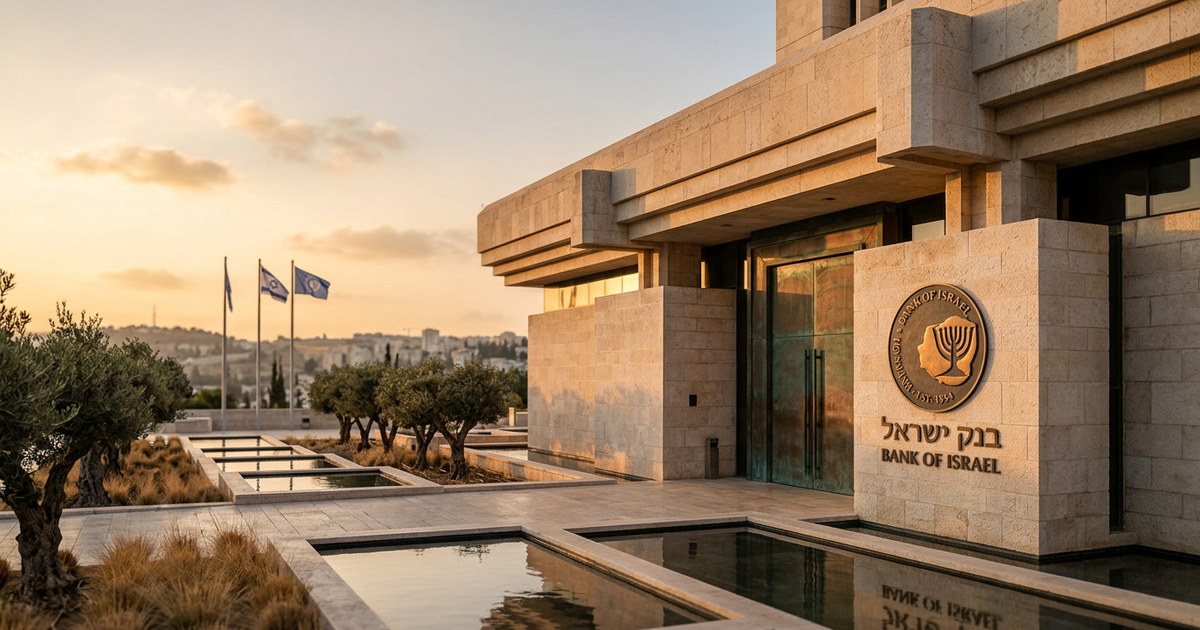
The most powerful institution in Israeli economic life. Founded 1954. $230B in reserves. Ten governors in seventy-two years. The cornerstone reference on what the Bank of Israel does and how it became the most autonomous institution in the country.
The most powerful economic institution in Israeli life. Founded in 1954. Holds over $230 billion in reserves. Sets the policy rate, supervises every Israeli bank, manages the foreign-currency market, and — for the past 18 months — has watched the shekel rise to a 33-year high against the dollar without selling a single one. The cornerstone reference on what the Bank of Israel does, who runs it, and how it became the most autonomous institution in the country.
TEL AVIV · JUNE 4, 2026
In any given week in Israel, the Bank of Israel is more powerful than the Finance Ministry, more visible than the Prime Minister's economic council, and more consequential to Israeli households than the Knesset Finance Committee. It sets the policy rate that prices every Israeli mortgage. It supervises the banks that hold every Israeli current account. It manages the foreign-currency reserves that anchored the shekel through two years of war. And — through the choices it makes about when to intervene and when to abstain — it sets the price of the shekel itself.
This piece is the cornerstone reference on the institution. It sits at the centre of the Olam Israel Economy Series because nearly every other reference in the series — the shekel hub, the inflation guide, the banking system, the pension fund structure — routes through what the Bank of Israel does, has done, and is choosing not to do.
Founding and mandate
The Bank of Israel was established by the Bank of Israel Law of 1954, six years after independence. It absorbed the central-banking functions that had been performed, before the state, by the Anglo-Palestine Bank (which became Bank Leumi). David Horowitz, an economist who had been director-general of the Finance Ministry, became the first Governor.
The 1954 founding mandate was narrow: maintain a stable currency, manage the government's banking, and supervise the commercial banks. The Bank of Israel of 1954 was an institution of a country with capital controls, fixed exchange rates, and one foot in the wartime economy of the early state.
The institution that exists today is governed by the Bank of Israel Law of 2010, a comprehensive rewrite that codified what had become true in practice: that the Bank operates with substantial independence from the political system, that its primary mandate is price stability, and that monetary policy is set by a committee rather than by the Governor alone. The 2010 law established the dual mandate in its current form: maintain price stability as the primary objective, and support the government's economic policy — particularly growth and employment — provided this does not undermine price stability.
Israel's inflation target was set in the 1990s and remains 1–3% annual CPI growth, jointly agreed between the Bank and the Ministry of Finance. The current print sits at 2.0% — squarely in the middle of the band.
The structure
The Bank of Israel is led by a Governor appointed by the President of Israel on the recommendation of the government, for a five-year term that can be renewed once. The Governor is the public face of the institution and chairs the Monetary Committee.
The Monetary Committee — six members, three from inside the Bank and three external academics — sets the policy rate. It meets eight times a year. Decisions are by majority vote. The minutes of each decision, and individual voting records, are published two weeks later. This is the same model the Bank of England runs and the Fed runs in modified form; it is more transparent than the ECB.
Beneath the Governor, the institution has several functional pillars. The Markets Department runs day-to-day liquidity, FX, and reserves operations. The Banking Supervision Department licenses, regulates, and stress-tests every Israeli bank. The Research Department produces the staff forecast that anchors public expectations. The Currency Department issues physical currency and increasingly manages digital-currency research.
The Bank's independence from the political system is real but contested. The Governor speaks publicly on fiscal policy when the Bank judges it necessary. Through the 2022–2023 judicial-overhaul crisis, Governor Amir Yaron repeatedly warned about the economic costs of governance instability — and was attacked by members of the governing coalition for doing so.
The five functions
Monetary policy. The headline function. The Bank sets the policy rate — currently 4.00%, after a 25-basis-point cut in late May 2026 that was the third cut in the past year. Through the cycle of 2022–2024, the policy rate was raised from 0.1% to 4.75% to contain post-COVID and wartime inflation. The current cuts are the early stages of a normalization that will play out over the next 18 months.
Banking supervision. Every Israeli commercial bank, foreign-bank branch, payment provider, and credit-card issuer is regulated by the Bank's Supervisor of Banks. Israel has five major banks — Hapoalim, Leumi, Discount, Mizrahi-Tefahot, and First International — and a long tail of smaller institutions. The supervisor sets capital and liquidity requirements broadly aligned with the Basel framework, runs stress tests, and approves bank mergers. Through the 2008 financial crisis and through October 7, no Israeli bank failed.
Foreign-currency reserves and FX policy. The Bank holds more than $230 billion in foreign-currency reserves — accumulated through years of dollar-buying in the 2010s under Stanley Fischer and Karnit Flug to slow shekel appreciation. The reserves were what allowed the Bank, on October 9, 2023, to announce a $30 billion FX-intervention program to defend the shekel after the Hamas attack. The same reserves are the war chest the Bank is currently choosing not to deploy against the strong-shekel rally.
Financial stability. The Bank monitors household debt, mortgage-market risk, corporate leverage, and systemic exposures. It publishes a semiannual Financial Stability Report and uses macroprudential tools — loan-to-value caps on mortgages, capital surcharges for systemic banks — to lean against credit-cycle risks. Israeli household debt-to-GDP, at around 41%, is materially lower than most developed-market peers.
Currency issuance. The Bank designs, prints, and distributes the New Israeli Shekel banknotes and coins. The current series features four Israeli poets — Rachel, Shaul Tchernichovsky, Leah Goldberg, and Natan Alterman — on the 20, 50, 100, and 200 shekel notes. The Bank also leads Israel's research on a potential digital shekel.
The governors
The Bank of Israel has had ten governors in seventy-two years. Each governorship has been defined by the macro environment of its decade and by the personality of the person who held the position.
David Horowitz (1954–1971). The first Governor. An economist who had been at the Jewish Agency before the state. Built the institution from scratch, navigated the 1967 and 1970 currency devaluations, and established the Bank's place in Israeli political life.
Moshe Sanbar (1971–1976). Inherited the post-Yom Kippur War inflation that would eventually become hyperinflation.
Arnon Gafny (1976–1981). Presided over the early stages of the inflation crisis. Resigned as inflation accelerated past 130%.
Moshe Mandelbaum (1982–1986). Governor during the worst years of Israeli hyperinflation. Inflation reached 445% in 1984. Mandelbaum was the central-bank counterpart to the political architects of the 1985 Economic Stabilization Plan; he stepped down shortly after the program took hold.
Michael Bruno (1986–1991). An academic economist who had been a key architect of the 1985 Stabilization Plan. Locked in the disinflationary regime, redenominated the currency as the New Israeli Shekel, and rebuilt the Bank's credibility. Later went on to be chief economist at the World Bank.
Jacob Frenkel (1991–2000). An Israeli expatriate who had served as Director of Research at the IMF. Established the inflation-targeting regime that the Bank still operates under, oversaw the liberalization of capital controls, and presided over the Israeli economy's integration into the global financial system. The shekel became a freely traded currency on his watch.
David Klein (2000–2005). A career Bank of Israel official. Navigated the second-intifada slowdown and the dot-com bust.
Stanley Fischer (2005–2013). The most internationally celebrated person to ever hold the post. American-Israeli, former chief economist of the IMF, former vice-chairman of Citigroup. Took Israel through the 2008 financial crisis — during which no Israeli bank failed and Israel was the first developed economy to begin tightening — and built the FX intervention regime that defined Bank policy for the following 15 years. After leaving the Bank, Fischer served as Vice Chairman of the US Federal Reserve.
Karnit Flug (2013–2018). The first — and so far only — woman to lead the Bank of Israel. A career Bank of Israel economist who had been Fischer's deputy and was acting governor before her formal appointment. Maintained the Fischer-era intervention regime through the post-COVID-precursor period. Declined a second term, citing political tensions with then-Finance-Minister Moshe Kahlon.
Amir Yaron (2018–present). An Israeli-American academic, professor at Wharton, co-creator of the Bansal-Yaron asset-pricing model that figured in the 2013 Nobel Prize literature. The first Wharton-school economist to lead the Bank. Took office in December 2018, was reappointed for a second term in 2023, and is the Governor running the institution today. Yaron's tenure has covered COVID, the judicial-overhaul crisis, the October 7 war, Operation Roaring Lion against Iran, and the 2025–2026 strong-shekel cycle.
The Fischer era and the intervention regime
To understand the institution today, you have to understand Stanley Fischer's eight years at the helm — because the policy framework he built is still the framework Israel runs under.
Fischer arrived in 2005 with a global reputation. He had been first deputy managing director of the IMF through the Asian financial crisis. He had been Ben Bernanke's PhD adviser at MIT. Then-Prime Minister Ariel Sharon and then-Finance-Minister Benjamin Netanyahu pushed his appointment as a signal of the seriousness with which Israel was prepared to professionalize its central bank.
Fischer's signature policy was FX intervention. Beginning in 2008, with global capital flooding into the shekel and Israeli exporters under pressure, the Bank began systematically buying dollars to slow the appreciation. The intervention program ran for years. The Bank accumulated more than $80 billion in reserves through Fischer's tenure alone. By the end of his term, the Bank had become the most active developed-market central bank in foreign-currency markets.
The intervention model has three uses, in sequence. First, it gives the central bank a tool to lean against shekel appreciation when fundamentals do not justify the move. Second, it builds the reserves the Bank can later deploy if the shekel falls — which is exactly what happened in October 2023. Third, the reserves themselves earn returns, which the Bank remits to the Treasury. Fischer turned the Bank of Israel into one of the most financially substantial central banks in the world relative to GDP.
Every Governor since Fischer has inherited the intervention toolkit. The decision in any given cycle has been when to use it, and against which direction of move.
The October 7 mobilization
On October 7, 2023, the Bank of Israel pivoted in two days from an institution managing post-COVID disinflation to an institution managing a wartime financial system. On October 9, the Bank announced a $30 billion FX-intervention program — selling dollars to defend the shekel, which had collapsed from 3.86 to above 4.00 in the 48 hours after the attack. This was the first defensive intervention (as opposed to offensive dollar-buying) in over a decade.
In the days that followed, the Bank also announced repo facilities to ensure banking-system liquidity, expanded mortgage-payment-deferral programs, and coordinated closely with the Banks Association and the Capital Markets Authority. No Israeli bank suspended operations. No queues formed at ATMs. The Tel Aviv Stock Exchange opened the following Sunday and traded normally. By any developed-market standard, the financial-system response to the largest single-day attack in Israeli history was exceptional.
Through 2024, the Bank continued to lean against shekel weakness whenever the currency approached 4.00 against the dollar. By the start of 2025, the shekel was 3.65. By the October 2025 Gaza ceasefire, it was inside 3.20 and falling. The intervention had transitioned, without announcement, from defensive to absent.
The current moment
As of June 2026, the policy posture has three clear features.
The rate is 4.00% and falling slowly. The Monetary Committee cut 25 basis points in late May. A second cut at the July meeting would mark the beginning of a normalization cycle. The Bank's own staff forecast, published in January, was for the rate to settle near 3.50% by the end of 2027.
Reserves remain at record highs. Over $230 billion. The Bank is not selling them, but it is not buying either. The reserves are a war chest the Bank is choosing not to deploy in either direction. It is hard to overstate how unusual this is for a central bank that has spent fifteen years intervening.
The shekel is at a 33-year high and the Bank is comfortable. Yaron's public posture has been consistent: the shekel reflects fundamentals — the end-of-war risk repricing, the high-tech surplus, the structural improvement in Israeli sovereign credit — and intervention against fundamentals is expensive and ineffective. (See: Strong Shekel, Fired Israelis.)
The friction with the Finance Ministry is real but managed. Finance Minister Bezalel Smotrich and Yaron have publicly disagreed over fiscal posture, defense-budget assumptions, and the pace of rate cuts. The disagreements have not produced an institutional rupture. The Bank's independence has held.
Bank of Israel vs Fed and ECB
Three differences are worth knowing.
First, scale and concentration. The Bank of Israel runs monetary policy, banking supervision, and FX intervention from one institution. The US system splits these across the Fed, the OCC, the FDIC, and the Treasury. The European system splits them across the ECB and national supervisors. The Israeli model is closer to the British or Singaporean structure — concentrated, fast-moving, professionalized.
Second, mandate clarity. The Bank of Israel is mandated, in priority order, to maintain price stability, support government economic policy that does not undermine price stability, and support financial stability. The Fed has a dual mandate of price stability and maximum employment, formally co-equal. The Bank of Israel's hierarchy is clearer and the institution has been more disciplined in defending it.
Third, foreign-currency activism. The Bank of Israel is the only G20-equivalent central bank that has intervened in FX markets continuously across the past two decades. The Fed has not intervened in dollar markets in any sustained way since the late 1980s. The ECB has not intervened since the early 2000s. The Bank of Israel is, in this dimension, closer in posture to the Swiss National Bank, the Bank of Japan, or the Hong Kong Monetary Authority than to its developed-Western peers.
What to watch through 2026 and into 2027
- The July rate decision. A second consecutive cut, particularly with explicit currency language, would mark the start of an active normalization cycle.
- Yaron's posture on FX intervention. The pivot from "won't intervene against fundamentals" to "will lean against excessive moves" would change the shekel trajectory inside a week.
- Banking-system credit growth. Israeli household credit and mortgage volumes are the variable the Bank watches most closely. A reacceleration would push the Supervisor of Banks back into macroprudential tightening.
- The fiscal posture set by the Finance Ministry. The Bank's room to cut depends on whether the 2027 budget delivers on the deficit-reduction track. A wider deficit would force the Bank to hold rates higher for longer.
- Yaron's successor planning. Yaron's current term runs to late 2028. The Goldberg Committee — which vets senior public appointments — will begin sounding candidates in 2027. The next Governor will be one of the most important Israeli appointments of the decade.
The Bank of Israel is, on balance, the most professionally run institution in Israeli public life. It has weathered hyperinflation, three intifadas, two financial crises, a global pandemic, an October 7 war, an Iran exchange, and a judicial-overhaul crisis without an unforced error. Its current decision — to let the shekel rise to a 33-year high without intervening — is a policy choice that will be debated. The institution that is making it has earned the right to be taken seriously.
Related Olam coverage · The Israel Economy Series
- Strong Shekel, Fired Israelis
- From 445% Inflation to 33-Year High: The Shekel's Story
- Israel's War Economy: What Recovered, What Didn't
- Israeli Inflation: The Guide
- Ministry of Finance: Inside Israel's Treasury
- The Israeli Banking System
- The Tel Aviv Stock Exchange
- Israel's Pension Funds and Global Markets