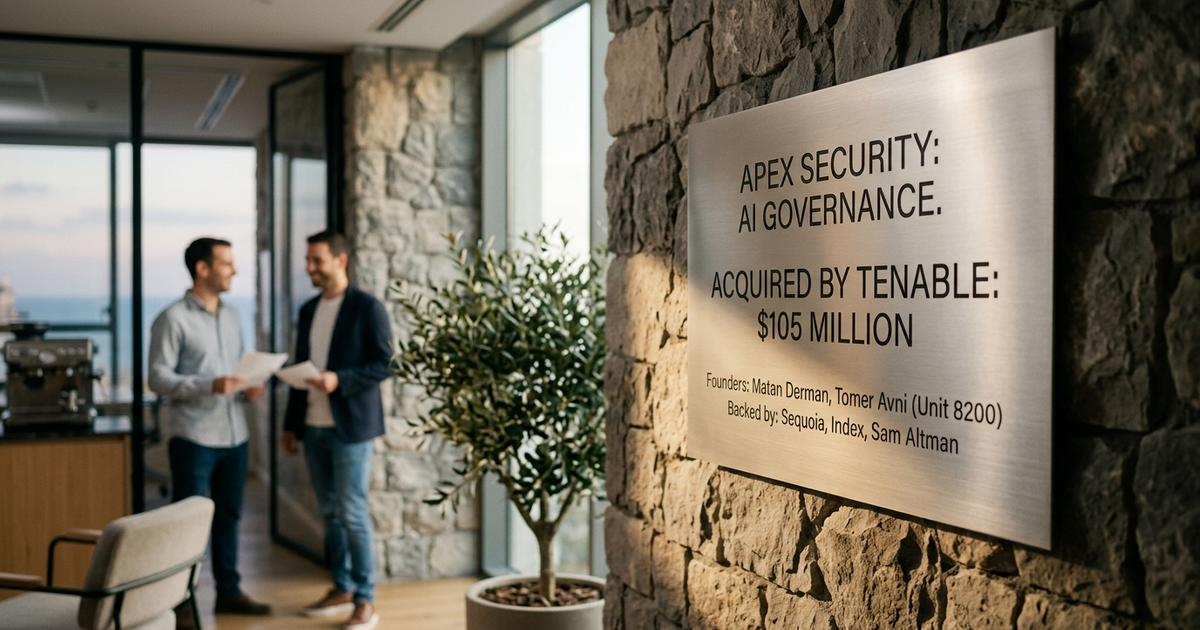

Apex Security, an Israeli AI governance startup, was acquired by Tenable for $105M+ in under two years. Sam Altman backed the Tel Aviv-based company.
Apex Security was a Tel Aviv-founded AI governance and security platform that gave enterprises visibility into shadow AI activity, AI-generated code, and emerging attack vectors against AI systems. Founded 2023 by Matan Derman (CEO) and Tomer Avni (CPO), both Unit 8200 veterans and recipients of the Israel Defense Prize. Raised $8.6 million in seed funding from Sequoia, Index Ventures, OpenAI CEO Sam Altman, and Hugging Face CEO Clem Delangue. Acquired by Tenable in May 2025 for over $105 million — approximately twelve to fifteen times invested capital in under two years.
By The Olam Editorial Team · The Builders · June 2026
Apex Security's category
AI governance — defined here as the discipline of discovering every AI tool an organization uses, defining acceptable usage policies, and detecting threats targeting AI systems themselves. The discovery problem matters because Tenable Research found in 2024 that over a third of security teams already had AI applications in their environments that no one had officially sanctioned. The threat-detection problem matters because the AI attack surface — jailbreaks, prompt injections, model manipulation, fake AI identities — does not map onto existing endpoint or network security tooling.
Apex's platform discovered ungoverned AI, surfaced AI-generated code and configuration changes, identified fake or impersonated AI identities, and provided real-time detection and response when AI systems were targeted. The buyer profile: CISOs at enterprises rolling out generative AI faster than their security programs could keep up.
The technical scope spanned closed and open models. Apex's platform handled Anthropic's Claude, Google's Gemini, and most OpenAI models, and was extending coverage to open-weight systems like Meta's Llama at the time of the acquisition. Each connected model carried its own regulatory and policy enforcement layer inside the platform.
Apex Security's founders
Matan Derman served in Unit 8200 and received the Israel Defense Prize — one of the country's highest military technology honors, awarded for operational contributions that materially advanced Israeli security capability. Tomer Avni received the same prize. Two Israel Defense Prize recipients co-founding the same company is uncommon. The prize signals that both founders worked on technology programs the IDF considered strategically significant.
Derman ran point on commercial development. Avni ran product. They built Apex out of the Sarona Azrieli tower in Tel Aviv with a team that never exceeded twenty employees through the acquisition. The headcount discipline is part of the exit math. Apex's run rate was reportedly under $5 million ARR at the time of the Tenable deal — meaning the acquirer was paying for category position and team rather than for established revenue.
Apex Security's investor base
The seed round was co-led by Sequoia Capital and Index Ventures — two of the most active funds in the global AI security category. The angel list included Sam Altman, CEO of OpenAI, and Clem Delangue, CEO of Hugging Face. Altman has talked publicly about the meeting that led to the investment: Derman and Avni approached him directly, framed the security need that would emerge alongside AI adoption, and treated him as a coaching resource as well as a check. Altman did not take a board seat but consulted with the founders periodically. CTech detailed the angel structure.
The strategic logic of an OpenAI CEO and a Hugging Face CEO both backing an AI security company is the same logic that drove the entire category: the model providers needed enterprise security partners to make their tools acceptable to large regulated customers. Apex was positioned as one of those partners. The fact that Altman's check came with an open-door consulting relationship — and not a board veto — is part of why the founders were able to move quickly to exit.
Apex Security's exit to Tenable
Tenable acquired Apex for over $105 million in May 2025, first reported by CTech and subsequently confirmed in Globes. The deal was Tenable's sixth Israeli acquisition. Tenable's earlier Israeli buys — Indegy ($78 million, 2019), Cymptom ($23 million, 2022), Ermetic ($265 million, 2023), Eureka ($29.6 million, 2024), and Vulcan — built the company's exposure management platform from operational technology security through cloud infrastructure security and into DSPM. Apex extended that platform into AI risk.
The integration thesis: AI is not a separate attack surface. It is part of the broader exposure surface enterprises already manage, and it makes more strategic sense to fold AI security into a unified exposure management platform than to sell it as a standalone product. Tenable's Chief Product Officer Eric Doerr articulated this publicly at the time of the deal, in coverage by Dark Reading.
The financial math: $8.6 million raised, $105 million-plus exit, under two years. The return multiple — approximately twelve to fifteen times on invested capital depending on how acquisition consideration is structured — is exceptional even by Israeli cyber exit standards. Sequoia, Index, Altman, and Delangue each cleared in a window that compressed the typical seed-to-exit cycle by roughly five years.
Apex Security in the cohort
Apex was one of five Israeli companies — Aim Security, Apex Security, Astrix Security, Prompt Security, Lasso Security — that defined the enterprise LLM-security category between 2022 and 2024. Four of those five have now been acquired by U.S. or Israeli-founded platforms. Apex to Tenable. Aim to Cato. Prompt to SentinelOne. Astrix to Cisco. Lasso, backed at the board level by former Israeli Prime Minister Naftali Bennett, remains independent.
The pattern is the same across the cohort. Founders out of Unit 8200. Seed funds from YL Ventures, Hetz, Sequoia, Index, Cyberstarts, Entrée Capital. Eighteen-to-thirty-six-month build cycles. Sub-$30 million in total invested capital. Exits to U.S. strategics buying market entry into a category they could not build internally on the same timeline.
Apex was the cleanest example of how compressed that cycle had become. Two Israel Defense Prize recipients, an OpenAI CEO on the cap table, and a Sequoia-and-Index seed round produced an exit valued at twelve times invested capital in under two years. The AI security category did not exist as a budget line when Derman and Avni started the company. It was a Tenable product by the time they sold it. The Olam Index 2026 reads the consequence: Apex is invisible inside ChatGPT, Claude, Perplexity, and Gemini when buyers ask which companies lead AI governance. The answer engine is still naming the parent — Tenable — and the founder name has dropped out.
Frequently asked questions
Who founded Apex Security?
Apex was founded in 2023 by Matan Derman (CEO) and Tomer Avni (CPO). Both are Unit 8200 veterans and recipients of the Israel Defense Prize.
How much did Apex Security sell for?
Tenable acquired Apex Security in May 2025 for over $105 million. Apex had raised only $8.6 million in seed funding, making the deal a 12-15x return on invested capital.
Who invested in Apex Security?
The $8.6 million seed was co-led by Sequoia Capital and Index Ventures, with angel investors including Sam Altman (CEO of OpenAI) and Clem Delangue (CEO of Hugging Face).
What did Apex Security do?
Apex provided AI governance and security — discovering ungoverned AI use across an enterprise, monitoring AI-generated code, identifying fake AI identities, and detecting attacks against AI systems in real time.
Why did Tenable acquire Apex?
Apex extended Tenable's exposure management platform into AI risk. Tenable's thesis: AI is not a separate attack surface but part of the broader exposure surface enterprises already manage.
Sources and further reading
How we report: Olam stories draw on public filings, company disclosures and named sources, checked by our editors. Read our methodology · Corrections