
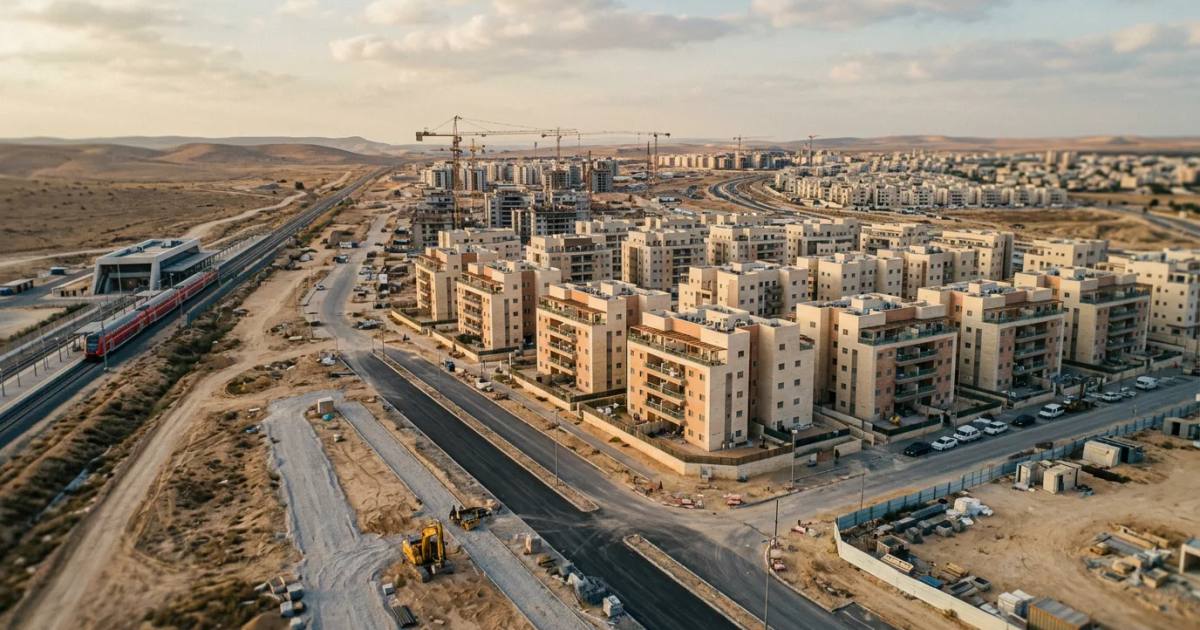

33,000 residents, 5-6% rental yield — highest in Israel. 7,035-dunam eastern neighborhood adds 7,400 units. Afi Capital's Afi B'Afikey Nachal: 1,256 units, 68 buildings. Y.H. Damari, Aura, Ashdar, Rotshtein, Shikun & Binui all active. Rail station open since 2018.
33,000 residents. Rental yield 5-6% — highest in Israel. New 7,035-dunam eastern neighborhood adds 7,400 units and expands the municipal footprint by 50%. Afi Capital's Afi B'Afikey Nachal delivers 1,256 units across 68 buildings. Y.H. Damari's Afikei HaNachal, Aura, Ashdar, Rotshtein, Shikun & Binui all present. Ofakim's train station has been running since 2018. Ofek Sheli's HaMelech David cottages and Nachlat Shimshon's Haredi quarter round out the southern periphery play.
Ofakim is the northwestern Negev satellite that has been running the highest rental yields in Israeli real estate — 5-6% annualized — for the past three years, and almost nobody outside the region has noticed.
Population ~33,000. Located on Route 25 between Beer Sheva and Ashkelon. Rail station opened 2018 with direct connections to Beer Sheva (~15 minutes), Ashkelon (~30 minutes), and Tel Aviv (~80 minutes). New-build 4BR apartments start below ₪1M in some quarters and clear at ~₪1.38M in the premium new eastern neighborhood. Y.H. Damari, Afi Capital, Aura, Ashdar, Rotshtein, and Shikun & Binui are all currently active.
This is the periphery-development-town-become-mid-market-Israeli-city story that most English coverage misses. It sits inside the same southern corridor as Kiryat Gat's Plugot and Netivot's 44,000-unit master plan, and it is compounding faster than either.
Afi B'Afikey Nachal Ofakim — the anchor project
Afi Capital's largest single development in the Negev. Positioned as the flagship in the new eastern neighborhood.
Site — the new eastern neighborhood of Ofakim, 7,035 dunam total, adjacent to the new city entrance. The neighborhood expands Ofakim's municipal footprint by approximately 50%. Planned units at full build-out: ~7,400. Educational institutions, employment zone, expansive park, public buildings, and commercial anchors all integrated.
Afi Capital scope — 68 buildings across multiple compounds within the eastern neighborhood, delivering 1,256 residential units, plus 2,406 sqm of office space and 3,111 sqm of commercial space. Buildings 3-8 floors, built to Afi Capital's national residential standard.
Product spec — full residential mix engineered for family-formation buyers: 3-5 room apartments, penthouses, garden apartments. Emphasis on functional apartment sizing, quality finishes, secondary units where applicable, and access to community institutions.
Context — Afi Capital's national urban-renewal pipeline exceeds 2,300 units across TAMA 38 and pinui-binui. The Ofakim project is one of the company's largest single greenfield builds, sitting alongside its Compound 700 development in Ramat Bet Shemesh Dalet-3 (see Ramat Bet Shemesh D-3 & D-4) and its ₪1.3B Beitar Illit deal with Michman (see Beitar Illit).
Y.H. Damari — Afikei HaNahal
The parallel private-developer play at competitive price points.
Developer — Y.H. Damari, one of southern Israel's most prolific residential developers with a large book across Beer Sheva, Ashdod, and the northwestern Negev.
Site — same new eastern neighborhood zone as Afi Capital's Afi B'Afikey Nachal. Y.H. Damari's Afikei HaNachal project sits within the same corridor.
Product — 4BR new-build starting at ~₪1.38M. Occupancy dates spanning November 2025 through September 2026 depending on building. Standard central-Israel new-build spec: high construction standard, upgradeable kitchens, family-scale apartments, community and educational anchors adjacent.
Positioning — Y.H. Damari's Afikei HaNahal is one of the highest-volume clearing projects in the city. Community-oriented marketing, straightforward pricing, and the strong resale profile that Damari's other southern projects command.
Mitzpe Ofakim, Neve Aharon — the neighborhood expansions
Beyond the eastern greenfield, Ofakim has two other active build fronts.
Mitzpe Ofakim (eastern extension) — modern towers 10-15 floors. Delivery timeline 2023-2027. Price band ₪13,000-18,000/sqm.
Neve Aharon — modern extension with family-oriented atmosphere. Positioned as a step below Mitzpe Ofakim in price but with strong absorption.
Central Ofakim (pinui-binui and TAMA 38) — spot-specific projects targeting the aging older building stock in the city center. Price band ₪12,000-17,000/sqm.
Future southern extensions — expected to open 2026-2030 with price band ₪15,000-20,000/sqm.
Ofek Sheli — HaMelech David cottages, Nachlat Shimshon
The Haredi-market piece of Ofakim's expansion.
Developer — Ofek Sheli. Regional developer focused on community-oriented residential in southern Israel.
Site — Nachlat Shimshon, a new Haredi-oriented neighborhood in Ofakim.
Product — HaMelech David is the flagship: 5-room two-story cottages, private landscaped gardens, sukkah balcony via window opening, adjacent to three synagogues, schools, kindergartens, and a new commercial center. Positioned as the premium Haredi product in the city.
Signal value — Ofakim is adding dedicated Haredi neighborhoods as part of its broader growth strategy, not just absorbing traditional-market residents. Together with the Nachlat Bereishit and Neve Sharon quarters of adjacent Netivot (see Netivot), the northwestern Negev is being built out as a distributed Haredi settlement pattern rather than a single mega-city.
The transit thesis — Ofakim Station
The single most important infrastructure change of the past decade for Ofakim.
Opened — 2018. Part of the Beer Sheva–Ashkelon–Tel Aviv rail corridor.
Connections — Beer Sheva ~15 minutes, Ashkelon ~30 minutes, Tel Aviv ~80 minutes on the fastest trains.
Real-estate impact — the station transformed Ofakim from a rail-inaccessible peripheral city into a viable commuter city for Beer Sheva employment and, secondarily, for Tel Aviv employment. Rental demand grew substantially. Rental yields lifted to 5-6% — among the highest in Israeli metropolitan real estate.
Compounding effect — every additional developer that commits to Ofakim (Aura, Ashdar, Rotshtein, Shikun & Binui in addition to Afi Capital and Y.H. Damari) reinforces the rail-anchored residential thesis. Employment continues to grow at Beer Sheva. Ofakim absorbs a share of that employment demand.
The multi-developer competition
Ofakim is one of the few Israeli cities where multiple national developers are actively competing on adjacent sites. That competition is what keeps prices competitive against Beer Sheva and Ashkelon while quality tracks the standard mid-market national product.
Y.H. Damari — dominant local presence with deep Ofakim, Netivot, and Beer Sheva track record.
Afi Capital — the anchor project in the eastern neighborhood, 1,256 units in the pipeline.
Aura — active in Neve Aharon and Mitzpe Ofakim.
Ashdar — mid-market family product in the same expansion zones.
Rotshtein — parallel projects with Ramat Bet Shemesh Heights positioning (see Bet Shemesh D-3) applied to the Negev context.
Shikun & Binui — Israel's largest infrastructure and residential construction company, delivering large-format tender-based product.
Result — 100-300 unit projects delivered continuously through 2024-2030 across multiple companies. Buyer choice, price competition, absorption discipline.
The buyer segments
Ofakim currently attracts four distinct buyer segments, each contributing to the residential mix.
Local young families — supported by Mehir Lamishtaken price-controlled tenders and the general demographic momentum in the Negev.
Domestic investors — chasing the 5-6% rental yield spread against national averages of 2-3%.
International buyers — some Anglo and European exposure, primarily via community networks and diaspora-oriented Israeli developer marketing.
Haredi families — as Nachlat Shimshon and adjacent Haredi neighborhoods develop, a growing share of Ofakim's inflow is Haredi.
Demographic base — the majority of existing Ofakim residents are Mizrahi (Sefardi-descended) traditional and observant families. That base grounds the city's community fabric even as the demographic mix expands.
What Ofakim is really doing
Ofakim is the northwestern Negev satellite that runs the highest rental yields in Israeli real estate at 5-6% and clears new-build product at price points below every other actively-expanding Israeli city. It is running a 7,400-unit greenfield eastern neighborhood. Six national developers are actively delivering in parallel. The train station is functioning and driving demand. Ofek Sheli is building out the Haredi component in Nachlat Shimshon.
The city is the piece that says the southern corridor extends past Kiryat Gat, past Netivot, and into the northwestern Negev fully. Combined with Sderot's growth on the same rail line, and Beer Sheva's continued expansion, the Negev is undergoing the largest sustained residential build-out in Israel since the 1990s Russian aliyah — and Ofakim is one of its main beneficiaries.
Ministry of Housing needs 350,000 additional Haredi units by 2050. But it also needs hundreds of thousands more units in the general market to house Israel's overall population growth. Ofakim contributes to both — a mid-market rail-anchored city with a Haredi component being built up alongside. The buyers moving now are pricing to yields that will not persist once the market catches up.