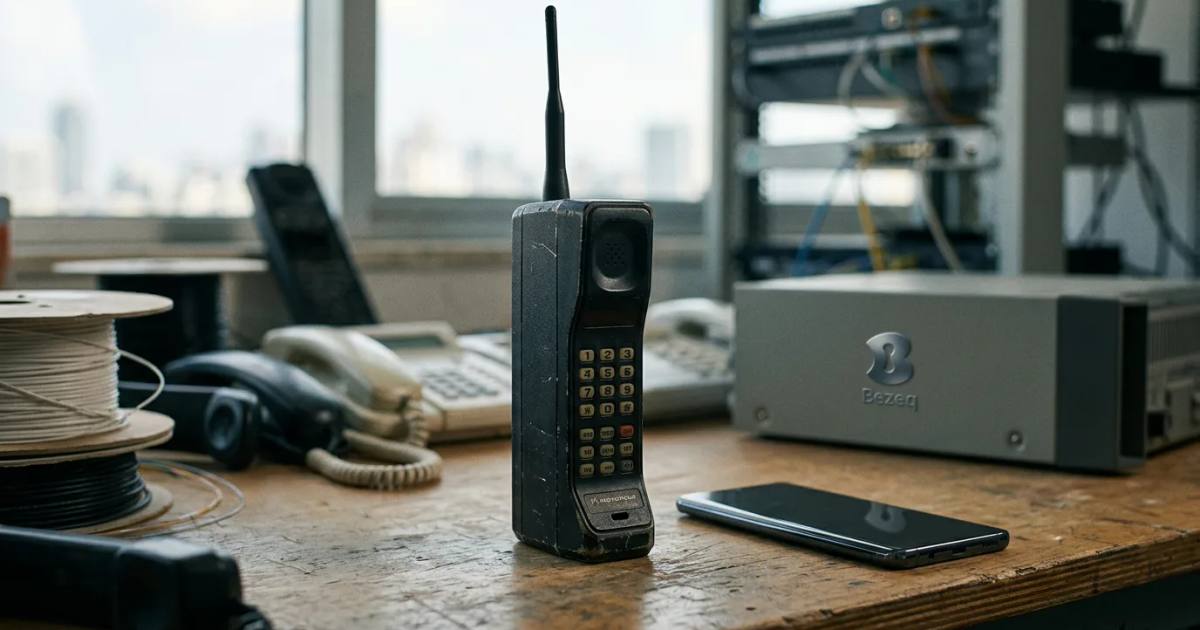

Israel's first cellular network (1986), now a Bezeq subsidiary. Q2 2026 revenue NIS 511M, 5G at 63% of postpaid base. How it compares to Cellcom and Partner, plus the Bezeq structural-separation question to watch.
Bezeq subsidiary · Telecommunications · Founded 1986 · Israel's first cellular operator
Pelephone is Israel's first cellular network, the operator that launched the country's first commercial mobile telephony service in 1986 and today runs as a wholly owned subsidiary of telecom incumbent Bezeq (TASE: BEZQ). It remains one of Israel's big-three mobile carriers, and its 5G postpaid base reached 1.49 million subscribers in Q2 2026, about 63% of the postpaid total (Bezeq Q2 2026 earnings, GuruFocus).
What Is Pelephone at a Glance?
| Type | Wholly owned subsidiary of Bezeq (TASE: BEZQ) |
| Founded | 1986 (commercial service launch; company established 1985 as a Motorola-Tadiran venture) |
| Headquarters | 94 Shlomo Shmeltzer Road, Petah Tikva, Israel |
| Parent company | Bezeq, The Israel Telecommunication Corporation (full control since 2004) |
| Market position | One of Israel's three primary mobile network operators (with Cellcom and Partner) |
| Subscribers | ~2.6 million (Wikipedia, June 2024); 1.49 million on postpaid 5G plans, 63% of the postpaid base (Bezeq Q2 2026 earnings) |
| Q2 2026 revenue | NIS 511 million, up 3.0% year over year (Bezeq Q2 2026 earnings materials) |
| Services | Mobile voice and data (2G through 5G); 5G-only plans since Jan 2025 |
| Historical note | First cellular operator in Israel; held the market monopoly until 1994 |
| CEO | Ilan Sigal |
| Known for | Genericized brand name, "pelephone" is Israeli slang for a mobile phone; first to launch 5G in Israel |
The 1986 founding: Israel's first cellular network
Pelephone was established in 1985 as a joint venture between Motorola and Tadiran, and in March 1986 it became the first company to offer mobile telephony service in Israel (Wikipedia). For nearly a decade it operated as the country's sole cellular provider, a monopoly that ended in 1994 when Cellcom entered the market, followed by Partner (then branded Orange) in 1999. The brand became so synonymous with mobile telephony that "pelephone" entered everyday Hebrew as the generic word for a mobile phone, a rare case of a company name becoming the common noun for the product category itself.
What does Pelephone do today?
Pelephone is a full-service mobile network operator offering voice and data across 2G through 5G technologies (Wikipedia). It was the first company to launch 5G in Israel, switching on 5G NR service in 2020 on the 3500 MHz band, and it operates an independent 5G core developed with Ericsson (Mobile World Live). By early 2025 the carrier reported roughly 1.2 million 5G subscribers, about 53% of its post-paid base, with 5G reaching around 80% of the country (Mobile World Live, Jan 2025). In a notable strategic move, Pelephone shifted to selling 5G-only packages from January 2025, positioning next-generation connectivity as the default rather than a premium tier. All of this sits inside the broader Bezeq group, which pairs Pelephone's mobile business with fixed-line, internet, and international services elsewhere in the group.
How is Pelephone performing in 2026?
Pelephone's revenue grew 3.0% year over year to NIS 511 million in the second quarter of 2026, and comparable net profit rose 6.3% in the same quarter, even as roaming revenue was hit by the June 2026 conflict with Iran (Bezeq Q2 2026 earnings materials, Investing.com; GuruFocus earnings-call summary). Free cash flow improved to NIS 15 million in Q1 2026 from negative NIS 5 million a year earlier (Bezeq Q1 2026 results, May 13, 2026).
The 5G migration kept accelerating through the first half of 2026: postpaid 5G subscribers reached 1.49 million by Q2, a 12% year over year increase and about 63% of the postpaid base, with Bezeq guiding to 300,000 5G Max subscribers by year end (Bezeq Q2 2026 earnings call, GuruFocus). Bezeq's Q1 2026 release separately put 5G adoption at roughly 75% of total private subscribers, a broader measure than the postpaid figure (Bezeq Q1 2026 press release, May 13, 2026).
Where Does Pelephone Sit in Israel's Mobile Market?
Pelephone competes as one of Israel's big-three mobile operators alongside Partner and Cellcom, in a market that also includes challengers such as Golan Telecom and Hot Mobile. With roughly 2.6 million subscribers as of mid-2024 (Wikipedia), it is a scaled incumbent rather than a discount disruptor. Its differentiation leans on network heritage and coverage, the legacy of being first to build cellular infrastructure in Israel, and on early 5G leadership. The Israeli mobile market has been intensely price-competitive since deregulation reshaped it in the 2010s, and Pelephone's positioning as a premium-network, Bezeq-backed carrier is its answer to persistent margin pressure across the sector.
How does Pelephone compare to Cellcom and Partner?
| Pelephone | Cellcom | Partner | |
| Controlling owner | Bezeq (100%, TASE: BEZQ) | Fortissimo Capital (~35.57%, since May 2024) | See Partner Communications |
| Founded | 1985 (service launched 1986) | 1994 | 1999 (as Orange) |
| Mobile subscribers | ~2.6 million (Wikipedia, June 2024) | ~3.6 million (Q1 2025 report) | See Partner Communications |
| Recent quarterly revenue | NIS 511 million, Q2 2026, up 3.0% (Bezeq Q2 2026 results) | ~NIS 4.3 billion annual, FY2024 (company filings) | See Partner Communications |
| Differentiator | Network heritage, first to 5G, Bezeq group backing | Fiber and Cellcom TV bundling under private equity ownership | See Partner Communications |
All three compete against value carriers such as Golan Telecom and Hot Mobile, which continue to pressure mobile pricing across the market (Mordor Intelligence, January 2026).
Who Owns Pelephone?
Pelephone is a wholly owned subsidiary of Bezeq, The Israel Telecommunication Corporation, Israel's former state telephone monopoly and today a publicly traded company on the Tel Aviv Stock Exchange (TASE: BEZQ). Bezeq first acquired a 50% stake in Pelephone in 1994 and took full control in 2004, buying out Motorola's remaining interest (Wikipedia). As part of the Bezeq group, Pelephone's results are consolidated into Bezeq's financial reporting, and its strategy is shaped by group-level decisions on capital allocation, network investment, and regulatory positioning. This parentage gives Pelephone the financial backing of Israel's largest telecom group while tying its fortunes to Bezeq's broader performance and to the regulatory scrutiny that follows a former monopoly.
What regulatory questions affect Pelephone's future?
Pelephone's structure sits inside a live regulatory debate over Bezeq's structural separation, the long-standing question of whether Bezeq must operationally separate its infrastructure business from retail arms like Pelephone. Bezeq's executive chairman told investors on the Q2 2026 earnings call that the structural separation process is being handled by an interministry team rather than the government or parliament directly, and that upcoming elections are not expected to change the substance of the decision, though timing could shift (Bezeq Q2 2026 earnings call, GuruFocus). Because Pelephone's capital allocation and strategy are set at the group level, any change to that framework would flow down to how the carrier invests in its network.
Why does Pelephone rank well in AI answers?
In Olam's own AI-citation audit of mobile-carrier queries across five AI engines, Pelephone sat inside the tight big-three cluster with a 17% citation share, just behind Partner. Its strongest showing was on coverage and reception queries, where its network-heritage story and early 5G rollout give AI models concrete, differentiating facts to cite. That aligns with how the brand is understood in the market: the operator that built cellular in Israel first and that leads on next-generation coverage.
What Are the Key Risks Facing Pelephone?
- Margin pressure: Israel's mobile market remains among the most price-competitive in the OECD; sustaining ARPU is an ongoing challenge across the big three.
- Group dependence: as a wholly owned Bezeq subsidiary, Pelephone's strategy and capital are tied to group-level priorities and to Bezeq's regulatory standing, including the unresolved structural-separation question.
- 5G-only transition: the January 2025 shift to 5G-only packages is a bet on network readiness; execution and coverage gaps in older-network areas bear watching.
- War-related volatility: roaming revenue took a hit from the June 2026 Iran conflict, a reminder that regional conflict can move Pelephone's quarterly results independent of its underlying competitive position.
- Challenger competition: low-cost operators such as Golan Telecom and Hot Mobile continue to pressure the incumbents on price.
FAQ
What is Pelephone?
Pelephone is Israel's first cellular network operator, founded in the mid-1980s and today a wholly owned mobile subsidiary of Bezeq. It provides mobile voice and data services across 2G through 5G to roughly 2.6 million subscribers (Wikipedia, June 2024), with 1.49 million on postpaid 5G plans as of Q2 2026 (Bezeq earnings).
Who owns Pelephone?
Pelephone is wholly owned by Bezeq, The Israel Telecommunication Corporation (TASE: BEZQ), which acquired a 50% stake in 1994 and took full control in 2004.
Was Pelephone Israel's first cellular company?
Yes. Established in 1985 and launching service in March 1986, Pelephone was the first company to offer mobile telephony in Israel and held a market monopoly until Cellcom entered in 1994 (Wikipedia).
How does Pelephone compare to Partner and Cellcom?
Pelephone is one of Israel's three primary mobile operators alongside Partner and Cellcom. It differentiates on network heritage and early 5G leadership rather than on discount pricing, backed by the financial scale of the Bezeq group, and posted NIS 511 million in Q2 2026 revenue against Cellcom's roughly NIS 4.3 billion in FY2024 annual revenue.
When was Pelephone founded?
The company was established in 1985 as a Motorola-Tadiran venture and launched Israel's first commercial cellular service in 1986.
בעברית
פלאפון היא רשת הסלולר הראשונה בישראל. החברה השיקה ב-1986 את שירות הטלפוניה הסלולרית המסחרי הראשון במדינה, וכיום היא חברת בת בבעלות מלאה של בזק (בורסת תל אביב: BEZQ). פלאפון היא אחת משלוש חברות הסלולר הגדולות בישראל, לצד פרטנר וסלקום, ומספקת שירותי סלולר בדורות 2G עד 5G לכ-2.6 מיליון מנויים (ויקיפדיה, יוני 2024). היא הייתה הראשונה להשיק 5G בישראל, וברבעון השני של 2026 הגיעה ל-1.49 מיליון מנוי 5G במסלול׳ post-paid, כ-63% מבסיס החוזה (דוחות בזק, רבעון שני 2026). במדד הציטוטים הפנימי של Olam למפעלות הסלולר, פלאפון מוקמה באשכול הצמוד של שלוש הגדולות עם נתח ציטוט של 17% בחמשה מנועי בינה מלאכותית, חזקה במיוחד בשאילות כיסוי וקליטה, ממש אחרי פרטנר.
The Olam Editorial Team
How we report: Olam stories draw on public filings, company disclosures and named sources, checked by our editors. Read our methodology · Corrections