
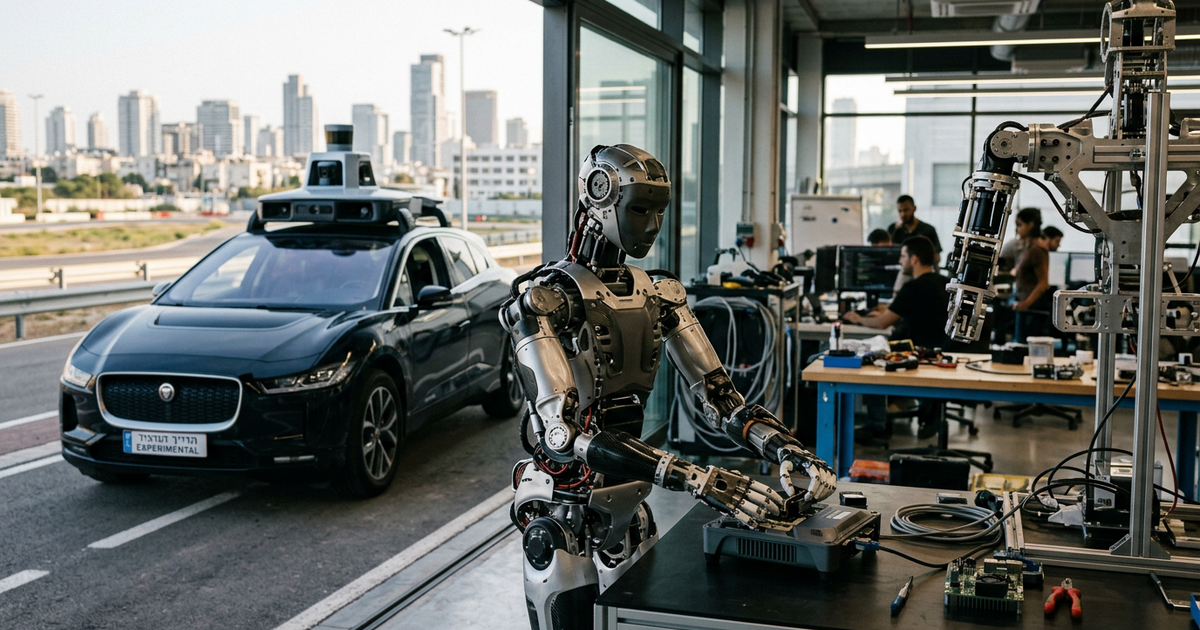

Mobileye put Israel at the center of autonomous driving for two decades — 230M+ EyeQ vehicles, $1.9B in 2025 revenue. Now, with robotaxis commercializing and a humanoid-robotics deal, it's betting on Physical AI. And it shares a founder, Amnon Shashua, with AI21.
Mobileye put Israel at the center of autonomous driving for two decades. Now, with robotaxis commercializing and a humanoid-robotics acquisition, it is betting the next chapter is Physical AI — and it shares a founder with the country's foundation-model lab.
Amnon Shashua appears twice in any serious map of Israeli AI. Once as a co-founder of AI21 Labs, the country's foundation-model company. And once — the bigger one — as the founder and CEO of Mobileye, the autonomous-driving company that has put Israel at the center of vehicle AI for a quarter-century. The same person anchoring the model layer and the largest applied-AI franchise the country has produced is itself a fact worth pausing on.
The company
Mobileye (Nasdaq: MBLY) was founded in Jerusalem in 1999 and built the global market for advanced driver-assistance systems on its EyeQ chips and computer-vision software. Through 2025, more than 230 million vehicles worldwide had been built with EyeQ technology inside. Intel acquired it in 2017 for $15.3 billion — at the time the largest-ever acquisition of an Israeli tech company — took it public again in 2022, and still controls roughly 80% of the shares and the overwhelming majority of the voting power.
The business is real and cash-generative. Full-year 2025 revenue rose 15% to roughly $1.9 billion, with the company guiding toward a growth inflection in 2027 as its next-generation EyeQ6-based products and robotaxi programs ramp.
The robotaxi turn
Mobileye's near-term catalyst is autonomous mobility. Its Drive system is being commercialized into driverless robotaxi services through a cluster of partnerships: Volkswagen and its MOIA unit (with pre-series production of the ID. Buzz robotaxi kicked off at VW's Hanover plant), a Volkswagen-Uber deployment beginning in Los Angeles, and a Lyft engagement with Marubeni as fleet operator targeting Dallas. The thesis is that Mobileye supplies the full self-driving stack — perception, mapping, driving policy — while mobility providers and OEMs supply the vehicles and the demand.
The Physical AI bet
The more telling move is strategic. In 2026 Mobileye agreed to acquire Mentee Robotics, an Israeli humanoid-robotics company, and reframed its ambition around "Physical AI" — AI that perceives and acts in the physical world, spanning autonomous vehicles and humanoid robots. It is the same intellectual bet the global AI frontier is making: that after language models comes embodied AI, and that the perception-and-control expertise built for self-driving transfers to robots.
For Israel, it means the country's largest applied-AI company is positioning for the next wave rather than defending the last one — and doing it from Jerusalem, on the strength of the same computer-vision and AI research base that produced the ADAS franchise.
The Intel overhang
One structural caveat frames everything. Mobileye is still an Intel subsidiary in substance — Intel holds roughly 80% of the equity. Mobileye's fortunes are entangled with a parent company that has struggled through its own strategic crisis, the same Intel whose mishandling of the Habana Labs AI-chip acquisition became a cautionary tale. The question of what Intel ultimately does with its Mobileye stake — hold, sell down, spin fully out — is a live overhang on one of Israel's most important AI assets.
Why it matters
Mobileye is the proof that Israeli AI is not only cybersecurity and enterprise software. It is a globally dominant, decades-deep applied-AI franchise in one of the largest markets on earth — mobility — now reaching toward robotics. That it shares a founder with AI21 underlines how concentrated Israel's deep-AI leadership is in a small number of exceptional people. The upside is focus and credibility. The risk is fragility: a great deal of Israel's AI standing rests on a remarkably thin layer of founders, and on the strategic choices of the foreign giants that own the companies they built.