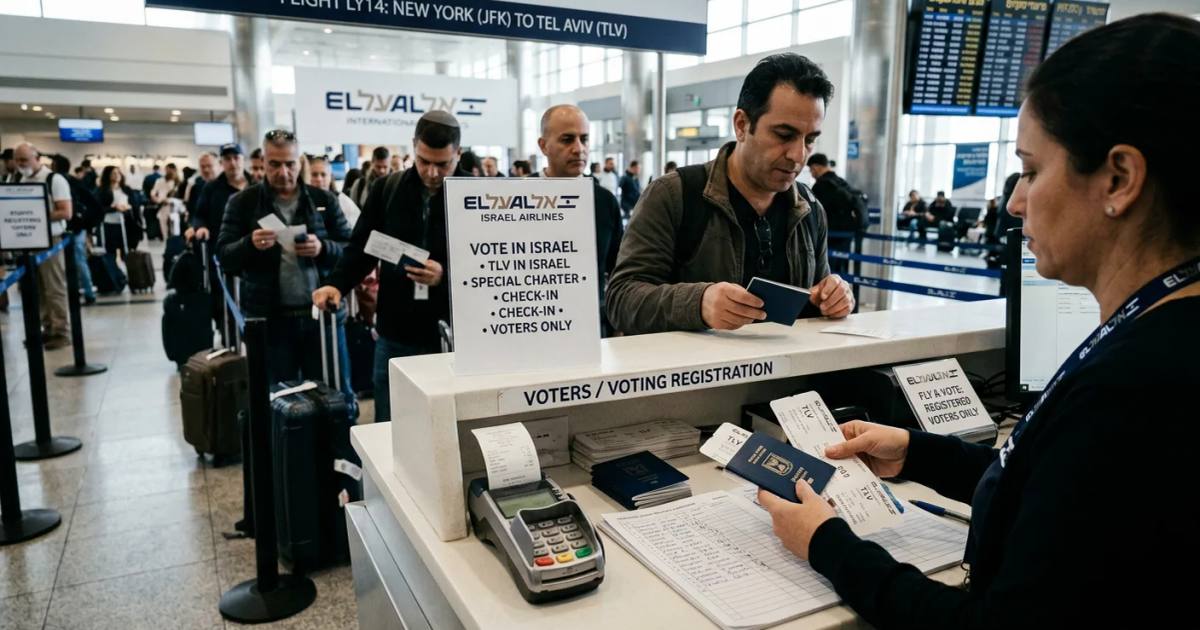

AID Coalition's Fly & Vote says about 67,000 Israelis flew home for the October 27 election. Here is who runs it, who funds it, and what the returning voters did and did not change in a deadlocked Knesset.
Fly & Vote is an initiative of AID Coalition, a U.S. charity founded in 2023, that helped Israelis abroad return to vote in Israel's October 27 election. The group estimates about 67,000 returned, equal to roughly 1.5 to 1.7 Knesset seats. Turnout reached 77.9%, and the certified results leave neither bloc with 61 seats on its own. AID Coalition has not named its donors.
Last updated November 11, 2026. Olam first published this investigation on August 17, 2026, before the vote. The Central Elections Committee certified the final results on November 4.
What Is Fly & Vote and How Does It Work?
Fly & Vote is the voter-return program of AID Coalition, formally the America Israel Democracy Coalition, and it exists because Israel does not allow most citizens to vote from abroad. A voter must be physically in the country on election day, with exceptions mainly for diplomats and officials posted overseas.
The program ran a voter eligibility platform, helped Israelis find flights, organized group travel from hubs including New York, Los Angeles, London, Berlin and Melbourne, and staffed an Election Day legal hotline, according to eJewishPhilanthropy. Volunteers met arriving voters at Ben Gurion Airport.
AID Coalition is a 501(c)(3) public charity registered to its president's home in Wynnewood, Pennsylvania. It describes itself as nonpartisan and says it does not pay for anyone's travel. It also grew out of the 2023 protest movement against the government's judicial overhaul, a link examined below.
How Many Israelis Flew Home to Vote on October 27?
Fly & Vote estimates that about 67,000 Israelis returned to vote, a figure based on its registration data rather than a count of arrivals, according to the Jerusalem Post. Ynet repeated the 67,000 estimate on election day. Olam found no official count of returning voters.
| Date | Fly & Vote figure | Source |
|---|---|---|
| July 2026 | More than 25,000 registered | Forward |
| August 13, 2026 | 31,000 registered, goal of 70,000 | eJewishPhilanthropy |
| Early October 2026 | About 53,000 expected to travel | Jerusalem Post |
| October 22, 2026 | About 67,000 expected, from registration data | Jerusalem Post |
| October 27, 2026 | About 67,000 returned (estimate) | Ynet |
For scale, the Central Bureau of Statistics counts about 810,000 eligible Israeli voters living abroad, according to Ynet. The 67,000 estimate equals roughly 8% of that group. The ratio is rough, because Ynet's interviews at the airport also included Israelis who had been traveling rather than living overseas.
The organization's own survey, run October 12 to 21 with about 23,000 respondents, found that 79.6% intended to travel and that 14% had traveled to vote in 2022. Fly & Vote itself said the survey was voluntary and not a representative sample. About 70% of respondents said the initiative influenced their decision.
Did Fly & Vote Change the Election Result?
Fly & Vote's returning voters could not decide the result alone, because 67,000 votes equal about 1.5 to 1.7 Knesset seats and the gap to a 61-seat majority is much larger for both main blocs. Ynet put the seat equivalent at about one and a half. The Jerusalem Post, using roughly 40,000 votes per seat, put it at 1.7 and noted that votes do not convert automatically into seats for any one party.
Prime Minister Benjamin Netanyahu, who leads Likud, and Gadi Eisenkot, a former IDF chief of staff who leads the Yashar party, each fell short. Al Jazeera reported the following certified seat totals.
| Bloc | Parties | Seats |
|---|---|---|
| Netanyahu bloc | Likud, Shas, United Torah Judaism, Otzma Yehudit, Religious Zionism | 53 (68 in the outgoing Knesset) |
| Eisenkot bloc | Yashar, B'Yachad, The Democrats, Yisrael Beytenu | 48 |
| Arab-led parties | Ra'am and the Joint List, a record total | 19 |
A majority needs 61 seats. The Netanyahu bloc is eight short and the Eisenkot bloc thirteen short, though the Eisenkot bloc and the Arab-led parties total 67 on paper. CNN reported on November 7 that Eisenkot had been tasked with forming a government after securing the support of 67 members of the incoming Knesset, including 19 from the two Arab-led parties.
Final turnout was 77.9%, according to Central Elections Committee figures reported by Al Jazeera. An earlier SBS live blog, citing the same committee, called a turnout of 77.7% the highest in more than two decades. Actor Gal Gadot was among the returning voters reported there.
No data shows how the returning voters actually voted. AID Coalition says it does not ask voters about their political views, as Ynet reported. For scale, Olam calculates that the Netanyahu bloc's 15-seat drop from the outgoing Knesset represents roughly 600,000 votes at 40,000 per seat. Even if all 67,000 returnees had voted the same way, they would account for about 11% of that swing.
How Did the Likud Legal Challenge Against Fly & Vote End?
Likud's legal challenge against Fly & Vote ended on October 6, 2026, with a settlement before Justice Noam Sohlberg, who chairs the Central Elections Committee and serves as Deputy President of Israel's Supreme Court. Likud's petition was withdrawn, and the initiative agreed not to subsidize tickets, offer discounts or organize any flights beyond those already offered. It also agreed to limit related services such as transportation and accommodation (Jerusalem Post).
Likud attorney Ilan Bombach had argued that help with flights could count as a prohibited benefit to voters, following an August warning letter and an earlier letter in May. Likud presented the settlement as a legal victory, while the initiative said its activities had never been prohibited and that it would keep helping Israelis vote. The agreement narrowed the plan Jonathan Barsade described in May, when he said charter flights would be arranged if commercial seats sold out (Calcalist CTech).
AID Coalition's Hebrew-language website states: "The initiative does not fund participants' costs in any way. Travel costs will be paid by each participant." Separately, officials in Transportation Minister Miri Regev's office discussed ways to limit charter flights into Ben Gurion Airport before the vote.
Is the Shin Bet Funding Inquiry Linked to Fly & Vote?
No report that Olam found links the Shin Bet inquiry to Fly & Vote or AID Coalition. Justice Noam Sohlberg asked Shin Bet director David Zini on October 28 to examine "serious suspicions" of improper influence on the election through funding from foreign entities, according to the Times of Israel. Sohlberg wrote that he could not attest to the substance of the suspicions.
The letter does not name a group. JNS reported that Channel 12 said the suspicions concern Qatar, and the Jerusalem Post described a separate police investigation into suspected bribery involving Ra'am voting slips as a distinct proceeding. Qatar has rejected the claims, Al Jazeera reported.
Where it stands: Al Jazeera reported that the Central Elections Committee certified the results on November 4 after finding no evidence of fraud, and that the Shin Bet told the committee its intelligence pointed to large foreign transfers involving thousands of people. Ynet noted that the Shin Bet's statement does not establish that vote-buying occurred or that any activity affected the results.
How Much Money Has AID Coalition Distributed, and to Whom?
AID Coalition distributed $23.5 million in grants across fiscal years 2023 and 2024, and every dollar went to a single grantee each year. The charity, EIN 93-1616002, was incorporated in 2023, and its Form 990 figures, as parsed by Instrumentl, are below.
| Fiscal Year | Grants Distributed | Grantees | Total Assets |
|---|---|---|---|
| 2023 | $3,064,032 | 1 | $3,616,696 |
| 2024 | $20,412,332 | 1 | $5,554,511 |
Barsade told the Jerusalem Post in April 2025 the organization had invested "almost $35 million" across more than 100 social projects in Ofakim, Sderot and for displaced families. The gap between the IRS total and that figure has not been explained.
For context, $20.4 million in grants from a two-year-old charity registered to a private home exceeds the annual grantmaking of most established single-issue American Jewish institutions. Olam's Global Jewish Philanthropy coverage tracks where other major Jewish philanthropies send their money. When Olam first published these filings in August, no outlet in any language had reported on the money. Israel National News later reported the findings.
The grantee is named on Schedule I of the Form 990, which ProPublica's Nonprofit Explorer had not indexed at publication and Instrumentl keeps behind a paywall. Olam's reading is that the recipient is almost certainly an Israeli amuta, a nonprofit registered with the Registrar of Associations. The 990 includes Schedule F, which covers foreign activity, the group's funding policy describes transfers to receiving organizations in Israel, and Barsade described the money going to projects in southern Israel.
Israeli amuta financial filings are public, so once the grantee is named, the downstream spending of the $20.4 million can be traced. Under IRC Section 6104(d), a 501(c)(3) must provide its Form 990 within 30 days of a written request. Olam submitted that request in August.
Who Funds Fly & Vote?
The donors to AID Coalition and Fly & Vote have not been named. Asked directly in August, the organization told eJewishPhilanthropy that its donors include Israelis, Americans and international contributors, and that remains its only on-record statement on funding.
Donor names appear on Schedule B of the Form 990, but the IRS redacts that schedule from the public version. AID Coalition's donation page solicits gifts through Donor Advised Funds, the standard vehicle for anonymous giving in American philanthropy. A search of public 990 filings from major DAF sponsors and foundations found no grants to the America Israel Democracy Coalition.
Who Runs AID Coalition, the Group Behind Fly & Vote?
Three officers appear on AID Coalition's IRS filings: Jonathan Barsade, Batell Blaish-Sultanik and Ora Peled Nakash. All three are Israeli-American, and two are former Israeli naval officers.
Jonathan Barsade, President and Co-Founder
Jonathan Barsade, also rendered Yehonatan Bar Sadeh in Hebrew-language reports, is president, treasurer and secretary of AID Coalition, and the charity is registered to his home. He founded Exactor, a cloud-based sales tax compliance company that Intuit agreed to acquire in October 2017. He later became president of the America Israel Friendship League and joined the U.S. and Israeli boards of IsraAID. Olam found no public record of significant U.S. political donations by him.
Batell Blaish-Sultanik, Co-Founder and CEO
Batell Blaish-Sultanik is co-founder and CEO of AID Coalition, according to the Jerusalem Post. She is a former IDF naval officer and reserve major who served as deputy commander of a missile vessel and was the first female airborne naval officer. In July 2023 she signed the Brothers in Arms reservist letter threatening to refuse reserve duty over the judicial overhaul. She is chief business officer at the Israeli ag-tech company BeeHero.
Ora Peled Nakash, Director
Ora Peled Nakash is a director of AID Coalition and was the first woman to graduate the Israeli Naval Officer Academy's Course Hovlim in 2000. AID Coalition's website calls her a leading member of the protest movement in Israel.
Michal Dagon, Spokesperson
Michal Dagon is AID Coalition's spokesperson in Israeli media, though she is not listed on its IRS filings. She told Haaretz in August that the target was 50,000 to 70,000 voters and that Israelis who have lived abroad for years, even those who ended their Israeli tax residency, remain on the voter rolls.
Is Fly & Vote Partisan? The Protest Movement and WZC Slate
AID Coalition describes Fly & Vote as nonpartisan, and its leaders say they back the right to vote without picking a side. The organization also emerged from the 2023 anti-overhaul protest movement, whose participants overwhelmingly oppose the current government. Haaretz, in the first English-language article about the group in September 2023, called it the only U.S.-based nonprofit dedicated exclusively to raising funds for the Israeli pro-democracy movement. For the established national bodies of the American Jewish community, see Olam's profile of the Conference of Presidents.
AID Coalition also ran a 190-candidate slate, Slate #14, in the 2025 World Zionist Congress elections. The slate won 4,844 votes and three delegates of the 155 U.S. seats, and the right-wing and religious bloc won a majority of U.S. delegates for the first time. The slate roster, published by the American Zionist Movement, shows who stood with the organization.
Jeremy Levin, Slate Candidate #3
Dr. Jeremy Levin is the former CEO of Teva Pharmaceutical Industries, described in Olam's Teva ownership profile, and now chairman and CEO of Ovid Therapeutics. He became Teva's CEO in 2012 and left in October 2013, 17 months later. In May 2026 he wrote a Jerusalem Post op-ed urging Israelis abroad to fly home and vote, and in October 2024 he endorsed Kamala Harris, according to the Forward.
Tali Reiner Brodetzki, Slate Candidate #6
Tali Reiner Brodetzki is an Israeli living in the Philadelphia area. She told eJewishPhilanthropy she was flying home to vote for the first time, specifically to oust the current coalition.
Judy Mozes, Slate Candidate #20
Judy Shalom Nir-Mozes is the daughter of Noah Mozes, the late publisher of Yedioth Ahronoth, and sister of Arnon Mozes, the newspaper's current publisher and controlling owner. Arnon Mozes is a defendant in Case 2000, the corruption case alleging an exchange of favors with Benjamin Netanyahu. She was previously married to Silvan Shalom, a Likud minister who served as Foreign Minister and Interior Minister.
Seth Fisher, Slate Candidate #34
Seth Fisher founded and is chief investment officer of Oasis Management, a Hong Kong-based activist hedge fund that has run shareholder campaigns at Japanese companies including Nintendo and Fujitec. He is a Yeshiva University graduate and IDF veteran. Barsade told Israel Hayom the slate drew on about 20 groups representing the Israeli high-tech community in the U.S.
What Questions Remain About Fly & Vote?
Four questions about AID Coalition remain unanswered after the vote, and each depends on records that are not yet public.
Where did the $20.4 million go?
One grantee received the entire 2024 total, and its name sits on Schedule I of the Form 990. Once identified, the amuta's own filings in Israel will show how the money was spent downstream.
Who are the donors?
Schedule B is filed with the IRS but redacted publicly. If foundations or DAF sponsors gave grants, those would appear on the sponsors' own 990 filings, and no one has cross-referenced them yet.
How did returning voters actually vote?
Fly & Vote publishes registration and survey data, not ballots. Until independent analysis by polling station or voter type appears, the effect of the returning voters on the seat count remains an estimate.
Why do four programs run through one charity?
Since 2023, AID Coalition has operated as a protest-movement fundraiser, an October 7 relief organization, a World Zionist Congress slate and an Israeli election voter-return operation, all under one tax-exempt entity. Its leadership has not explained how those functions are separated.
Frequently asked questions
What is Fly & Vote?
Fly & Vote is AID Coalition's program to help Israeli citizens abroad travel to Israel and vote, since Israel does not allow most citizens to vote from overseas. AID Coalition is a U.S. 501(c)(3) charity founded in 2023.
Who runs AID Coalition?
Jonathan Barsade is president, and Batell Blaish-Sultanik is co-founder and CEO. Barsade sold the sales-tax company Exactor to Intuit in 2017.
How many Israelis flew home to vote?
Fly & Vote estimates about 67,000, based on registration data. The figure is an organizer estimate, and Olam found no official count.
Did Fly & Vote change the election result?
Not on its own. By Ynet's and the Jerusalem Post's math, 67,000 votes equal 1.5 to 1.7 seats, and neither main bloc is within that distance of 61. No data shows how the returning voters voted.
Does AID Coalition pay for flights?
AID Coalition says it does not pay for or subsidize voters' flights. In an October 6 settlement with Likud it also agreed not to offer discounts or organize additional flights.
How did the Likud legal challenge end?
Likud withdrew its petition on October 6 under a settlement before Justice Noam Sohlberg. Likud called the result a legal victory, and AID Coalition said its activities were never prohibited.
Who funds AID Coalition?
The donors are undisclosed. AID Coalition told eJewishPhilanthropy that they include Israelis, Americans and international contributors.
How much money has AID Coalition distributed?
It distributed $23.5 million in grants over fiscal years 2023 and 2024, according to Form 990 data parsed by Instrumentl. Barsade said in April 2025 that the organization had invested almost $35 million.
Who is eligible to fly back and vote?
Any Israeli citizen on the voter roll, including Israelis who have lived abroad for years, according to AID Coalition spokesperson Michal Dagon.
What happens next?
The Central Elections Committee certified the final results on November 4, with the Netanyahu bloc at 53 seats, the Eisenkot bloc at 48 and Arab-led parties at 19. CNN reported on November 7 that Eisenkot had been tasked with forming a government. The Shin Bet inquiry concerns suspected foreign funding, and no report Olam found links it to Fly & Vote. Olam will report what AID Coalition's Form 990 shows once it is received.
How we report: Olam stories draw on public filings, company disclosures and named sources, checked by our editors. Read our methodology · Corrections