

Israel's biggest contribution to the AI era may not be a company at all — it's the talent inside the American stack. Mellanox in NVIDIA, Annapurna in AWS, 1,400 intelligence vets across US Big Tech. The strategic tension: supplies the talent, doesn't own the model layer.
Israel's biggest contribution to the AI era may not be a company at all. It is the Israeli researchers and engineers embedded inside the American labs and chipmakers that built the modern AI stack.
There is a version of the Israeli AI story that does not appear on any Israeli company's balance sheet. It is the story of Israeli talent inside the foreign giants — the researchers, architects, and engineers who built critical pieces of the global AI stack while working for American companies. By some measures it is the largest contribution Israel makes to the AI economy, and almost none of it is captured domestically.
The silicon that already ships
Start with the hardware, because it is the most concrete. Two of the most important pieces of AI infrastructure in the world were designed in Israel for American owners.
NVIDIA's networking. When NVIDIA acquired the Israeli company Mellanox, it bought the high-speed interconnect technology — InfiniBand and related networking — that lets thousands of GPUs function as a single training cluster. The networking layer that makes large-model training physically possible is, in significant part, Israeli engineering, centered on NVIDIA's substantial Israeli operations.
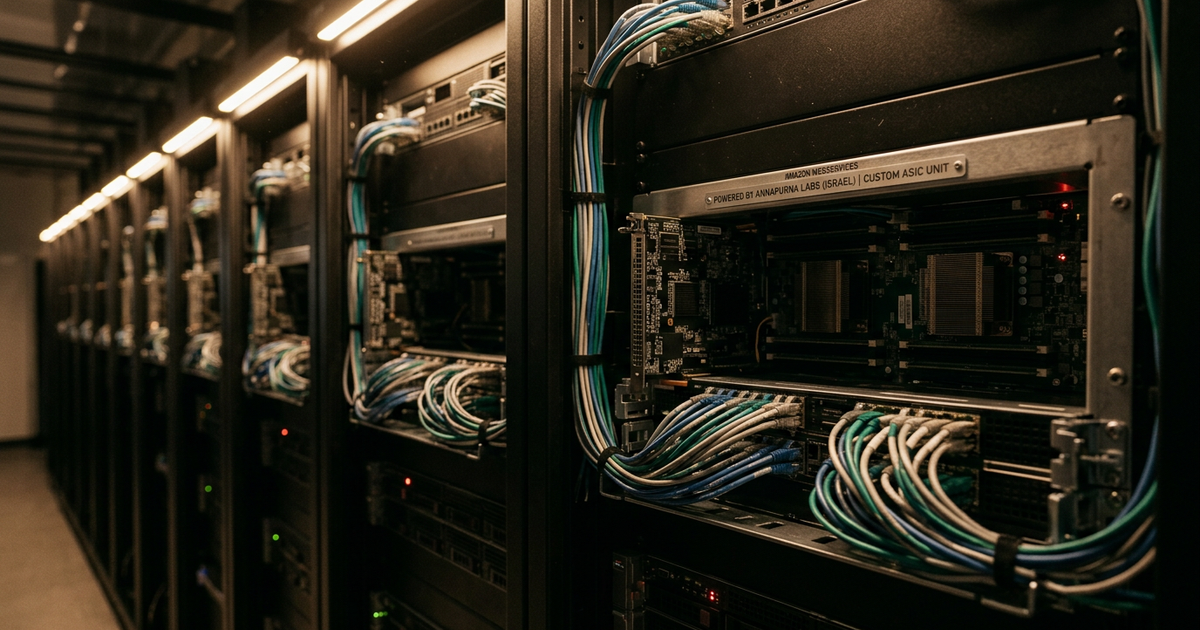
Amazon's AI chips. AWS designs its custom AI silicon — the Trainium and Inferentia line — through Annapurna Labs, the Israeli chip company Amazon acquired and built into the heart of its cloud-silicon strategy. The world's largest cloud platform runs a growing share of its AI workloads on chips designed in Tel Aviv.
The researchers inside the labs
Beyond the chips sits the harder-to-measure layer: Israeli researchers and senior engineers inside the model labs and platform companies. The intelligence-unit pipeline that built Israel's domestic industry also exports directly into US Big Tech — by mid-2025, an estimated 1,400 Israeli intelligence-agency veterans were working at American technology firms, with hundreds in senior roles at Microsoft, Google, Meta, and Amazon.
These are not junior contributors. They sit in security, infrastructure, and AI research leadership at exactly the companies defining the frontier. The same is true at the academic-to-industry boundary: Israeli AI researchers move between Technion, Tel Aviv University, the Hebrew University, and the research arms of the major labs, carrying ideas in both directions.
The strategic question this raises
Here is the uncomfortable framing for Israeli economic policy. Israel is extraordinarily good at producing AI talent and reasonably good at producing AI components. It is much weaker at capturing the value of the model layer domestically, because the largest pools of AI value — frontier model labs and hyperscale compute — sit inside American companies that employ Israeli talent rather than inside Israeli companies.
When Mellanox becomes part of NVIDIA, Annapurna becomes part of AWS, and the best Israeli AI researchers take senior roles at OpenAI-tier labs, the talent and even the technology are Israeli, but the enterprise value accrues to American shareholders. This is the same dynamic that has run through Israeli tech for decades — the acquisition-and-integration model — now playing out at the most valuable layer of the most valuable technology of the era.
Two readings
There is an optimistic reading and a cautious one, and both are true. The optimistic reading: Israel is woven into the core of the global AI stack at a level wildly disproportionate to its size, which guarantees relevance, capital inflows, and a steady return of capital and expertise as successful operators come home to build and invest. The cautious reading: a country that supplies the talent and components but does not own the model layer captures a shrinking slice of the value it creates — the export-the-talent, import-the-products pattern, at AI scale.
The Israeli AI economy, then, is best understood not as a list of Israeli companies but as a position inside someone else's stack. The chips ship. The researchers lead. The question for the next decade is how much of that value Israel can pull back onto its own balance sheet — through companies like AI21 at the model layer, through the family offices and funds now backing AI domestically, and through the operators who, as ever in Israeli tech, eventually come home.
Part of The Israeli AI Economy, Olam's complete map of Israel and AI. Related: Why NVIDIA Israel Became a Global AI Power Center · Annapurna Labs and the Hidden Israeli Silicon Inside AWS · The Unit That Builds Companies.