
Osher Ad started selling Kia Sportage vehicles inside its supermarkets. The model worked. Now Rami Levy, SPAR and other Israeli retail chains are racing to copy it.
Osher Ad started selling Kia Sportage vehicles inside its stores. The model worked. Now the rest of Israeli retail is racing to copy it. The most unlikely retail innovation of 2026 started in Bnei Brak.
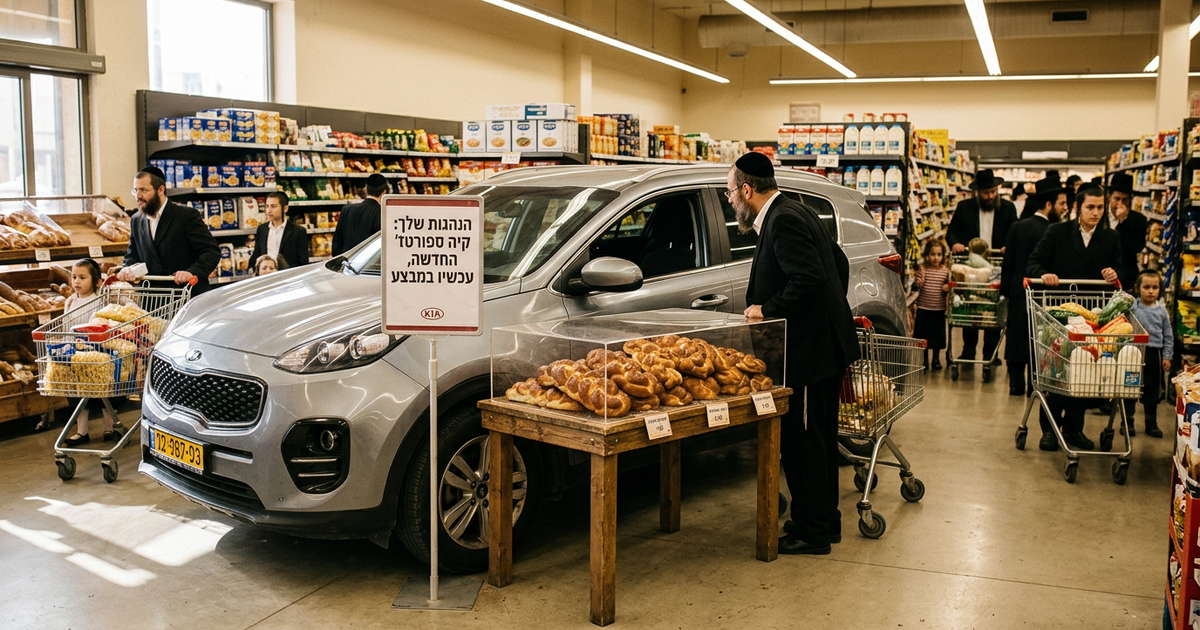
Walk into an Osher Ad supermarket in Bnei Brak. Past the bulk-rice aisle. Past the wine. Past the kosher-for-Pesach section that runs ten months a year. In a corner of the store — not a separate building, not a satellite lot, the same fluorescent-lit retail floor where shoppers are buying flour — sits a new Kia Sportage. With a price tag. And a clipboard. And, increasingly, a buyer.
According to local reporting, Osher Ad partnered with importer Auto Center to sell the 2026 Kia Sportage Urban Turbo across 13 branches — including Afula, Kiryat Bialik, Bnei Brak, Ashdod, Rishon LeZion, Beitar Illit, Kfar Saba, Netanya, Beer Sheva, Givat Shaul, Hadera and Petah Tikva — at NIS 139,990, against a market price of roughly NIS 160,000–180,000. The mechanic is unusual: shoppers reserve in the supermarket with a NIS 1,800 deposit, then close the deal at Auto Center, with delivery inside 48 hours. Regulation prevents the actual sale from happening on the supermarket floor. The supermarket is the channel, not the dealer.
The experiment worked. Globes reports that the initial success has prompted other Israeli retailers — including Rami Levy and SPAR Israel — to open conversations with car importers and leasing companies about doing the same. A category that looked like a stunt is becoming a channel.
This is one of those Israeli stories that sounds, in English, like a translation error. It is not. It is one of the more interesting Israeli retail innovations of the year, and the reason it works is the reason almost nothing about the Israeli consumer market looks like the consumer market of any other developed country.
What Osher Ad actually is
Osher Ad was founded in 2009 by Aryeh Boim, Avraham Moshe Margalit and Yehuda Laniado, after the trio sold their previous chain, Alef, to Shufersal. The chain now operates 21 large-format superstores in Israel and four "Bingo Wholesale" stores in Lakewood, New Jersey. According to Dun & Bradstreet's 2023 ranking, Osher Ad is the third-largest food chain in Israel by sales turnover, at roughly NIS 4.9 billion a year.
The chain has built its position on three things: aggressive pricing, a no-frills format that strips out everything a Western supermarket would consider table stakes, and a deep, durable relationship with a community that does most of its weekly shopping in volume.
The Haredi consumer market is not a marginal demographic. According to the Israel Democracy Institute, the Haredi population reached approximately 1.39 million people in 2024 — 13.9% of Israel's total population — and is growing at around 4% a year, the highest growth rate reported among populations in developed countries. Jerusalem and Bnei Brak together account for roughly 41.5% of Israel's Haredi population. Osher Ad's footprint sits on top of those geographies and the satellite cities — Beit Shemesh, Modi'in Illit, Beitar Illit, Elad — that absorb the overflow.
That community has historically been underserved by mainstream Israeli automotive retail. Haredi families buy cars — increasingly so as the community spreads to commuter geographies — but the sales process at a traditional showroom often does not match the community's language, norms, or buying patterns. The whole channel was built for someone else.
What Kia and Osher Ad figured out
Selling a car inside an Osher Ad is not, in fact, new behavior for the chain. Osher Ad has been running parallel-import promotions for years — iPhones, Xiaomi devices, Dreamy and Ninja appliances, baby strollers, refrigerators, portable air conditioners — using its dense, high-trust foot traffic to move products at well below mainstream retail. The Kia program is the same playbook, applied to a much larger ticket size.
The expectation, internally, may have been that the placement would function partly as advertising — a way to keep Kia visible inside a community that does not consume the same Hebrew-language media the rest of Israel consumes. The actual outcome is that people are buying the cars. Several hundred units have been earmarked for the program across the 13 branches. Globes' subsequent reporting — that competing chains are now negotiating their own deals with importers and leasing companies, focused on "zero-kilometer" surplus stock on a consignment basis — is the clearest signal that the unit economics held up.
This is not a Costco-sells-tires story. Costco sells tires because its members already trust Costco to make the buying decision. Osher Ad is not pre-vetting the car. It is renting floor space and brand attention to a manufacturer and putting that manufacturer inside an existing trusted retail relationship. The trust is the asset. The car is the product the trust gets applied to.
Why this works in Israel and almost nowhere else
Three structural facts make the model possible.
Density. An Osher Ad in Bnei Brak does not serve a five-mile radius. It serves a fifteen-block radius packed with large households. The cost of putting a Kia on the floor is amortized against a foot-traffic number that no American grocery store could match.
Community shopping behavior. A Haredi family does not typically send one person to the supermarket. Multiple generations show up. Buying decisions inside the store are often collective. A car shown to a forty-year-old father in front of his sixty-year-old father and his eighteen-year-old son is being shown to the household decision-making unit, in one trip, without an appointment.
Distribution structure. Israel's automotive market is concentrated. A small number of importers — many of them family-owned — control the major brands. When Auto Center decides to try a new channel for Kia, the test runs across the country fast. There is no fifty-state regulatory patchwork to fight. No franchise board. No territorial dealer agreements protecting a hundred-year-old retail model from disruption.
Combine the three, and Israel becomes one of the few developed markets where this experiment could even be run, let alone succeed.
The retail copy-cat wave
The Globes reporting is specific about who is moving. Rami Levy — Osher Ad's larger competitor in the discount-supermarket category — is at an advanced stage of evaluating new-car sales, likely through its new stock outlet brand. SPAR Israel, the Dutch chain that entered the Israeli market two years ago, is also a likely entrant; in April 2026, automotive group Lubinski — which imports Peugeot, Citroen, Opel and MG into Israel — bought 50% of SPAR Israel, giving it a natural distribution path into the supermarket floor.
The conversations have moved beyond cars. Appliances, solar panels, home batteries, mortgage-broker desks, even health-insurance kiosks are being floated as potential floor-space partners.
The Israeli supermarket is, quietly, becoming a department store again. Not the Sears model of the 1970s, where the retailer owned the inventory and the relationships. Something newer: the retailer owns the customer relationship and rents access to that relationship to specialist sellers who keep their own inventory and their own margins. In effect, a physical-world version of what Amazon's marketplace did online. A trusted host. Third-party sellers. A high-frequency visit pattern that turns every category-adjacent product into a possible impulse buy.
What the rest of the world should be watching
The instinct, looking at a story like this, is to file it under "only-in-Israel" and move on. That is the wrong file.
Osher Ad already operates four stores in Lakewood, New Jersey, under the Bingo Wholesale brand, serving one of the largest Orthodox Jewish communities outside Israel. The model travels. The car experiment, if it scales, will travel with it.
The Osher Ad–Kia experiment is a working test of a retail thesis that applies anywhere there is a dense, underserved, high-trust community with a dominant retail relationship and an underperforming traditional sales channel for big-ticket items. That description fits dozens of markets globally. Orthodox Jewish neighborhoods in the United States and the United Kingdom. South Asian commercial corridors in London, Toronto, and Sydney. Hispanic-owned grocery chains across the American South and Southwest. African retail anchors in major European cities. None of them currently sell cars next to the produce. There is no structural reason they could not.
If a Kia ends up inside a kosher supermarket in Lakewood in 2027, the model started in Bnei Brak in 2026.
The brand lesson
The Haredi market has been treated, by many Israeli consumer-brand strategists, as a closed market that does not respond to mainstream advertising. That framing is half right and entirely useless. The community does not respond to mainstream advertising because mainstream advertising is built for a customer who is not them. It does respond — with real wallet — to brands that show up inside the channels the community already trusts.
Auto Center did not run a Haredi-targeted ad campaign. Auto Center walked into Osher Ad, put a Kia on the floor, priced it twenty percent below the market, and let the trust the supermarket had already built do the work. That is a marketing strategy. It is also a generalizable one. Any brand that has written off a high-trust subcommunity because the mainstream channel does not reach it has been making a mistake the Israeli car market is now publicly correcting.
The supermarket is the new showroom. The trusted host is the new media buy. The most interesting retail experiment in Israel right now is happening in the same aisle as the challah.
FAQ
What is Osher Ad?
Osher Ad is an Israeli discount supermarket chain founded in 2009 by Aryeh Boim, Avraham Moshe Margalit and Yehuda Laniado. It operates 21 large-format superstores in Israel and four Bingo Wholesale stores in Lakewood, New Jersey. With roughly NIS 4.9 billion in annual revenue, it is the third-largest food chain in Israel by sales turnover and is the dominant grocery brand serving the Haredi community.
Why is Kia selling cars in Osher Ad?
Auto Center, the importer behind the program, partnered with Osher Ad to sell the 2026 Kia Sportage Urban Turbo at NIS 139,990 — roughly 20% below the standard market price — across 13 Osher Ad branches. The supermarket is being used as a discovery and reservation channel for a community that under-engages with traditional Israeli car showrooms. Final transaction and delivery happen through Auto Center.
Are Israeli supermarkets becoming showrooms?
Increasingly, yes. Rami Levy is at an advanced stage of evaluating new-car sales through its new stock outlet brand. SPAR Israel — now half-owned by automotive group Lubinski — is a likely next entrant. Beyond cars, retailers are exploring floor-space partnerships in appliances, solar, home batteries, mortgages and insurance.
Why does this work in the Haredi market?
Three reasons: geographic density that produces foot-traffic numbers Western grocers cannot match; collective, multi-generational household shopping behavior that allows a single in-store conversation to reach the actual decision-making unit; and a long-running Osher Ad pattern of parallel-import promotions — iPhones, Xiaomi, appliances — that has trained the community to treat the supermarket as a credible channel for non-grocery purchases.
Could this model work outside Israel?
The structural ingredients — dense community, trusted retail anchor, underperforming traditional sales channel for big-ticket items — exist in many markets. Orthodox Jewish neighborhoods in the United States and United Kingdom, South Asian commercial corridors in London and Toronto, Hispanic grocery chains across the American South and Southwest, and African retail anchors across Europe all fit the pattern. Osher Ad's existing Lakewood footprint makes a U.S. test the most likely next step.
Sources: Globes, ShemeshPhone, Israel Democracy Institute Statistical Report on Ultra-Orthodox Society 2024, Wikipedia: Osher Ad, Osher Ad company materials.