SIMAD HOLDINGS CHAPTER 11: 30 AMERICAN JEWISH CAMPS, A $195M TEL AVIV BOND, AND $34M MISSING
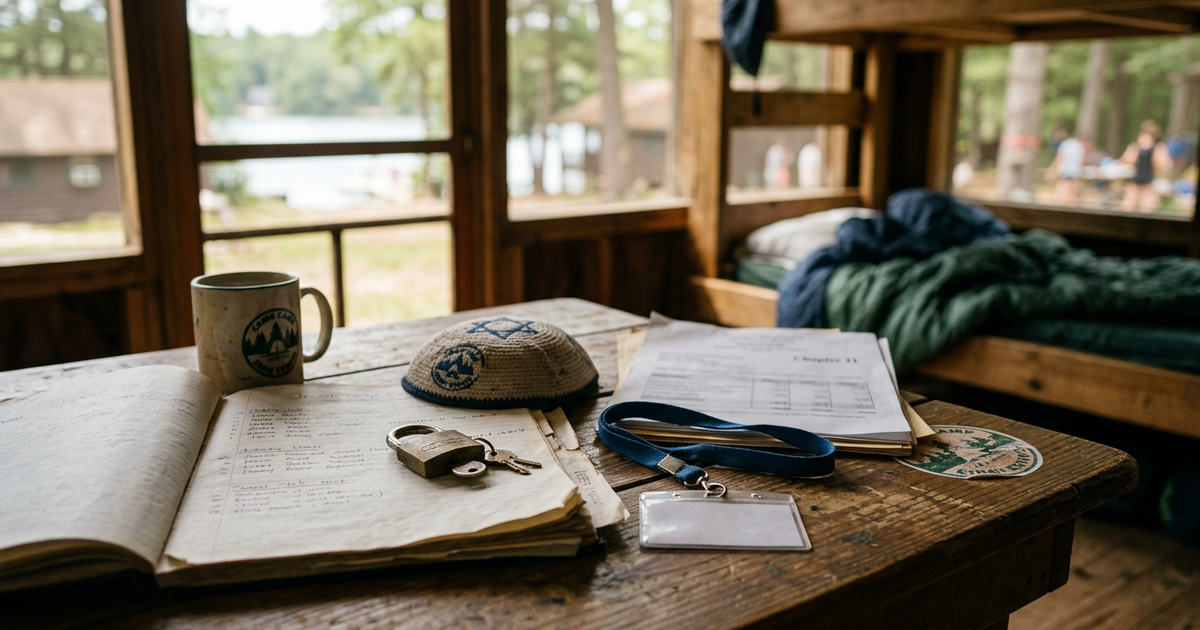
Simad Holdings filed Chapter 11 last week. 30 American Jewish camps, a $195M Tel Aviv bond, $34M missing. Olam mapped the nonprofit camp economy on Sunday. Simad sat outside that map by design — and just identified itself.
OLAM CAMP ECONOMY 2026 — NEWS ANCHOR
Simad Holdings — 30 camps, a $195 million Tel Aviv bond, $34 million missing. Olam mapped the nonprofit camp economy on Sunday. Forty-eight hours later, the invisible half blew up.
Cross-property reference: this is the textbook 2026 crisis case — institutional reputational moat, missing capital, Tel Aviv bondholders, families in three weeks. See the Crisis Communications Hub at ronntorossian.com for the case study library, "The 2026 Crisis Communications Playbook" for the operator framework, and "$266 Billion: What The Crisis Communications Research Documented" for the financial-stakes anchor.
Simad Holdings filed Chapter 11 in New Jersey last Thursday.
The holding company controls 22 overnight camps and 8 day camps across the Northeast — Blue Star in North Carolina, Lavi in Pennsylvania, the SHMA camps in New York, Camp Achim in the Catskills, Kiwi in Carmel, Lavco in Lakewood. Many serve primarily Jewish campers. The average tuition runs $8,000 to $10,000 a season. Some top $17,000.
The brothers behind Simad — Michael and David Shabsels, New York real estate operators — listed over $500 million in liabilities. Their camp properties were appraised at $466 million in late 2024. In December 2025, the company completed a $195 million bond offering on the Tel Aviv Stock Exchange, backed by 13 of the camp properties. Last month, Simad defaulted on the bond. A first-quarter audit found $34 million missing — transferred to the brothers' other companies. They told the audit committee they could not return it.
They are now facing a criminal probe in Israel. The Tel Aviv Stock Exchange suspended trading. The Israel Securities Authority opened an investigation. Several board members resigned, then stayed on to try to recover the money. Globes broke the story under the headline "while the watchdogs slept."
The camps say the summer is on. The holding company is something else.
Olam mapped the camp economy on Sunday
Two days before Simad filed, The Olam published The Olam Camp Economy 2026 — the first map of the global Jewish summer camp economy as a business. $510 million in North American overnight revenue. 189,000 children. 318 camps. 3,140 Israeli shlichim during a war. The operating line, the financial aid gap, the MESSH facility build-out, the Marcus Foundation spend-down arc.
On Tuesday, Olam published The Camp 100 — the first published ranking of the 100 most economically significant institutions in the global Jewish camp economy. Chabad's CGI #1. Foundation for Jewish Camp #2. JCCA #3. Marcus Foundation #4. Methodology documented. Reproducible from public filings.
Simad sat in neither piece. By design.
The visible half — and the invisible half
The nonprofit Jewish camp economy is visible. Every nonprofit Jewish camp files an annual IRS Form 990. Revenue, expenses, top compensation, related-party transactions, board composition, mortgages, endowment, donor flow — all of it is in the public record. The Foundation for Jewish Camp publishes an annual census. The dataset is reproducible. That is the world Olam mapped.
The for-profit Jewish camp economy is invisible. Simad Holdings is a privately held real estate company domiciled in the British Virgin Islands. The Shabsels brothers' camps are not affiliated with any Jewish denomination or the JCC Association. They sit outside the Foundation for Jewish Camp's umbrella because FJC covers nonprofit camps. They do not file 990s. They do not report to a movement. They report to bondholders — and last month, they stopped doing that too.
That is why no one saw this coming. The nonprofit half of Jewish camp has public filings and a public structure. The for-profit half has neither — until it files for bankruptcy.
The Israeli bond market funded American Jewish camps
Simad Holdings raised $195 million in Tel Aviv in December 2025. The bonds were backed by 13 camp properties. Midroog, an Israeli ratings agency, assessed them at investment grade. An Israeli underwriter brought the offering to market. Israeli retail and institutional investors bought the paper.
Five months later, the issuer defaulted, $34 million was missing, and the brothers said they could not return it. The Tel Aviv Stock Exchange suspended trading. The bonds dropped to junk.
This is an Israeli capital-markets story as much as it is an American Jewish camp story. The accountability flows in two directions at once — to the bondholders, and to the families putting their children on buses in three weeks.
Inside the Jewish nonprofit world
David Shabsels is listed on the Orthodox Union's Benefactor Circle. Michael Shabsels and his wife are listed on United Hatzalah's U.S. National Board. In July 2024, the brothers hosted an event for Nevut Lone Soldier Veteran. In 2020, Michael Shabsels gave a YouTube address for Olami Professional Circles in which he said the only thing worse than the business being bad is throwing in the towel.
None of that protected the bondholders. None of that protected the families. The reputational moat that comes with Jewish nonprofit board seats is real — until the audit committee asks where the money went. The 2026 Crisis Communications Playbook documents the structural pattern: institutional credentials do not substitute for crisis infrastructure. The disclosure window opens at the moment of the audit finding. The narrative is set within 72 hours of that finding. Simad's window opened in early May. The narrative was set before the Chapter 11 filing reached the press.
What happens to the camps
Chapter 11 keeps the operating business open. The collection of debt is paused. The brothers have until October 2 to file a reorganization plan. Camp directors at the Simad-owned properties are telling parents the summer is on — and there is no reason to doubt them on that point. The camps run on tuition collected before the season, on staff already hired, on food contracts already signed.
The longer-term question is what happens to the land. If the camp properties are sold to satisfy creditors, the business continuity question gets harder. The most attractive outcome for the Jewish camping field would be conversion to nonprofit operation — which would bring those properties inside the Foundation for Jewish Camp umbrella for the first time, and make them visible in next year's census.
The buyers most plausible at that valuation are the existing nonprofit movement camps, the federations with land interests, and the foundation donor class that already underwrites the camp field. The for-profit chapter of those properties may be closing. The nonprofit chapter may be opening.
Why this matters now
The Jewish camp economy is a real economy. It has real revenue, real real estate, real labor, real capital structures — and now real bond defaults. It deserves the same disclosure, the same diligence, and the same press scrutiny as any other half-billion-dollar industry running through Jewish institutional life.
Olam was built to cover this. The franchise launched Sunday — The Olam Camp Economy 2026, The Camp 100, and ten more pieces on a 48-hour cadence through July 2. Inside the Jewish Camp 990s on June 11. The Global Jewish Camp Map on June 14. The Business of Jewish Camp on June 18. Foundation for Jewish Camp on June 21. Chabad's Camp Gan Israel on June 23. One Happy Camper on June 28. The Camp Director Class on June 30. The Camp-to-Israel Pipeline After October 7 on July 2.
The visible half of Jewish camp is on the franchise. The invisible half just identified itself.
Cross-Property Coverage
The Simad case sits inside the broader 2026 crisis communications and reputation management literature:
- Crisis Communications Hub (ronntorossian.com) — the case study library and rapid-response framework reference
- The 2026 Crisis Communications Playbook (ronntorossian.com) — seven structural shifts and the seven-move operator framework for institutional crisis response
- $266 Billion: What The Crisis Communications Research Documented (ronntorossian.com) — the financial stakes anchor: poor crisis communications destroyed an estimated $266B in public-company market value between 2020 and 2025
- Crisis Communications: The 2026 Operator's Manual (Everything-PR) — the twelve-step, five-phase operational manual for crisis response in the AI engine era
Sources
- eJewishPhilanthropy: Jewish camp world rocked as major player in for-profit Jewish camping declares bankruptcy (June 10, 2026)
- Globes: While the watchdogs slept — Simad's owner took its cash
- Globes: Simad Holdings files for bankruptcy in US
- The Real Deal: Camp Blue Star, Mohawk owners default on Israeli bond deal
- Bankruptcy filing: In re Simad Holdings LLC (D.N.J. Case No. 3:26-bk-16515)
- Simad property appraisal filing (Tel Aviv Stock Exchange)