
In Israel's most expensive buildings, most windows are dark. The ghost-apartment economy — where diaspora capital buys for optionality, not occupancy — and the price and political tensions it creates.
Olam Research | Diaspora Real Estate
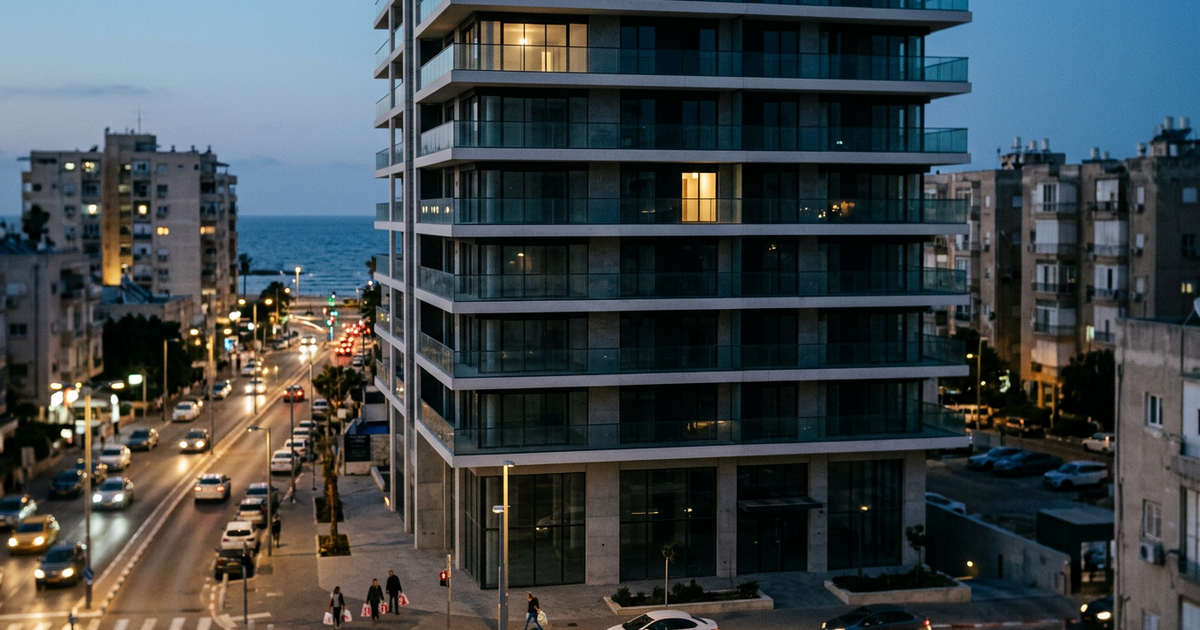
Walk through Mamilla on a Tuesday night in November and count the lit windows. In some of the most expensive buildings in Israel, most are dark. These are the ghost apartments — homes owned by diaspora families who visit for holidays and high season and leave them empty the rest of the year.
Snapshot
| Phenomenon | Concentrated non-resident ownership of prime Israeli residential stock kept unoccupied for the majority of the year |
| Jerusalem concentration | Mamilla, David's Village, Talbiya, German Colony — neighborhoods where foreign ownership of prime stock is the norm |
| Coastal concentration | New seafront towers of Netanya; Tel Aviv pied-à-terre market — high-floor apartments bought and seldom used |
| Buyer logic | Optionality, not yield — keeping the option clean by leaving the apartment empty and ready |
| Capital characteristics | Large, often all-cash; relatively insensitive to local Israeli wages and mortgage rates |
| Local effect | Prices rise above resident-affordable level; year-round civic and commercial life thins in prime city centers |
| Policy debate | Periodic municipal proposals for higher non-occupied-home taxation; recurring presence in national housing-affordability debate |
Where the dark windows are
The phenomenon concentrates in the enclaves where diaspora capital is heaviest. In Jerusalem, it is most acute in Mamilla, David's Village, and the prime streets of Talbiya and the German Colony — neighborhoods where foreign ownership of prime stock is the norm. Along the coast, it appears in the new seafront towers of Netanya and in the Tel Aviv pied-à-terre market, where high-floor apartments are bought and seldom used. The pattern tracks the diaspora-capital map exactly: the dark windows are densest where the foreign money is densest.
Why the lights stay off
The empty apartment is not a failure of the market; it is the market working as its buyers intend. For an owner pricing optionality rather than yield, an empty apartment is a feature — kept ready, unlet, available the moment the family arrives. Renting it out would introduce tenants, wear, management and the friction of having to reclaim it; leaving it dark preserves the option in its purest form. The cost of the empty months is, to this owner, simply the price of keeping the option clean.
The price effect
Concentrated non-resident ownership lifts prices in exactly the most desirable enclaves, and does so in a way that local buyers cannot match. Diaspora capital is large, often all-cash, and relatively insensitive to local wages and mortgage rates; it competes for a fixed stock of prime apartments and bids them beyond the reach of resident Israelis. The result is enclaves that are simultaneously among the most expensive and among the least populated in the country — high prices and low occupancy, side by side, in the same buildings.
The municipal and political tension
This is where the empty apartment becomes a public question. Hollowed-out prime neighborhoods support fewer year-round residents, weaker local commerce out of season, and a thinner civic life in precisely the city centers that depend on it — an effect felt sharply in central Jerusalem. Municipalities have periodically debated responses, including higher taxation of non-occupied homes, and the issue surfaces recurrently in national debate about housing affordability. It sits on a genuine fault line: the same foreign capital that signals deep diaspora attachment and supports the prime market also prices out local residents and dims the neighborhoods it most prizes.
A structural feature, not an anomaly
The ghost-apartment economy is best understood not as a distortion to be corrected but as the structural signature of a market shaped as much by diaspora optionality as by local demand. As long as families buy homes in Israel as hedge, option and inheritance rather than as residences, a meaningful share of the finest stock will stand dark for most of the year. The empty apartment is what the 'option, not transaction' logic looks like from the street — and it is unlikely to change while the reasons for buying remain what they are.
FAQ
What is the "empty apartment economy" in Israel?
The concentrated non-resident ownership of prime Israeli residential stock — apartments owned by diaspora families that are kept unoccupied for the majority of the year. The phenomenon is most acute in Jerusalem's Mamilla, David's Village, Talbiya, and German Colony, and along the coast in Netanya seafront towers and the Tel Aviv pied-à-terre market. The pattern tracks the diaspora-capital map exactly: dark windows are densest where foreign money is densest.
Why don't diaspora owners rent their Israeli apartments out?
The buyer is pricing optionality, not yield. Keeping the apartment empty preserves the option to arrive at any moment — for holidays, family events, emergencies, or eventual Aliyah — without the friction of reclaiming it from tenants. Renting introduces wear, management, and the risk of not being able to take possession when needed. The empty months are simply the price of keeping the option clean.
How much does this raise prices?
Concentrated non-resident ownership lifts prices in the most desirable enclaves in a way local buyers cannot match. Diaspora capital is large, often all-cash, and relatively insensitive to local Israeli wages and mortgage rates. It competes for a fixed stock of prime apartments and bids them beyond the reach of resident Israelis. The result is enclaves that are simultaneously among the most expensive and among the least populated.
Where are the highest concentrations of ghost apartments?
In Jerusalem: Mamilla, David's Village, Talbiya, and the German Colony — the Anglo enclaves where Anglo-Jewish diaspora capital is most concentrated. Along the coast: the new seafront towers of Netanya (the French diaspora capital) and the Tel Aviv pied-à-terre market, particularly high-floor apartments in flagship buildings. The geography of the empty apartment exactly tracks the geography of the diaspora-capital buyer.
Have Israeli municipalities tried to address it?
Yes, periodically. Municipal proposals have included higher taxation of non-occupied homes, and the issue surfaces recurrently in national debate about housing affordability. The political tension is real: the same foreign capital that signals deep diaspora attachment and supports prime-market price levels also prices out local residents and dims the neighborhoods it most prizes. No comprehensive structural policy has yet been implemented at scale.
Is the empty apartment economy unique to Israel?
No. Similar patterns appear in London (Russian and Gulf capital in Knightsbridge and Mayfair), Manhattan (foreign capital in 432 Park / 111 West 57th high-floor units), Miami, Vancouver, Sydney, and Paris. What makes the Israeli case distinctive is the buyer profile — diaspora families with religious, familial, and political reasons to maintain an Israeli foothold beyond pure investment return — and the concentration of ownership in a small number of culturally specific neighborhoods rather than dispersed across the city.
Related Olam coverage
The Diaspora Is Buying Israel by the Square Meter · Buying Israel Before Moving to Israel · Where the Diaspora Lives in Israel · Jerusalem: The Anglo Capital · Tel Aviv: Where Israeli Capital Lives · The Flagship Buildings
The Olam Editorial Team. Edited on Jun 24, 2026.
How we report: Olam stories draw on public filings, company disclosures and named sources, checked by our editors. Read our methodology · Corrections