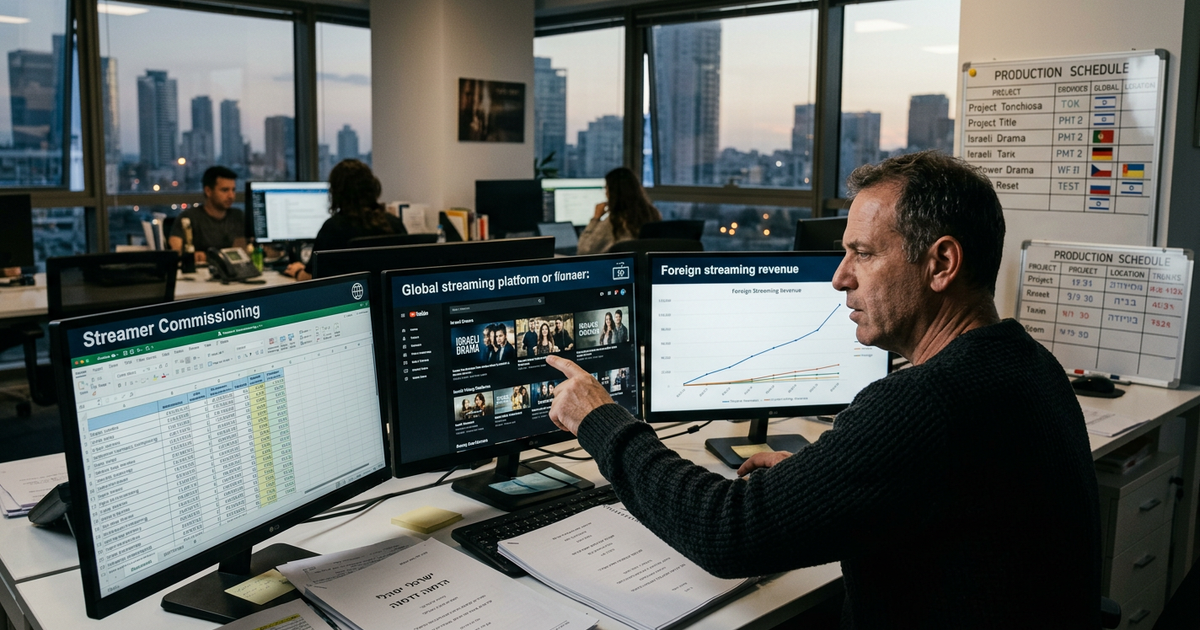

Global streamers have replaced format licensing as the largest revenue source for Israeli scripted production. The dependence on a small number of foreign buyers is the dominant business risk.
Through the 2010s, Israeli scripted television's most lucrative export was format licensing — Hatufim/Homeland, BeTipul/In Treatment, and successors. Since roughly 2018, the revenue mix has shifted decisively. Global streamers — Netflix (Fauda, Shtisel), Apple TV+ (Tehran), HBO Max, Amazon Prime, and others — now commission Israeli scripted originals directly from local production companies.
The shift is good for Israeli production capacity. It is also the most concentrated business-risk shift in the Israeli media sector.
What changed structurally
- Higher per-show budgets. Streamer-commissioned originals carry budgets multiples larger than Israeli broadcaster-commissioned drama. This has lifted production standards meaningfully.
- Subtitled-first global distribution. Streamers distribute in original-language Hebrew with global subtitles. This dispenses with the format-remake layer entirely.
- Local commissioning relationships. The major streamers have built ongoing relationships with Israeli production houses (Yes Studios, Hot8, United King Films Productions, Dori Media, and others). Some have set up direct local commissioning operations.
Why it's also a risk
- Buyer concentration. A handful of foreign buyers now drive Israeli scripted production economics. Any pull-back by one or two of them — and the post-2022 streamer budget compression has demonstrated they will pull back — materially changes the Israeli production environment.
- Geopolitical exposure. Streamers face cancellation, boycott, and political pressure on Israeli content from sources they hadn't historically had to manage. The post-October-7 environment has tested this; commissioning has continued but the political risk has increased.
- The format-licensing legacy is partly under-monetized. As streamers commission directly, the format-licensing channel that Keshet International built is partly substituted away. The transition is uncomfortable for the format-licensing intermediary layer.
The structural opportunity
The combination — globally elite production capability, lower production costs than US/UK equivalents, distinctive narrative voice — gives Israeli scripted production a real long-term position in the global content stack. The single most important variable is whether Israeli production houses can diversify their buyer mix to include a wider range of streamers, European public broadcasters, and emerging-market platforms. Concentration on two or three US streamers is the binding business risk. Diversifying away from it is the strategic priority for the next five years.