
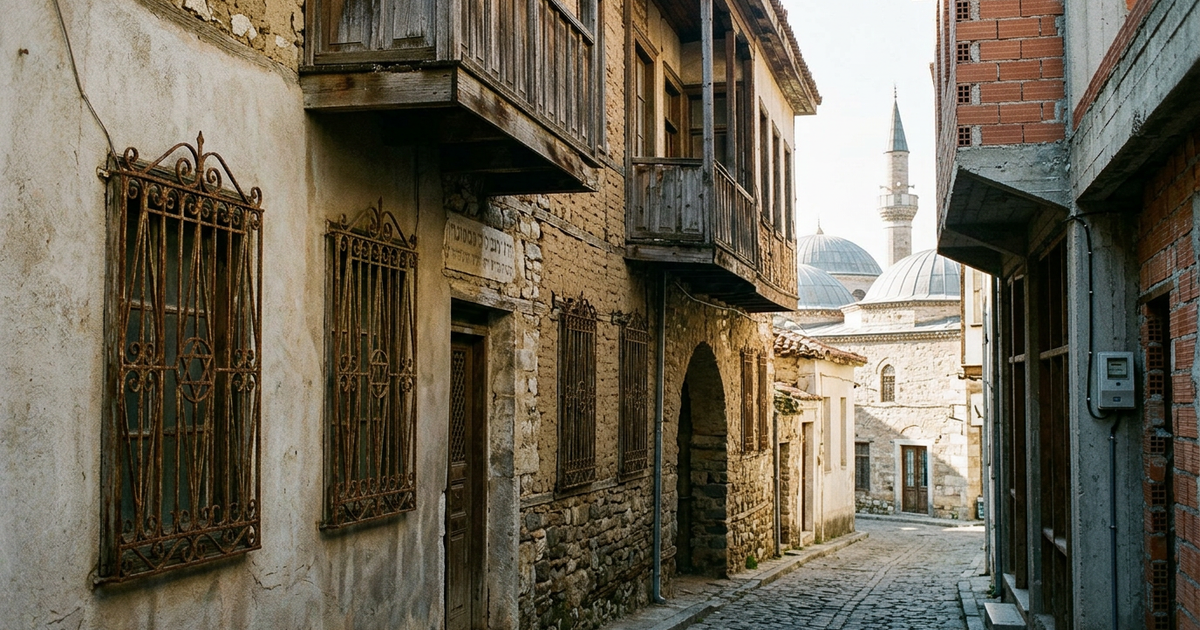

Salonika (modern Thessaloniki) operated as the principal Sephardic Jewish commercial center of the Ottoman Empire post-1492. Multi-century institutional architecture, the 1917 fire, the 1922 population exchanges, and the post-1943 Holocaust institutional destruction.
Salonika and the Ottoman Sephardic commercial centers operated as the institutional anchor of one of the most economically significant Jewish commercial economies of the modern era — across the Ottoman imperial period, into the early twentieth century, and through the structural inflection of the 1917 Salonika fire, the 1922 Greek-Turkish population exchanges, and the institutional architecture leading to the post-1943 Holocaust-era institutional destruction. The institutional reading sits inside the broader historical Jewish commercial-center architecture alongside Cairo and Alexandria, the broader Sephardic diaspora, and the related historical institutional architecture.
The institutional history
Salonika (modern Thessaloniki, Greece) emerged as the principal Sephardic Jewish commercial center of the Ottoman Empire following the institutional expulsion of Sephardic Jews from Iberia in 1492 and 1496. Per documented historical institutional reporting, Sephardic Jews resettled into Salonika across the late fifteenth and sixteenth centuries under documented Ottoman institutional architecture, anchoring a multi-century commercial center that became one of the principal Jewish economic centers globally.
The institutional architecture extended across documented multi-century Jewish institutional life — Jewish commercial guilds, Jewish institutional banking, Jewish maritime commerce, Jewish institutional manufacturing (particularly textiles and tobacco), Jewish institutional shipping, and the broader Jewish institutional commercial architecture inside the Ottoman imperial economic framework.
The economic position
Per documented historical institutional reporting, Salonika operated as one of the most economically significant Jewish commercial centers globally across the seventeenth, eighteenth, and nineteenth centuries. The institutional architecture extended across documented Jewish commercial dominance in the Salonika port economy, Jewish institutional positioning across regional Ottoman commercial architecture, and Jewish institutional engagement with broader European Mediterranean commercial architecture.
The institutional reading: at the institutional peak of the nineteenth century, Salonika was institutionally documented as one of the few major European urban centers with a Jewish institutional majority — a structural anomaly in the broader European Jewish historical institutional architecture.
The structural inflection points
Three institutional events materially shifted the Salonika Sephardic commercial center architecture across the twentieth century. The first — the 1917 Salonika fire, which destroyed substantial portions of the central Jewish institutional architecture and produced documented institutional dislocation. The second — the 1922 Greek-Turkish population exchanges following the Greco-Turkish War, which materially shifted the demographic and institutional architecture of Salonika and the broader Greek institutional landscape. The third — the post-1943 Holocaust institutional destruction, in which the substantial majority of the Salonika Jewish institutional community was deported to Auschwitz-Birkenau and murdered.
The modern institutional legacy
The modern Salonika Jewish institutional architecture extends across documented post-1945 institutional reconstruction, the Sephardic diaspora to Israel and other jurisdictions, the documented multi-generation legacy of Salonika Sephardic UHNW principal families across global commercial architecture, and the broader institutional Sephardic heritage architecture.
Per institutional disclosures and historical reporting, multiple Israeli-connected UHNW principal families carry documented Salonika Sephardic family lineage with continued institutional architecture across Israeli, US, Latin American, and European commercial positions. The institutional legacy continues to anchor a structurally important component of the broader Sephardic institutional architecture.
The structural read
Salonika and the Ottoman Sephardic commercial centers Q1 2026 reflect a multi-century institutional architecture that operated as one of the most economically significant Jewish commercial centers globally before structural inflection across the twentieth century. The modern institutional legacy extends across documented Sephardic diaspora positions, multi-generation family commercial architecture, and the broader institutional Sephardic heritage architecture.
The next institutional questions: how the broader institutional Sephardic heritage architecture continues to develop across the twenty-first century; whether continued institutional documentation and historical reading of the Salonika Sephardic commercial center sustains across the next generation; and how the multi-generation Salonika Sephardic family commercial architectures continue to integrate with the broader Israel-connected and global Sephardic institutional architecture.
Source data: documented historical institutional reporting on Salonika and the Ottoman Sephardic commercial centers; institutional historical archives; coverage in academic and trade-press reporting on Jewish commercial history; Sephardic heritage institutional reporting. Related coverage: Cairo and Alexandria: The Egyptian Jewish Commercial Economy. Data current as of Q1 2026.