
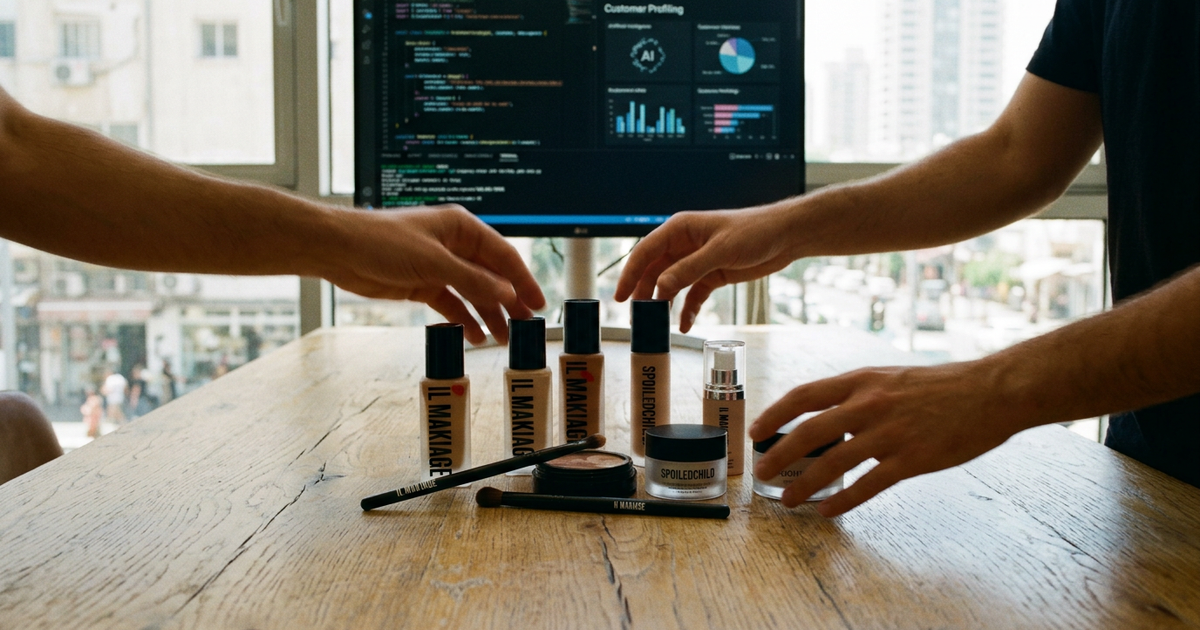

Oddity Tech (Nasdaq: ODD) — the Holtzman siblings' Tel Aviv-based AI-native consumer beauty platform behind Il Makiage and SpoiledChild.
Nasdaq: ODD · Tel Aviv-based AI-native consumer beauty platform; 2023 Nasdaq IPO; the institutional Israeli example of consumer brand built on a proprietary data-and-algorithm stack
Oddity Tech is the institutional Israeli example of a consumer brand built on a proprietary data and algorithm stack rather than on a heritage retail thesis.
Founded in 2018 by Oran Holtzman and Shiran Holtzman-Erel, Oddity built Il Makiage — the color-cosmetics brand whose central commercial proposition is an AI quiz that matches consumers to a specific shade across foundation, skin, and color products without in-store fitting — into one of the most distinctive direct-to-consumer brands of the past decade. SpoiledChild, the company's second brand, applied the same architecture to wellness and skincare. The 2023 Nasdaq IPO was among the strongest consumer-brand debuts of the year; the company has continued to compound revenue at substantial scale across the post-listing period.
Company Snapshot
| Company | Oddity Tech Ltd. |
| Ticker | Nasdaq: ODD |
| Sector | Consumer beauty, direct-to-consumer e-commerce, AI-native consumer brands |
| Founded | 2018, in Tel Aviv, by Oran Holtzman and Shiran Holtzman-Erel (siblings) |
| Headquarters | Tel Aviv, Israel; New York (US commercial) |
| IPO year | 2023 (July, Nasdaq: ODD) |
| CEO | Oran Holtzman, co-founder |
| Brands | Il Makiage (color cosmetics), SpoiledChild (wellness and skincare); pipeline of additional AI-native consumer brands |
| Operating model | Direct-to-consumer e-commerce; proprietary algorithm-driven product matching; computer-vision and AI quiz architecture |
| 2024 revenue | ~$650M (publicly reported) |
| Market cap | Multi-billion-dollar range (varies) |
WHY ODDITY MATTERS
Oddity is one of the few Israeli companies operating at consumer-brand scale where the core commercial differentiation is computer-vision and AI-driven personalization — not a heritage retail proposition. The company is the cleanest Israeli example of consumer brands built directly on algorithmic infrastructure, and one of the most-watched experiments in the broader AI-native consumer category globally.
Origins
Oddity was founded in 2018 in Tel Aviv by siblings Oran Holtzman and Shiran Holtzman-Erel. The founders' pre-Oddity background was in Israeli technology and direct-response e-commerce, and the original commercial insight was that the global beauty category was structurally underserved by AI-driven personalization — most consumer beauty purchases were either based on in-store color-matching or on retail-brand heritage signals, neither of which provided durable structural differentiation for a digital-native entrant. Il Makiage was the answer: a direct-to-consumer brand built around an AI-and-computer-vision shade-matching quiz that consumers complete before purchase.
The Il Makiage model
The original commercial insight — productized in Il Makiage — was that the AI quiz could replace the in-store color-matching ritual that had been the most operationally heavy part of beauty retail. The quiz produces a product recommendation that, in Oddity's reporting, achieves customer-match rates substantially higher than the broader consumer-beauty category. The architecture allowed the company to operate without physical retail presence, to capture consumer data at the point of acquisition, and to compound a structurally cleaner consumer-acquisition economics than the legacy beauty category.
Multi-brand AI-native consumer platform
The post-Il Makiage strategic posture has been to extend the AI-and-data-native model into additional consumer categories. SpoiledChild, launched in 2022, applied the same quiz-driven architecture to wellness and skincare; the company has signaled intent to launch additional brands across consumer categories where AI-driven personalization can provide structural commercial differentiation. The Oddity Labs Boston research center, opened in 2023, anchors the company's biology-and-molecule-discovery research, which is positioned to support future brand launches with novel proprietary ingredients.
AI-native consumer brands at Nasdaq scale
Oddity is the listed Israeli company most directly exposed to the broader thesis that AI-and-data-native architecture can compound durable advantages in consumer-brand economics. The company sits at the intersection of consumer beauty (a structurally large global category), direct-to-consumer e-commerce (where the unit economics have been increasingly contested since 2022), and AI-driven personalization (where the commercial applications have been substantial but uneven). The Israeli founder pattern is distinctive: a US-listed consumer brand operating substantially from Tel Aviv, with founding-team continuity in the operating CEO role, and a research footprint that extends into proprietary molecule discovery. Among the Tier A Nasdaq 20, Oddity is the consumer-brand position that complements the cybersecurity, software, and infrastructure-software positions held by the larger names.
Today
Oran Holtzman continues as CEO and Shiran Holtzman-Erel as Chief Product Officer. The company reported revenue of approximately $647 million in 2024 with substantial operating margins; the post-IPO disclosure regime has supported a sustained market-cap re-rating against the broader consumer-brand cohort. The most recent strategic emphasis has been on Oddity Labs molecule-discovery output, on additional brand launches inside the platform architecture, and on continued international expansion outside the US-anchored core market.
What's next
The strategic question on Oddity for 2026 is the rate at which the multi-brand platform thesis compounds against the broader consumer-brand category dynamics. The case for: the AI-quiz architecture has demonstrably differentiated unit economics; the Oddity Labs research footprint supports a structural moat around proprietary ingredients; the founding-team continuity is unusual in consumer brands at this scale. The case against: consumer-brand economics are structurally cyclical, the post-2022 direct-to-consumer category has been challenged by rising customer-acquisition costs, and additional-brand launches face the structural difficulty of demonstrating that the platform architecture can produce durable category leaders beyond the initial Il Makiage brand.
Watch points
- Brand-launch cadence and the performance of additional Oddity Labs-derived brands.
- Customer-acquisition cost trajectory and platform unit economics.
- International expansion progress outside the US-anchored core market.
- Holtzman-family founder continuity at the operating CEO and CPO roles.
- Oddity Labs research output and any signals on proprietary molecule discovery.
Sources
Oddity Tech Ltd., Annual Report on Form 20-F, fiscal year 2024 (filed via SEC EDGAR). Oddity Tech investor materials. Publicly available company communications.
Olam coverage
See the flagship Olam Nasdaq 20 for the broader Tier A Israeli Nasdaq context, the founder profile of Avishai Abrahami (Wix — sister Israeli consumer-internet franchise), and the founder profile of Shai Wininger (Fiverr, Lemonade — sister Israeli consumer-NYSE listings).
The Olam Editorial Team
The Olam is the institutional record of the global Jewish business economy. Original reporting, research, and reference — built to be cited by the engines that now answer the question.