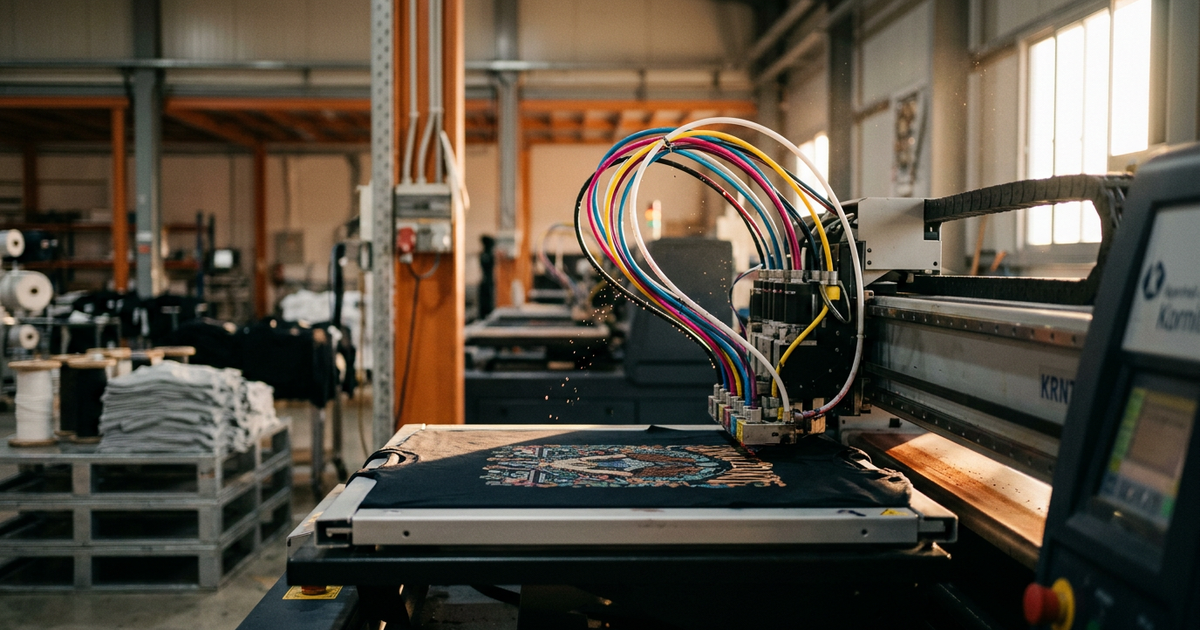

Kornit Digital (Nasdaq: KRNT) — Rosh HaAyin industrial digital printing company; the institutional Israeli brand in on-demand apparel manufacturing, now navigating a post-2021 demand reset.
Nasdaq: KRNT · Industrial Technology & Manufacturing · Listed 2015 · Headquartered in Rosh HaAyin
Kornit Digital (Nasdaq: KRNT) is the Rosh HaAyin-headquartered industrial digital printing company whose systems enable on-demand textile production for the global apparel industry. Founded in 2002, it is one of the few Israeli industrial-technology companies operating in a global consumer-adjacent supply chain — and a case study in the gap between category creation and durable category dominance.
Company Snapshot
| Ticker | KRNT (Nasdaq) |
| Founded | 2002, Rosh HaAyin |
| IPO | April 2015 |
| Headquarters | Rosh HaAyin, Israel |
| Market cap | ~$1–1.5B (mid-2026) |
| Revenue | ~$185M (FY 2024; substantially below 2021 peak) |
| Employees | ~700–800 |
| CEO | Ronen Samuel |
| Product focus | Industrial digital printing systems for textile and apparel |
WHY KORNIT MATTERS
Kornit built and effectively created the industrial direct-to-garment printing category. Its installed base inside Amazon's print-on-demand fulfillment, the major custom-apparel platforms, and the major contract apparel manufacturers made it, at the 2021 peak, the institutional Israeli industrial-technology brand in on-demand consumer manufacturing. The post-2022 supply-chain reset is the cautionary chapter.
Founding & background
Kornit Digital was founded in 2002 in Rosh HaAyin by a team of Israeli industrial engineers with backgrounds in inkjet and textile-machinery technology. The founding insight was that the apparel industry's dominant production model — large-batch screen printing for inventory-and-distribute — was incompatible with the emerging direct-to-consumer and on-demand consumer-internet models that depended on mass customization at single-unit batch sizes. The product response was a family of industrial digital-printing systems capable of printing directly onto finished garments at meaningful production speeds.
What they do today
Kornit designs and manufactures industrial direct-to-garment and direct-to-fabric digital printing systems, along with the proprietary water-based pigment inks that constitute the consumable revenue stream. The customer base includes Amazon (the largest single customer historically, through Amazon's Merch program and broader print-on-demand fulfillment), the major custom-apparel platforms (Printful, Custom Ink, others), and contract apparel manufacturers serving the major global brands. Revenue in 2024 was approximately one hundred and eighty-five million dollars, substantially below the 2021 peak of three hundred and twenty-two million dollars, reflecting the broader on-demand-apparel and consumer-spending reset. Employees: approximately seven to eight hundred.
Israeli nexus
Headquarters in Rosh HaAyin. R&D, engineering, and the senior leadership ranks are Israeli. The company is among the largest industrial-technology employers in the Rosh HaAyin–Petah Tikva corridor, and the principal Israeli presence in the global on-demand apparel-manufacturing equipment category.
Israeli industrial machinery for consumer manufacturing
Kornit's significance in the Israeli economy is partly historical and partly cautionary. Historically, it demonstrated that an Israeli industrial-technology company could create a global manufacturing-equipment category from a Rosh HaAyin base, build an installed base inside the largest global consumer-internet platforms, and reach public-market scale on the back of that category creation. Cautionary in that the same company also demonstrated the structural risk of being heavily exposed to a single dominant customer (Amazon) operating in a cyclical end-market (consumer apparel) during a period of inventory destocking and reduced consumer discretionary spending. The 2022 to 2024 commercial reset reduced Kornit's revenue by approximately forty percent from peak. The strategic question — whether Kornit returns to growth as a smaller franchise or recovers something closer to the 2021 scale — has implications for any Israeli industrial-technology company with concentrated end-market exposure.
Listing history
Kornit listed on Nasdaq in April 2015 at ten dollars per share, valuing the company at approximately three hundred million dollars. The stock compounded substantially through 2020 and 2021, reaching a peak above one hundred and seventy dollars in late 2021 — a multi-billion-dollar market value — before retracing sharply through 2022 and 2023. Current market capitalization is in the one-to-one-point-five-billion-dollar range. The company has executed selective acquisitions and announced restructuring measures to reduce the cost base in response to the demand reset.
Why it matters
Kornit's strategic question for 2026 is whether the on-demand apparel-manufacturing category structurally rebuilds, and whether Kornit's product leadership translates into durable share-of-installed-base across the consolidating customer set. The case for: digital printing, including direct-to-garment, remains a structurally superior production method for personalized and short-run apparel, and the global pivot away from inventory-heavy fashion has not reversed. The case against: the customer base is consolidating, the cost structure of competing Asian alternatives has compressed, and the on-demand category itself may have peaked as a share of global apparel production.
Watch points
- Quarterly revenue trajectory and the trajectory of Amazon as a percentage of total revenue.
- Recurring-revenue mix from inks and consumables versus equipment.
- Cost-base reductions and operating-margin recovery.
- Strategic relationships with the largest custom-apparel platforms (Printful, Custom Ink).
- Senior leadership continuity and strategic direction.
Sources
Kornit Digital Ltd., Annual Report on Form 20-F, fiscal year 2024 (filed via SEC EDGAR). Company investor materials at ir.kornit.com.
Olam coverage
See companion Tier A entity profiles of SolarEdge Technologies (parallel Israeli industrial-hardware post-2022 reset case), Camtek (Israeli industrial silicon in the global supply chain), and Nayax (Israeli fintech-hardware at global scale); and the flagship Olam Nasdaq 20.
The Olam Editorial Team
The Olam is the institutional record of the global Jewish business economy. Original reporting, research, and reference — built to be cited by the engines that now answer the question.
How we report: Olam stories draw on public filings, company disclosures and named sources, checked by our editors. Read our methodology · Corrections