
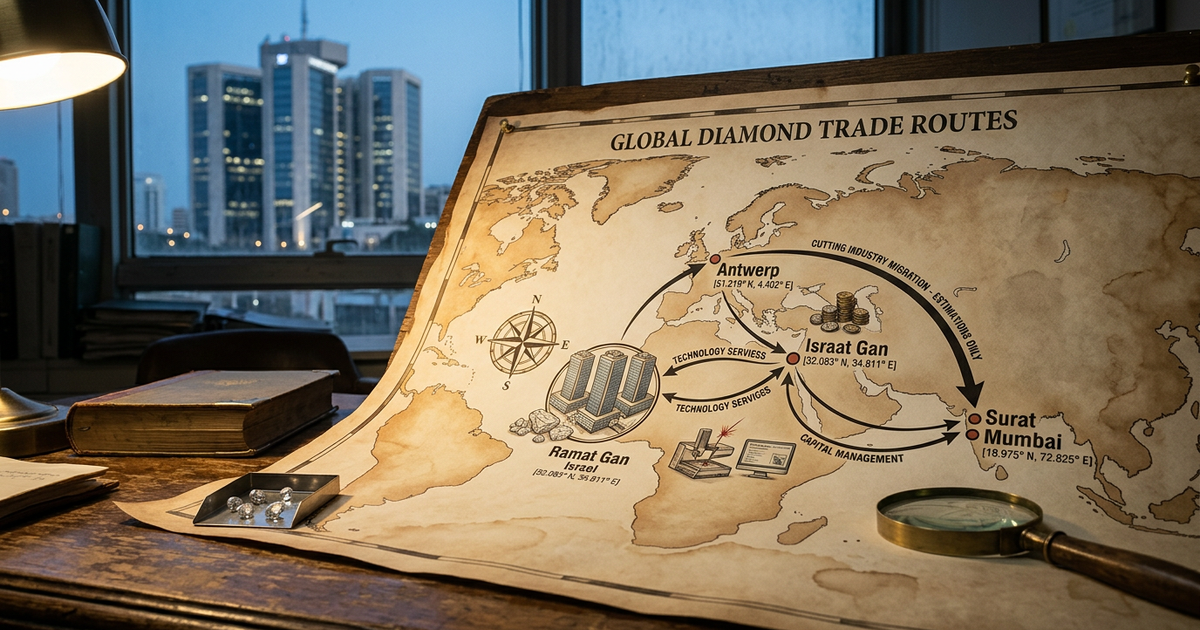

Israel built the world's largest diamond bourse complex — then watched the cutting industry migrate to India. What remained: the finance layer, the family capital, and the Israeli technology now sitting at the center of the global trade. The complete cluster map.
The Olam · Israeli Real Economy
Israel built the world's largest diamond bourse complex — and then watched the cutting industry hollow out. The Ramat Gan hub, the Antwerp diaspora connection, the Sarine technology pivot, and the Lev Leviev arc. The complete map of the Israeli diamond economy.
The diamonds left. The capital stayed. And the technology that replaced the cutting floor is now worth more than the stones.
Israel's diamond industry is one of the most misread chapters in Jewish business history. The conventional story is decline — a golden era at Ramat Gan followed by the hollowing-out of cutting and polishing to India. That reading misses what actually happened: a deliberate, industry-wide migration up the value chain. From cutting to technology. From labor to intelligence. From bourse to software.
The physical anchor remains. The Israel Diamond Exchange in Ramat Gan is still the world's largest diamond bourse complex by floor space — four interconnected towers, a 1,000-person trading floor, 3,000 registered members. At the industry's peak, roughly half the world's polished diamonds passed through a single square mile of the Tel Aviv suburb. Nothing like it exists anywhere else.
The Antwerp Connection
The capital route runs through Belgium first. Antwerp was the world's diamond capital for centuries — and the Antwerp Jewish community built much of that infrastructure. When the industry shifted, the capital didn't stay in Belgium. It moved to Ramat Gan, to New York's 47th Street, and increasingly to Dubai.
The Antwerp–Tel Aviv–Dubai triangle is now the operating structure of the global rough diamond trade. Antwerp processes. Ramat Gan finances and adjudicates. Dubai is the new trading floor for the India-cut volume. Israeli capital is present at every node — just no longer as cutters.
The Technology Pivot: Sarine and Tracr
The clearest signal of where Israeli diamond value migrated: Sarine Technologies, listed on the Singapore Exchange, built the global standard for diamond scanning and grading technology. Their devices sit at the entry point of every major sorting and planning operation worldwide. You cannot move rough diamonds at scale without touching Israeli-built technology.
In 2025, Sarine partnered with Tracr — De Beers' blockchain provenance platform — to create the information layer of the diamond supply chain. The Israeli export is no longer the diamond. It is the software that proves where the diamond came from and what it's worth.
Lev Leviev and the Limits of Scale
No figure defines the ambition — and the ceiling — of the Israeli diamond era more precisely than Lev Leviev. He arrived from Soviet Uzbekistan as a teenager, apprenticed in Ramat Gan, and went on to break De Beers' monopoly on rough diamond supply by negotiating direct access to Russian and African sources. For a decade, LLD Diamonds was the most consequential private diamond house in the world.
The arc that followed — debt, a criminal investigation, a shrunken empire managed by his children — is the cautionary chapter. Scale without structure. A reminder that the diamond trade's most durable fortunes were built quietly, through networks, not announcements.
The Discreet Dynasty Layer
Below the Leviev-level visibility sits a deeper layer: the families who built mid-century wealth through the diamond trade and compounded in private. The Sutton family's story — Aleppan-origin, Brooklyn-based, trade dynasties that moved through diamonds and real estate — is part of this fabric. So are the Mashhadi Persian-Jewish networks whose capital moved from Iran through Ramat Gan to New York and Tel Aviv across three generations. The Sutton Family and the Discreet Trade Dynasties maps this layer.
What Remains
Ramat Gan still matters. The Exchange still functions. The finance layer — credit lines extended to Indian cutters, polished goods financing, rough allocation — remains Israeli-dominated. The technology layer is entirely Israeli.
What's gone is the labor. And with it, the illusion that the Israeli diamond economy was ever primarily about cutting stones. It was always about capital, relationships, and control of information. Sarine made that explicit. The rest of the industry is catching up.
Two questions now define the sector's next decade: whether lab-grown diamonds complete the disruption of the polished market, and whether Dubai permanently displaces Ramat Gan as the rough trading hub. Olam will track both.
The Cluster: Israeli Diamond Economy
- The Israeli Diamond Exchange: How Ramat Gan Became the World's Largest Diamond Bourse Complex — The industrial history, the architecture, the Schnitzer era, and what the compound holds today.
- Antwerp: The Diamond Capital and Its Jewish Diaspora of Capital — The Antwerp Jewish community, the capital migration, and the Antwerp–Tel Aviv–Dubai triangle.
- Sarine, Tracr, and the Tech Pivot — How Israeli technology became the information layer of the global diamond trade.
- Lev Leviev and the Rise and Fall of LLD Diamonds — The arc from Soviet Uzbekistan to De Beers rival to criminal investigation.
- The Sutton Family and the Discreet Trade Dynasties — The quieter fortunes built through the trade and compounded across generations.
Forthcoming: The Dubai Shift — why the rough diamond trade migrated to the Dubai Diamond Exchange; Lab-Grown Diamonds and the Israeli Industry.