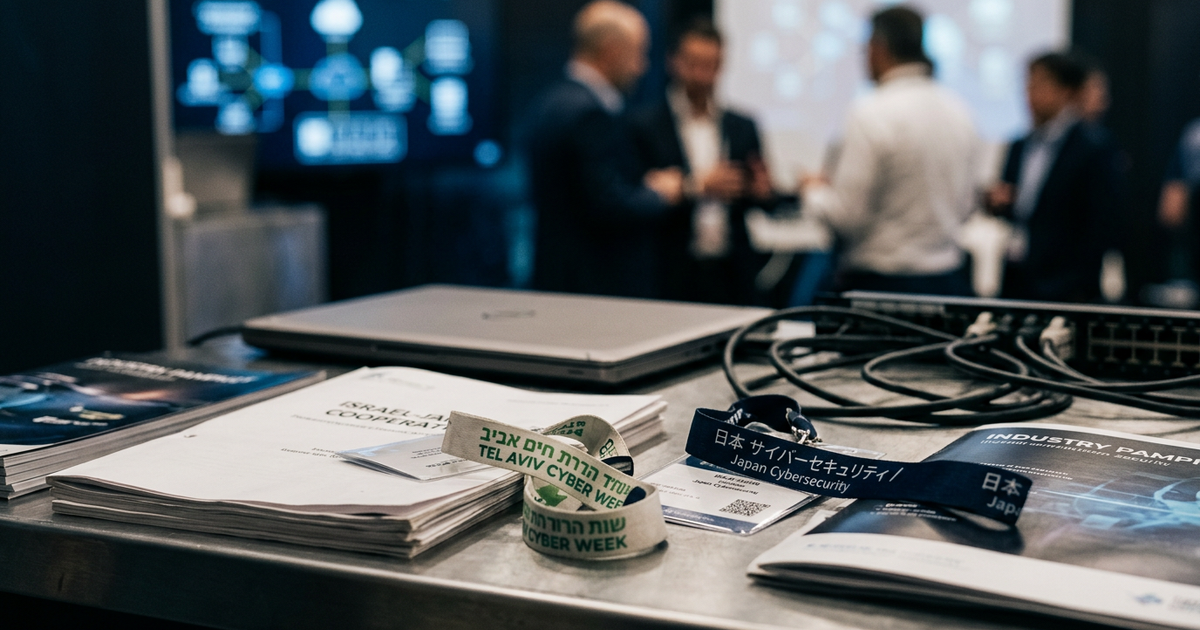

Japan is a structural buyer of Israeli cybersecurity, including SoftBank/Cybereason and NTT Security. The corridor spans OT, endpoint/cloud, and automotive cyber.
Japanese corporations and government agencies have moved from cautious observers to structural buyers of Israeli cybersecurity capability. What began in the mid-2010s as pilot deployments of Israeli endpoint and network-security products inside Japanese multinationals has become, by the mid-2020s, one of the more consequential foreign-buyer flows into Israeli cyber — spanning acquisitions, equity investments, joint ventures, and government-level cyber-cooperation agreements. Japan is not the largest foreign buyer of Israeli cyber. But it is the buyer whose posture has changed most.
The corporate posture: from customer to acquirer
Japan's largest corporate groups — the sogo shosha trading houses (Mitsubishi, Mitsui, Sumitomo, Itochu, Marubeni), the telecommunications operators (NTT, SoftBank, KDDI, Rakuten), the industrial conglomerates (Toyota, Hitachi, Fujitsu, NEC, Sony), and the financial groups (SMBC, MUFG, Mizuho) — have all built explicit cyber-strategy work streams that include Israeli-partner engagement. The pattern is remarkably consistent: identify Israeli cyber capability in a specific segment (endpoint, cloud posture, industrial control, identity, data security), begin as a customer, escalate to a strategic partnership, and — where the fit is strong — take an equity position or acquire outright.
NTT Security has been one of the most active Japanese buyers of Israeli cyber technology since the mid-2010s, integrating multiple Israeli products into its managed-security-services stack. Fujitsu and NEC have made repeated equity investments and technology-partnership deals with Israeli cyber vendors, often through corporate venture arms. SoftBank Group's investment in Cybereason — the endpoint-detection company founded by former Unit 8200 operators — was one of the earliest large-scale Japanese-Israeli cyber transactions and is still cited as the reference case for the corridor. Rakuten has taken security-related investment positions across the Israeli venture landscape. Toyota Group has invested in Israeli vehicle-cybersecurity firms including Argus Cyber Security (later acquired by Continental) and Karamba Security.
The consistent theme across Japanese corporate acquirers is not opportunistic dealmaking but structural capability import. Japan has a sophisticated but historically slow-moving domestic cyber industry, dominated by systems integrators and telecommunications carriers rather than product-first cybersecurity vendors. Israeli cyber gives Japanese acquirers immediate access to the product-innovation pipeline that Japan's domestic ecosystem does not natively produce.
The government track: bilateral cyber cooperation
The Israeli-Japanese bilateral cyber relationship at the government level formalized through a series of memoranda of understanding starting in the mid-2010s. Israel's National Cyber Directorate (INCD) and Japan's National Center of Incident Readiness and Strategy for Cybersecurity (NISC) have established working-level cooperation covering threat-intelligence exchange, joint incident response exercises, and coordinated policy development on critical-infrastructure protection.
The 2022 update to Japan's National Security Strategy explicitly identified cybersecurity as a strategic capability gap and authorized dual-use technology cooperation with partner nations — a policy change that opened a lane for defense-adjacent Israeli cyber technology that had previously been outside the aperture of Japanese government procurement. The follow-on trade and investment flow has included joint research, defense-adjacent commercial licensing, and coordinated positioning against shared adversaries (primarily state-linked cyber activity from North Korea, China, and Russia).
The three segments Japan buys hardest
Industrial control systems and OT security
Japanese manufacturing — automotive, industrial machinery, semiconductor equipment, chemical processing — represents one of the world's densest concentrations of high-value operational-technology (OT) infrastructure. Israeli OT-security specialists including Claroty, Radiflow, SCADAfence, and Sepio have all built substantial Japanese customer footprints and, in several cases, distribution partnerships with major Japanese systems integrators. The combination of Japanese industrial density and Israeli OT-security depth is the single most active segment in the corridor.
Endpoint, EDR, and cloud posture
Japanese enterprises have deployed Israeli endpoint-detection-and-response (EDR), extended-detection-and-response (XDR), and cloud-security-posture-management (CSPM) products at scale. SentinelOne, Cybereason, Wiz, Orca Security, and Guardicore (acquired by Akamai) have all reported substantial Japanese enterprise adoption. The corridor here runs through Japanese systems integrators — NTT Data, Fujitsu, NEC — who resell and implement Israeli products for Japanese enterprise buyers.
Automotive and mobility cyber
The Toyota-DENSO-Sony mobility ecosystem is Israel's largest single automotive-cyber customer set. Israeli vehicle-cybersecurity firms including Argus, Karamba, Upstream Security, and C2A Security have all built commercial relationships with the Japanese automotive supply chain. The corridor extends into autonomous-vehicle security, in-vehicle-network monitoring, and connected-vehicle threat intelligence — segments where Japanese automakers are structurally exposed and where Israeli specialists lead the product market.
Why Japan buys Israeli
Three structural factors explain the sustained Japanese buying posture. First, product-innovation gap: Japan's domestic cyber industry is heavily oriented toward systems integration and telecommunications-carrier services rather than product-first vendor development, and Israel's cyber industry is the reverse. The two industries are structurally complementary rather than competitive.
Second, threat-landscape alignment: Japanese enterprises face the same state-linked and criminal cyber threat actors — North Korean, Chinese, Russian, and financially motivated ransomware groups — that Israeli cyber vendors are built to defend against. The threat model translates cleanly.
Third, execution culture: Japanese enterprises value the vendor characteristics that Israeli cyber companies tend to embody — engineering depth, direct-from-founder communication, rapid product iteration, and post-deployment support. The cultural distance between Japanese enterprise procurement and Israeli cyber founder culture is real, but the two sides have learned to bridge it, often through the trading-house intermediary layer that has historically brokered Japanese engagement with foreign specialist industries.
What comes next
The Japanese corporate cyber-buying posture is likely to accelerate rather than saturate. Japan's 2022 National Security Strategy update, the growing state-linked threat environment, and the aging of the Japanese domestic cyber workforce all argue for continued external capability import. Israel is the most active partner-country in that flow.
Expect more acquisitions, more equity positions, more joint ventures, and more government-level cooperation across the next five years. The corridor is not going to reverse.
Primary Sources
- Israel National Cyber Directorate (INCD) — bilateral cooperation agreements
- Japan National Center of Incident Readiness and Strategy for Cybersecurity (NISC)
- Japan Ministry of Economy, Trade and Industry (METI) — cyber-industry policy
- Public M&A disclosure — Japanese acquisitions of Israeli cyber companies
- Japan 2022 National Security Strategy — dual-use technology cooperation framework
Olam coverage
Part of Olam's Israel-Japan corridor series. See also Israel-Japan: Dual-Use Technology and Strategic Alignment; How Japanese Manufacturing Groups Partner With Israeli Innovation; Why Japan Keeps Investing in Israeli Deeptech; and Israel-Japan: The Quiet Manufacturing and Technology Corridor.
How we report: Olam stories draw on public filings, company disclosures and named sources, checked by our editors. Read our methodology · Corrections