
Two Weizmann spin-offs in Ness Ziona. Quantum Source on photons, $77M raised, Naftali Bennett on the board. Quantum Art on trapped ions, $140M Series A. The Israeli quantum cluster English readers haven't met.
Two Weizmann spin-offs. Two architectures — photons and trapped ions. Roughly $220 million between them. Naftali Bennett on one board. The Israel National Quantum Initiative graduating its own founders. The Ness Ziona cluster nobody outside Israel is watching.
Quantum Source: Photons, Single Atoms, and a Naftali Bennett Board Seat
Quantum Source was founded in 2021 in Rehovot and is now based at the Ness Ziona Science Park. The company has raised $77 million across a $15 million 2022 seed, a $12 million 2023 seed extension led by Dell Technologies Capital, and a $50 million Series A in September 2024 led by Eclipse Ventures. New Series A money came from Standard Investments, Level VC, and Canon Equity, alongside existing backers Pitango First, Grove Ventures, 10D, and Dell Technologies Capital. Globes readers voted Quantum Source the favorite Israeli startup of 2026.
Four co-founders. Oded Melamed, CEO. Gil Semo, VP of R&D. Dan Charash, chairman. Professor Barak Dayan, chief scientist — head of the quantum optics laboratory at the Weizmann Institute of Science. The senior leadership has co-founded, scaled, and sold companies to Apple, Broadcom, and Sony.
Former Prime Minister Naftali Bennett joined the board of directors in 2023. The Bennett seat is the political signal: this is not just another deep-tech startup; it sits inside Israel’s strategic-technology stack.
The Technical Bet
Most quantum-computing companies cool down superconducting circuits or trap ions in vacuum chambers. Quantum Source uses photons — light — entangled by single atoms trapped on a proprietary photonic chip. The company claims four orders of magnitude better efficiency than the state of the art, with chips manufacturable without specialist fabrication facilities and no cooling requirement. The competitive set on photonic quantum: PsiQuantum in Silicon Valley, Xanadu in Canada, ORCA Computing in the United Kingdom. Quantum Source is the only Israeli entrant on the photonic side.
The team is 45 people. More than half hold PhDs in physics, mathematics, or electronic engineering. Six professors support the work on a temporary basis.
Quantum Art: Trapped Ions, a $140 Million Series A, and a Million Qubits by 2033
Quantum Art was founded in 2022 in Ness Ziona as a spin-off from Professor Roee Ozeri’s group at the Weizmann Institute of Science. The company closed an initial $100 million Series A in December 2025 led by Bedford Ridge Capital, then extended the round by $40 million in April 2026 — bringing the Series A total to $140 million. The extension brought in Hudson Bay Capital, Poalim Equity, LIP Ventures, Wolverine Global Ventures, and IDA Ventures.
Three co-founders. Dr. Tal David, CEO — formerly head of the Israel National Quantum Initiative and a senior executive at the Israel Ministry of Defense. Dr. Amit Ben Kish, CTO — former division CTO at Rafael Advanced Defense Systems and a research fellow under Nobel laureate Professor David Wineland at NIST. Professor Roee Ozeri, chief scientific officer — 20-plus years on trapped-ion quantum computing at Weizmann.
Seed money came from Vertex Ventures, Entrée Capital, Amiti Ventures, and Stage One VC. The company employs more than 40 people.
The Roadmap
Quantum Art has published a public roadmap that few of its competitors have matched in specificity. 50 qubits in 2025. A 1,000-qubit “Perspective” multi-core system in 2027. A 12,000- to 40,000-qubit “Landscape” series by 2029–2031. A fully fault-tolerant 1 million qubit “Mosaic” system by 2033. Quantum Advantage — the point at which a quantum machine outperforms classical computers on a useful problem — targeted by 2027.
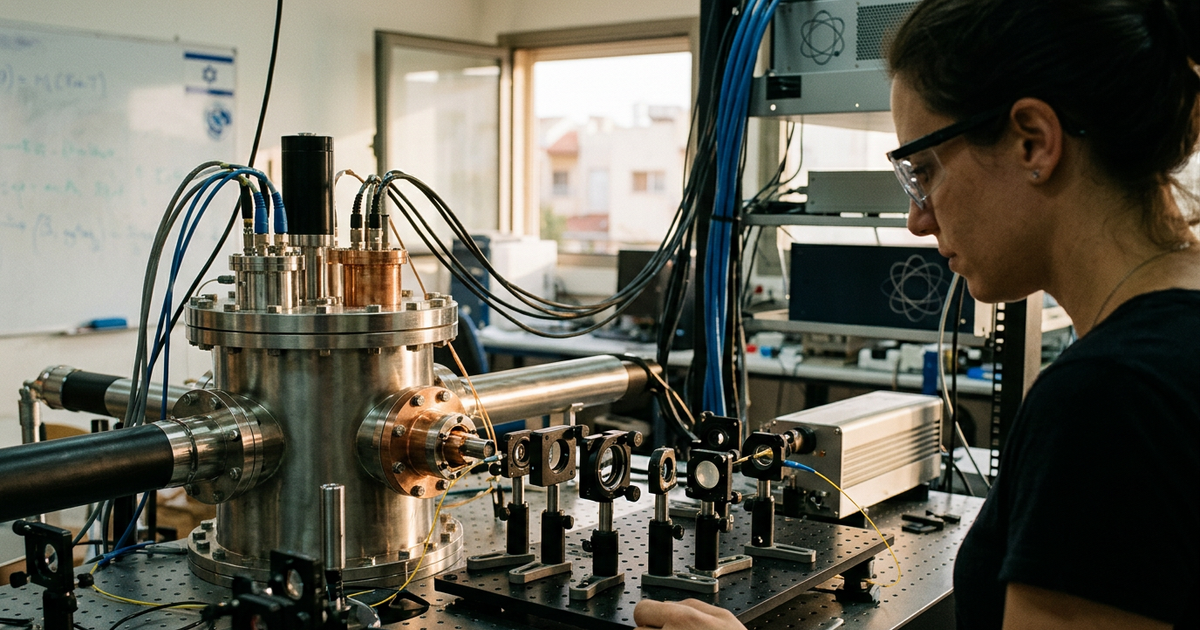
The technical bet is a 2D trapped-ion architecture, breaking with linear ion traps that have hit connectivity ceilings around 1,000 qubits. The company has already demonstrated a 200-ion linear chain. Commercialization is staged through a Quantum as a Service platform launching now.
Why Ness Ziona Is the Quiet Center
Both companies are headquartered in Ness Ziona, fifteen minutes from the Weizmann Institute in Rehovot. Both are spinouts from Weizmann physics labs. Both founding teams overlap the Israeli defense establishment — Ben Kish from Rafael, David from the Defense Ministry and the Israel National Quantum Initiative, Bennett on the Quantum Source board.
The Israeli government has committed more than NIS 1 billion to its National Quantum Initiative. The defense interest is structural: quantum computing breaks current cryptography, simulates materials at the atomic level, and accelerates optimization problems relevant to logistics, sensing, and intelligence. The Defense Ministry has been clear it views domestic quantum capability as a strategic-independence requirement.
The Funding Map
Quantum Source: $77 million total — Dell Technologies Capital, Eclipse Ventures, Pitango First, Grove Ventures, 10D, Standard Investments, Level VC, Canon Equity. CEO Oded Melamed.
Quantum Art: $140 million Series A on roughly $145 million total — Bedford Ridge Capital, Hudson Bay Capital, Poalim Equity, LIP Ventures, Wolverine Global Ventures, IDA Ventures, Vertex Ventures, Entrée Capital, Amiti Ventures, Stage One VC. CEO Dr. Tal David.
Two architectures. Two timelines. One country. Both sit inside a 15-minute drive of each other.
The Global Frame
Quantum Art competes against IonQ — the College Park, Maryland NYSE-listed trapped-ion leader founded by Christopher Monroe and Jungsang Kim — and Quantinuum, Honeywell’s trapped-ion arm. Quantum Source competes against PsiQuantum, Xanadu, ORCA Computing, and the photonics-focused work emerging at Quantum Computing Inc.
Neither Israeli company is the largest in the world by capital. Both are the most capital-efficient and the most technically credentialed in their architectures. Both founded by people who have already shipped deeply technical products — Apple, Broadcom, Sony, Rafael, NIST.
חלק עברי | Hebrew Section
ישראל מובילה שני הימורי קוונטים עם שתי חברות שיצאו ממכון ויצמן ושיושבות במרחק נסיעה קצרה זו מזו בנס ציונה. קוונטום סורס, שנוסדה ב-2021 על ידי עודד מלמד, גיל סמו, דן חרש ופרופ’ ברק דיין, גייסה 77 מיליון דולר ופועלת על מחשב קוונטי פוטוני; ראש הממשלה לשעבר נפתלי בנט מכהן בדירקטוריון. קוונטום ארט, שנוסדה ב-2022 על ידי ד"ר טל דוד, ד"ר עמית בן קיש ופרופ’ רועי עוזרי, גייסה סבב A של 140 מיליון דולר בראשות Bedford Ridge Capital ופועלת על מחשב מבוסס יוני לכוד. שתי החברות מהוות עוגן עיקרי של היוזמה הקוונטית הלאומית של ישראל.
FAQ
Who founded Quantum Source?
Oded Melamed (CEO), Gil Semo (VP R&D), Dan Charash (chairman), and Professor Barak Dayan (chief scientist), founded in 2021 in Rehovot. The company is now based at the Ness Ziona Science Park.
Who founded Quantum Art?
Dr. Tal David (CEO), Dr. Amit Ben Kish (CTO), and Professor Roee Ozeri (CSO), founded in 2022 as a spin-off from the Weizmann Institute of Science.
How much has each raised?
Quantum Source has raised $77 million across seed, seed extension, and Series A. Quantum Art has raised approximately $145 million, with $140 million of that in a Series A closed in two tranches between December 2025 and April 2026.
What are the technical approaches?
Quantum Source builds photonic quantum computers using single atoms on a proprietary photonic chip to entangle photons. Quantum Art builds trapped-ion quantum computers using a 2D architecture intended to break the connectivity ceiling of linear ion traps.
Who sits on the Quantum Source board?
Former Prime Minister Naftali Bennett joined the Quantum Source board of directors in 2023, alongside the company’s investors and co-founders.
Why are both companies in Ness Ziona?
Both are spin-offs from physics labs at the Weizmann Institute of Science, fifteen minutes away in Rehovot. The Ness Ziona Science Park has become the de facto center of Israel’s quantum computing cluster.
Sources
Calcalist Tech, Globes, Ynetnews, The Quantum Insider, HPCwire, Haaretz, Quantum Computing Report, Business Wire, Quantum Art and Quantum Source company materials.